
Alzheimer's disease pathology — MCQs

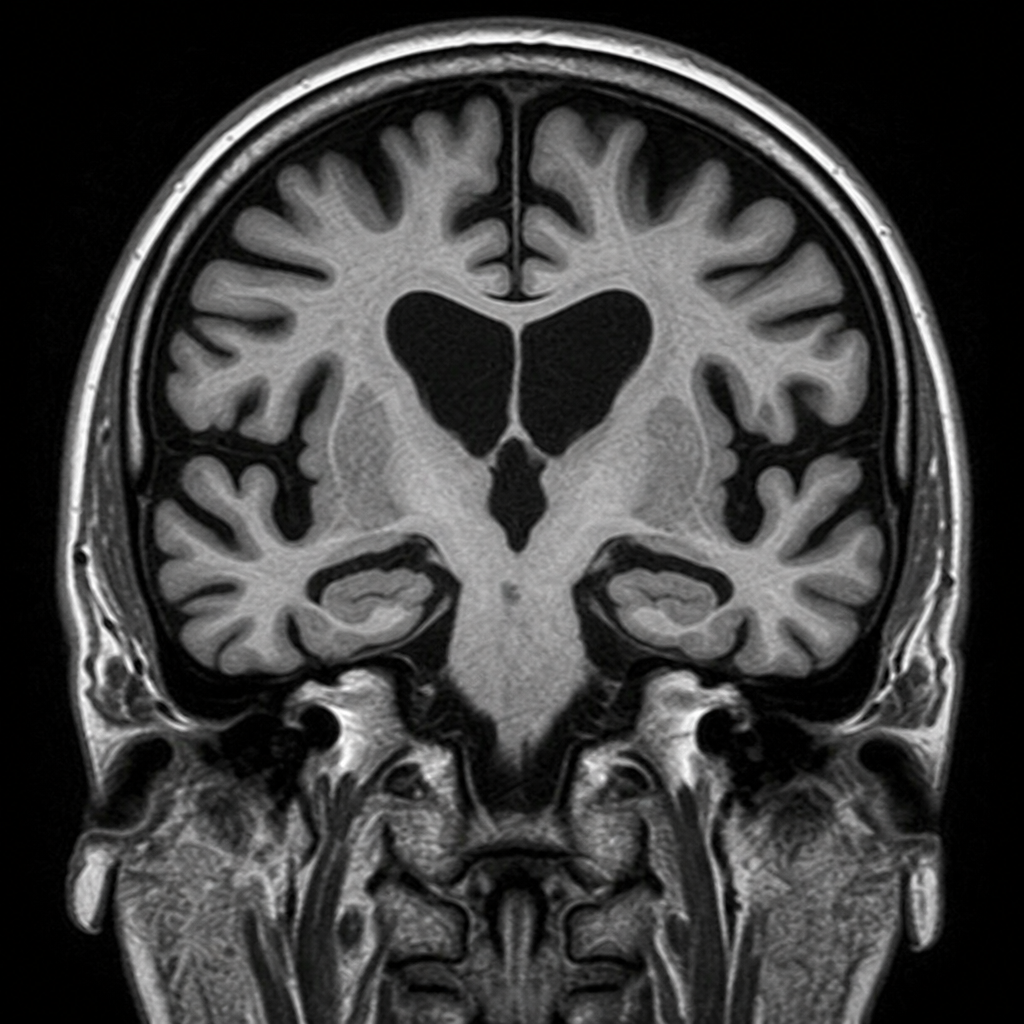
A 73-year-old man is brought to the physician by his daughter for evaluation of increasing forgetfulness during the past 6 months. The daughter reports that he recently got lost while walking home from the grocery store. He has also been more irritable recently. On mental status examination, he has a normal affect. He is oriented to person and place but cannot recall which month it is. He recalls memories from more than 20 years ago in great detail but cannot state his home address or the name of his recently born grandson. His gait is normal and there is no nystagmus. An MRI of the brain is shown. Which of the following is the most likely underlying cause of the radiologic findings?
A 70-year-old man with a long-standing history of diabetes mellitus type 2 and hypertension presents with complaints of constant wrist and shoulder pain. Currently, the patient undergoes hemodialysis 2 to 3 times a week and is on the transplant list for a kidney. The patient denies any recent traumas. Which of the following proteins is likely to be increased in his plasma, causing the patient’s late complaints?
A 45-year-old man is brought to the hospital by his daughter with complaints of wide-based gait. His daughter reveals that he was sitting silently in the examination chair with a blank face. In addition, he was frequently talking to the empty chairs and told that his friends are sitting there. He has been forgetting many small things recently. On physical examination, fine movements are seen at resting condition that disappears when he is asked to drink water. A stepwise slowness in movement is also seen in his upper limb. Which of the following is most likely to be observed in the histological specimen of this patient?
A 36-year-old woman is brought to the emergency room by her husband for “weird behavior" for the past several weeks. He reports that her right arm has been moving uncontrollably in a writhing movement and that she has been especially irritable. She has a history of depression, which was diagnosed 4 years ago and is currently being treated with sertraline. She denies any recent fever, trauma, infections, travel, weakness, or sensory changes. She was adopted so is unsure of her family history. Which of the following is the most likely explanation for her symptoms?
A 1-week-old baby is brought to the pediatrician’s office for a routine checkup. On examination, she is observed to have microcephaly with a prominent occiput. She also has clenched fists and rocker-bottom feet with prominent calcanei. A cardiac murmur is evident on auscultation. Based on the clinical findings, a diagnosis of nondisjunction of chromosome 18 is suspected. The pediatrician orders a karyotype for confirmation. He goes on to explain to the mother that her child will face severe growth difficulties. Even if her daughter progresses beyond a few months, she will not be able to reach developmental milestones at the appropriate age. In addition to the above, which of the following is most likely a consequence of this genetic disturbance?
A 65-year-old man was picked up by the security personnel for voiding urine and defecating at an inappropriate place in the community. On questioning, he was making offensive remarks and behaving inappropriately. On physical examination, the physician observed signs of cognitive impairment and amnesia. Initial urine drug screen is negative for any drugs of abuse. Which is the most likely pathological finding present in this patient?
An 81-year-old woman presents to your office accompanied by her husband. She has been doing well except for occasional word finding difficulty. Her husband is concerned that her memory is worsening over the past year. Recently, she got lost twice on her way home from her daughter’s house, was unable to remember her neighbor’s name, and could not pay the bills like she usually did. She has a history of hypertension and arthritis. She has no significant family history. Her medications include a daily multivitamin, hydrochlorothiazide, and ibuprofen as needed. Physical exam is unremarkable. Which of the following is associated with an increased risk of this patient’s disease?
A 68-year-old man is brought to the physician by his wife because she is concerned about his speech being irregular. Specifically, she says that over the last 8 months, her husband has been saying increasingly nonsensical statements at home. In addition, he is no longer able to perform basic verbal tasks such as ordering from a menu or giving directions even though he was an English teacher prior to retirement. She also reports that he has recently started attempting to kiss strangers and urinate in public. Finally, she has also noticed that he has been frequently binge eating sweets even though he was previously very conscientious about his health. When asked about these activities, the patient does not have insight into his symptoms. Which of the following would most likely be seen in this patient?
A 69-year-old man is brought to clinic by his daughter for poor memory. She states that over the past two years his memory has been slowly declining though he has been able to take care of himself, pay his own rent, and manage his finances. However, two months ago she noticed a sharp decline in his cognitive functioning as well as his gait. Then one month ago, she noticed a similar decline in his functioning again that came on suddenly. The patient has a past medical history of diabetes mellitus type II, hypertension, obesity, and dyslipidemia. Current medications include hydrochlorothiazide, lisinopril, metformin, and glipizide. His blood pressure is 165/95 mmHg, pulse is 82/minute, he is afebrile, and oxygen saturation is 98% on room air. Cardiac exam reveals a crescendo-decrescendo murmur heard in the left upper sternal border that radiates to the carotids. Abdominal exam is benign, and neurologic exam reveals an unsteady gait. Which of the following findings is associated with the most likely diagnosis?
A 28-year-old woman comes to the physician because of a 1-year history of intermittent buzzing in both her ears. She says she sometimes has episodes of mild dizziness which resolve spontaneously. She has a 15-year history of type 1 diabetes mellitus and episodes of low back pain. She does not smoke or drink alcohol. Current medications include insulin and aspirin. She works as a trombonist for a symphony orchestra. Her vital signs are within normal limits. On otoscopic examination, the tympanic membrane appears normal. Bone conduction is greater than air conduction in both ears. Weber test shows no lateralization. Which of the following is the most likely diagnosis?
Want unlimited practice?
Get full access to all questions, explanations, and performance tracking.
Scan to download app