
Vascular changes in inflammation — MCQs

A 2-year-old boy has a history of recurrent bacterial infections, especially of his skin. When he has an infection, pus does not form. His mother reports that, when he was born, his umbilical cord took 5 weeks to detach. He is ultimately diagnosed with a defect in a molecule in the pathway that results in neutrophil extravasation. Which of the following correctly pairs the defective molecule with the step of extravasation that molecule affects?
Two weeks after undergoing low anterior resection for rectal cancer, a 52-year-old man comes to the physician because of swelling in both feet. He has not had any fever, chills, or shortness of breath. His temperature is 36°C (96.8°F) and pulse is 88/min. Physical examination shows a normal thyroid and no jugular venous distention. Examination of the lower extremities shows bilateral non-pitting edema that extends from the feet to the lower thigh, with deep flexion creases. His skin is warm and dry, and there is no erythema or rash. Microscopic examination of the interstitial space in this patient's lower extremities would be most likely to show the presence of which of the following?
A 47-year-old man presents as a new patient at an outpatient clinic. He has never seen a physician before, but was motivated by his 40-year-old brother's recent heart attack and seeks to optimize his health. In particular, he read that uncontrolled atherosclerosis can lead to a heart attack. Which molecule is downregulated in response to the advent of atherosclerosis?
While playing in the woods with friends, a 14-year-old African-American male is bitten by an insect. Minutes later he notices swelling and redness at the site of the insect bite. Which substance has directly led to the wheal formation?
An 8-year-old boy is shifted to a post-surgical floor following neck surgery. The surgeon has restricted his oral intake for the next 24 hours. He does not have diarrhea, vomiting, or dehydration. His calculated fluid requirement is 1500 mL/day. However, he receives 2000 mL of intravenous isotonic fluids over 24 hours. Which of the following physiological parameters in the boy’s circulatory system is most likely to be increased?
A 48-year-old male dies in the intensive care unit following a severe Streptococcus pneumoniae pneumonia and septic shock. Autopsy of the lung reveals a red, firm left lower lobe. What would you most likely find on microscopic examination of the lung specimen?
A student is experimenting with the effects of nitric oxide in the body. He used a variety of amino acid isolates and measured the resulting nitric oxide levels and the physiological effects on the body. The amino acids function as substrates for nitric oxide synthase. After supplement administration, blood vessels dilated, and the systemic blood pressure decreased. Which of the following amino acids was used in this study?
A 67-year-old woman is admitted to the hospital because of a 2-day history of fever, headache, jaw pain, and decreased vision in the right eye. Her erythrocyte sedimentation rate is 84 mm per hour. Treatment with methylprednisolone is initiated but her symptoms do not improve. The physician recommends the administration of a new drug. Three days after treatment with the new drug is started, visual acuity in the right eye increases. The beneficial effect of this drug is most likely due to inhibition of which of the following molecules?
A 4-year-old Caucasian boy is brought by his mother to the pediatrician with a red and swollen elbow. He was playing outside a few days prior to presentation when he fell and lightly scraped his elbow on the sidewalk. He was born at 34 weeks' gestation and was in the neonatal ICU for 2 days. His temperature is 102.1°F (38.9°C), blood pressure is 105/65 mmHg, pulse is 110/min, and respirations are 20/min. On exam, he has a swollen, erythematous, fluctuant, and exquisitely tender mass on his right elbow. There is expressible purulence coming from his wound. A peripheral blood smear in this patient would most likely reveal which of the following findings?
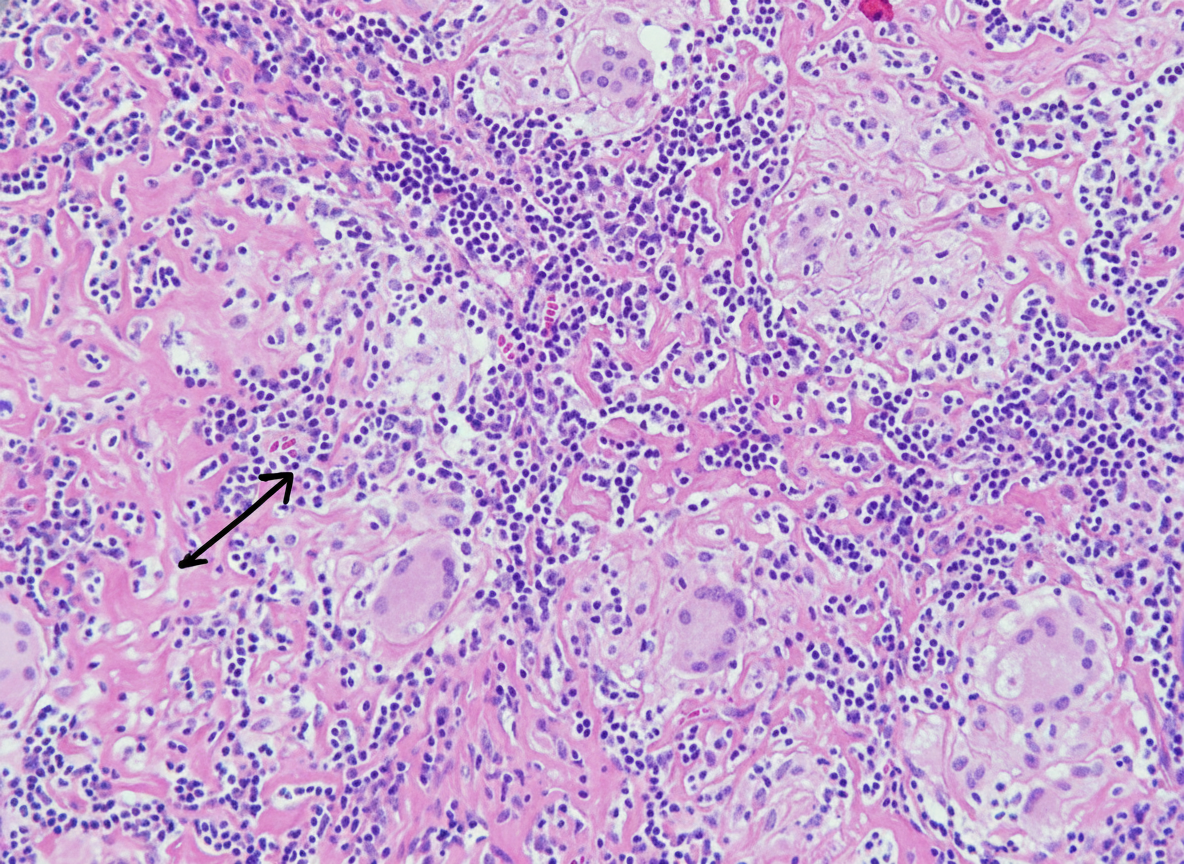
A 32-year-old man who recently emigrated from Somalia comes to the physician because of a 4-week history of fever, cough, and chest pain. He has had a 5-kg (11-lb) weight loss over the last 3 months despite no changes in appetite. His temperature is 38.1°C (100.6°F). Physical examination shows enlarged cervical lymph nodes. The lungs are clear to auscultation. The results of an interferon-γ release assay are positive. An x-ray of the chest shows bilateral mediastinal lymphadenopathy. A transbronchial needle aspiration biopsy of a mediastinal lymph node is performed; a photomicrograph of the specimen is shown. The structure indicated by the arrow is most likely comprised of which of the following types of cells?
Want unlimited practice?
Get full access to all questions, explanations, and performance tracking.
Scan to download app