
Resolution of acute inflammation — MCQs

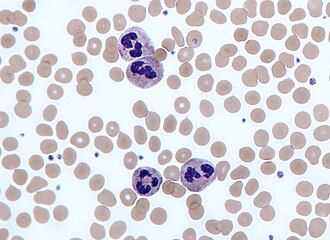
A 14-year-old girl presents with pain in the right lower quadrant of her abdomen. She describes the pain as sudden, severe, colicky, and associated with nausea and vomiting. Physical exam reveals tachycardia and severe tenderness to palpation with rebound in the right iliac region. Emergency laparotomy is performed which reveals an inflamed appendix. A presurgical blood cell count shows an increase in the number of cells having a multilobed nucleus and multiple cytoplasmic granules as shown in the image below. Which of the following is the main function of these cells?
A researcher is studying the interactions between foreign antigens and human immune cells. She has isolated a line of lymphocytes that is known to bind antigen-presenting cells. From this cell line, she has isolated a cell surface protein that binds to class I major histocompatibility complex molecules. The continued activation, proliferation and survival of this specific cell line requires which of the following signaling molecules?
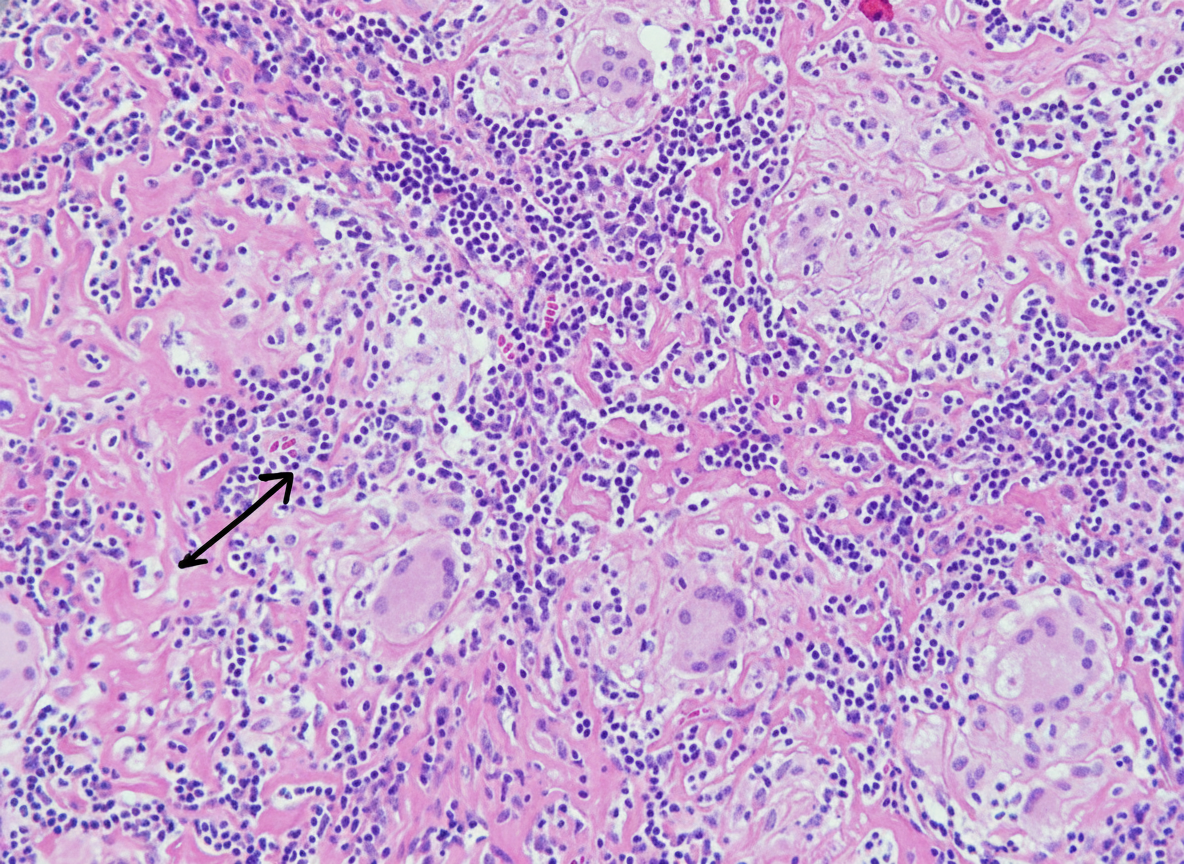
A 32-year-old man who recently emigrated from Somalia comes to the physician because of a 4-week history of fever, cough, and chest pain. He has had a 5-kg (11-lb) weight loss over the last 3 months despite no changes in appetite. His temperature is 38.1°C (100.6°F). Physical examination shows enlarged cervical lymph nodes. The lungs are clear to auscultation. The results of an interferon-γ release assay are positive. An x-ray of the chest shows bilateral mediastinal lymphadenopathy. A transbronchial needle aspiration biopsy of a mediastinal lymph node is performed; a photomicrograph of the specimen is shown. The structure indicated by the arrow is most likely comprised of which of the following types of cells?
A 21-year-old male presents to the emergency department after losing his footing and falling 20 feet off a construction scaffold. He hit his left side on a railing on the way down before landing on his left arm. He denies loss of consciousness during the event or feelings of lightheadedness. He has no significant past medical or surgical history and does not take any regular medications. Evaluation in the trauma bay revealed mild lacerations to the upper and lower extremities, pain to palpation in the distal left forearm, and bruising to the upper left quadrant of the abdomen as well as the lower left thorax. Free fluid was found in the abdomen by ultrasound, fluids were started, and he was rushed to the operating room for an exploratory laparotomy. A heavily lacerated spleen was discovered and removed. No other sources of bleeding were found. Further workup determined he suffered a non-displaced left distal radius fracture and non-displaced 9th and 10th rib fractures. Which of the following should be administered to this patient?
A 48-year-old man is brought to the emergency department with a stab wound to his chest. The wound is treated in the emergency room. Three months later he develops a firm 4 x 3 cm nodular mass with intact epithelium over the site of the chest wound. On local examination, the scar is firm, non-tender, and there is no erythema. The mass is excised and microscopic examination reveals fibroblasts with plentiful collagen. Which of the following processes is most likely related to the series of events mentioned above?
A 2-year-old boy has a history of recurrent bacterial infections, especially of his skin. When he has an infection, pus does not form. His mother reports that, when he was born, his umbilical cord took 5 weeks to detach. He is ultimately diagnosed with a defect in a molecule in the pathway that results in neutrophil extravasation. Which of the following correctly pairs the defective molecule with the step of extravasation that molecule affects?
A 12-year-old girl is brought to the physician by her mother 2 hours after cutting her hand while playing in the yard. Examination of the right hand shows a 2-cm laceration on the thenar region of the palm with some surrounding tenderness and erythema. The right palm appears mildly swollen in comparison to the left. In response to this patient's injury, the endothelial cells lining the blood vessels of the affected area express increased numbers of cellular adhesion molecules. Which of the following mediators is most likely directly responsible for the described change?
A researcher is studying how arachidonic acid metabolites mediate the inflammatory response in rats. She has developed multiple enzyme inhibitors that specifically target individual proteins in the arachidonic acid pathway. She injects these inhibitors in rats who have been exposed to common bacterial pathogens and analyzes their downstream effects. In one of her experiments, she injects a leukotriene B4 inhibitor into a rat and observes an abnormal cell response. Which of the following interleukins would most closely restore the function of one of the missing products?
A 28-year-old male presents to his primary care physician with complaints of intermittent abdominal pain and alternating bouts of constipation and diarrhea. His medical chart is not significant for any past medical problems or prior surgeries. He is not prescribed any current medications. Which of the following questions would be the most useful next question in eliciting further history from this patient?
An immunology expert is explaining the functions of macrophages to biology students. He describes a hypothetical case scenario as follows: a potentially harmful gram-negative bacillus encounters a macrophage in the tissues. The Toll-like receptor (TLR) on the macrophage recognizes the bacterial lipopolysaccharide (LPS). The macrophage is activated by the binding of TLR with bacterial LPS and by interferon-γ (IFN-γ). Which of the following cytokines is most likely to be secreted by the activated macrophage?
Want unlimited practice?
Get full access to all questions, explanations, and performance tracking.
Scan to download app