
Patterns of inflammatory response — MCQs

A 22-year-old sexually active, otherwise healthy female presents to her primary care physician complaining of several days of dysuria, frequency, urgency, and suprapubic pain. She denies fever, flank pain, vaginal itching, or vaginal bleeding/discharge. Which organism is most likely responsible for this patient's symptoms?
A 62-year-old woman presents to the emergency department with a 2-hour history of sharp chest pain. She says that the pain is worse when she inhales and is relieved by sitting up and leaning forward. Her past medical history is significant for rheumatoid arthritis, myocardial infarction status post coronary artery bypass graft, and radiation for breast cancer 20 years ago. Physical exam reveals a rubbing sound upon cardiac auscultation as well as increased jugular venous distention on inspiration. Pericardiocentesis is performed revealing grossly bloody fluid. Which of the following is most specifically associated with this patient's presentation?
A 38-year-old woman presents with fever and acute onset chest pain for the past 12 hours. She describes the pain as severe, sharp and stabbing in character, and localized to the retrosternal area. She also says the pain is worse when she breathes deeply or coughs. Past medical history is significant for recently diagnosed systemic lupus erythematosus (SLE). Her vital signs include: blood pressure 110/75 mm Hg, pulse 95/min, and temperature 38.0°C (100.4°F). Physical examination is significant for a friction rub heard best at the lower left sternal border. Which of the following is the most likely diagnosis in this patient?
A 62-year-old man comes to the physician because of an oozing skin ulceration on his foot for 1 week. He has a history of type 2 diabetes mellitus and does not adhere to his medication regimen. Physical exam shows purulent discharge from an ulcer on the dorsum of his left foot. Pinprick sensation is decreased bilaterally to the level of the mid-tibia. A culture of the wound grows beta-hemolytic, coagulase-positive cocci in clusters. The causal organism most likely produces which of the following virulence factors?
A 45-year-old immigrant presents with unintentional weight loss, sleep hyperhidrosis, and a persistent cough. He says these symptoms have been present for quite some time. Upon imaging, many granulomas in the upper lobes are present. It is noted that these apical granulomas have centers of necrosis that appear cheese-like in appearance. Encircling the area of necrosis are large cells with cytoplasms pale in color. Of the following surface markers, which one is most closely associated with these cells?
A 30-year-old man comes to the physician because of an episode of bloody vomiting this morning and a 1-week history of burning upper abdominal pain. Two weeks ago, he sustained a head injury and was in a coma for 3 days. An endoscopy shows multiple, shallow hemorrhagic lesions predominantly in the gastric fundus and greater curvature. Biopsies show patchy loss of epithelium and an acute inflammatory infiltrate in the lamina propria that does not extend beyond the muscularis mucosa. Which of the following is the most likely diagnosis?
An 18-year-old man presents with bloody diarrhea and weight loss. He undergoes endoscopic biopsy which shows pseudopolyps. Biopsies taken during the endoscopy show inflammation only involving the mucosa and submucosa. He is diagnosed with an inflammatory bowel disease. Which of the following characteristics was most likely present?
A 34-year-old woman comes to the physician because of a 6-week history of fever and productive cough with blood-tinged sputum. She has also had a 4-kg (8.8-lb) weight loss during the same time period. Examination shows enlarged cervical lymph nodes. An x-ray of the chest shows a 2.5-cm pulmonary nodule in the right upper lobe. A biopsy specimen of the lung nodule shows caseating granulomas with surrounding multinucleated giant cells. Which of the following is the most likely underlying cause of this patient's pulmonary nodule?
A 60-year-old man comes to the office because of an 8-month history of cough, night sweats, shortness of breath, and fatigue. He has also had a 9-kg (19.8-lb) weight loss during this time. He appears pale. Abdominal examination shows hepatosplenomegaly. His leukocyte count is 80,000/mm3 and his leukocyte alkaline phosphatase level is increased. A peripheral blood smear shows > 82% neutrophils with band forms and immature and mature neutrophil precursors. An x-ray of the chest shows a 9-mm right hilar nodule. Which of the following is the most likely cause of this patient's laboratory findings?
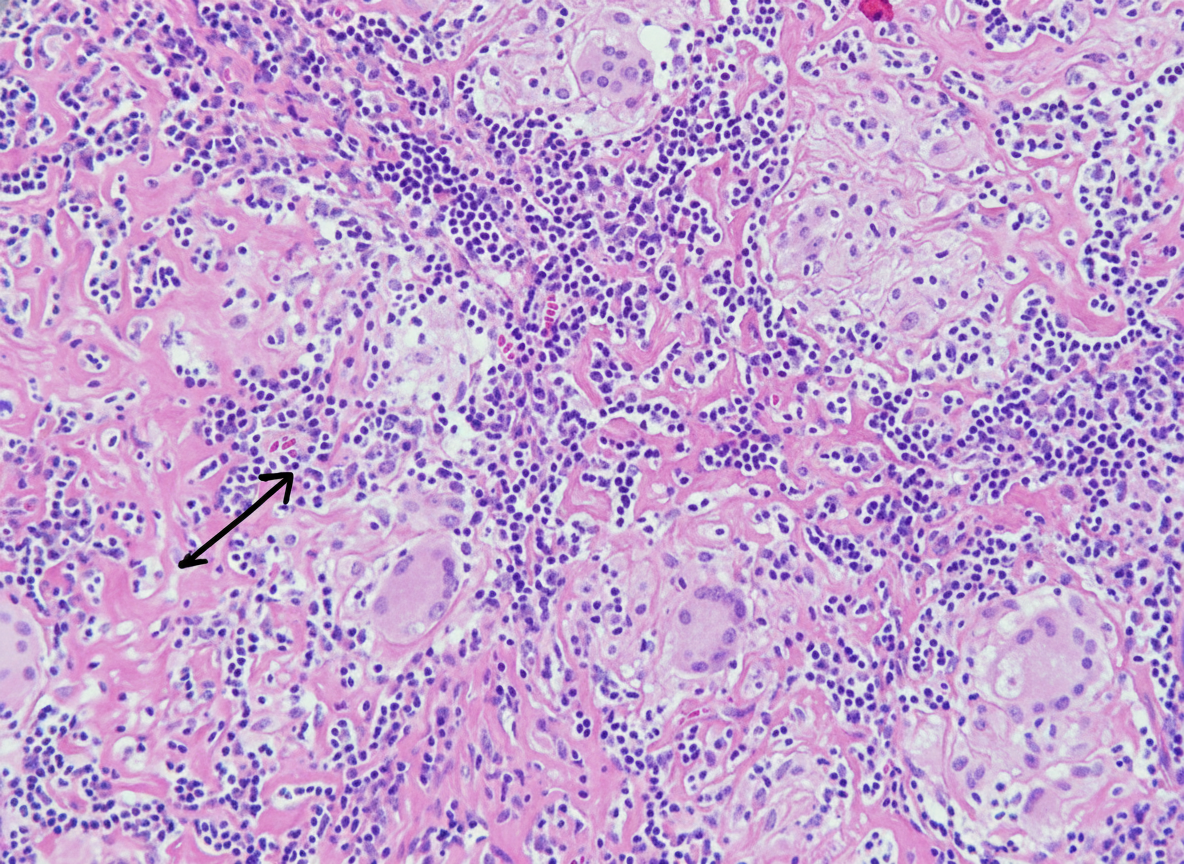
A 32-year-old man who recently emigrated from Somalia comes to the physician because of a 4-week history of fever, cough, and chest pain. He has had a 5-kg (11-lb) weight loss over the last 3 months despite no changes in appetite. His temperature is 38.1°C (100.6°F). Physical examination shows enlarged cervical lymph nodes. The lungs are clear to auscultation. The results of an interferon-γ release assay are positive. An x-ray of the chest shows bilateral mediastinal lymphadenopathy. A transbronchial needle aspiration biopsy of a mediastinal lymph node is performed; a photomicrograph of the specimen is shown. The structure indicated by the arrow is most likely comprised of which of the following types of cells?
Want unlimited practice?
Get full access to all questions, explanations, and performance tracking.
Scan to download app