
Cellular components of inflammation — MCQs

A 45-year-old immigrant presents with unintentional weight loss, sleep hyperhidrosis, and a persistent cough. He says these symptoms have been present for quite some time. Upon imaging, many granulomas in the upper lobes are present. It is noted that these apical granulomas have centers of necrosis that appear cheese-like in appearance. Encircling the area of necrosis are large cells with cytoplasms pale in color. Of the following surface markers, which one is most closely associated with these cells?
A 40-day-old child presents to a physician for the first time for a well-child visit. The mother is a 22-year-old college student who opted for a home birth. Upon examination, the child weighs 4.0 kg (8.8 lbs) and has intact reflexes. The umbilical cord is still attached and looks erythematous and indurated. A complete blood cell count reveals leukocytosis. Immunoglobulin levels are normal. A flow cytometry analysis is performed. Which of the following markers will most likely be deficient in this child?
A researcher is studying the circulating factors that are released when immune cells are exposed to antigens. Specifically, she is studying a population of CD2+ cells that have been activated acutely. In order to determine which factors are secreted by these cells, she cultures the cells in media and collects the used media from these plates after several days. She then purifies a small factor from this media and uses it to stimulate various immune cell types. She finds that this factor primarily seems to increase the growth and prolong the survival of other CD2+ cells. Which of the following is most likely the factor that was purified by this researcher?
A 25-year-old G1P0 female of Middle Eastern descent gives birth to a male infant at 38 weeks' gestation. The child is in the 15th percentile for both height and weight. Over the course of the first six months of the child's life, he develops multiple severe skin and mucosal infections characterized by dramatically elevated white blood cell counts. The patient also demonstrates mental retardation soon after birth. A thorough hematologic analysis via flow cytometry reveals that the child's neutrophils lack Sialyl-Lewis X. Which of the following processes is likely deficient in this patient?
A 30-year-old man is admitted to the hospital with a presumed pneumonia and started on antibiotics. Two days later, the patient shows no improvement. Blood cultures reveal yeast with pseudophyphae. Which of the following cell types is most likely deficient or dysfunctional in this patient?
Two days after being admitted for acute myocardial infarction, a 61-year-old man has sharp, substernal chest pain that worsens with inspiration and improves when leaning forward. Cardiac examination shows a scratchy sound best heard over the left sternal border. Histopathological examination of the infarcted myocardial tissue is most likely to show which of the following findings?
A 37-year-old man presents to his primary care physician because he has had constipation for the last several weeks. He has also been feeling lethargic and complains that this winter has been particularly cold. He also complains that he has been gaining weight despite no change in his normal activities. He reveals that two months prior to presentation he had what felt like the flu for which he took Tylenol and did not seek medical attention. Several days after this he developed anterior neck pain. Which of the following findings would most likely be seen on biopsy of this patient's abnormality?
A 4-year-old Caucasian boy is brought by his mother to the pediatrician with a red and swollen elbow. He was playing outside a few days prior to presentation when he fell and lightly scraped his elbow on the sidewalk. He was born at 34 weeks' gestation and was in the neonatal ICU for 2 days. His temperature is 102.1°F (38.9°C), blood pressure is 105/65 mmHg, pulse is 110/min, and respirations are 20/min. On exam, he has a swollen, erythematous, fluctuant, and exquisitely tender mass on his right elbow. There is expressible purulence coming from his wound. A peripheral blood smear in this patient would most likely reveal which of the following findings?
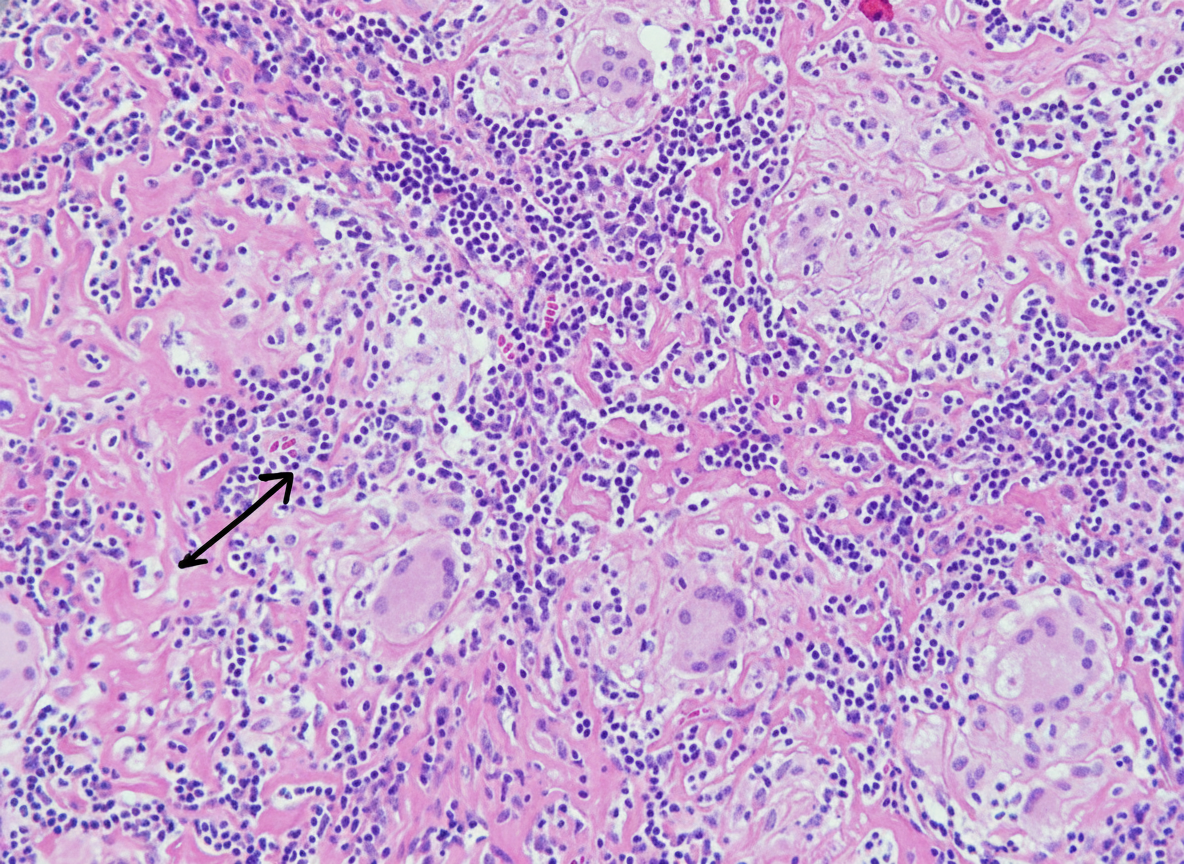
A 32-year-old man who recently emigrated from Somalia comes to the physician because of a 4-week history of fever, cough, and chest pain. He has had a 5-kg (11-lb) weight loss over the last 3 months despite no changes in appetite. His temperature is 38.1°C (100.6°F). Physical examination shows enlarged cervical lymph nodes. The lungs are clear to auscultation. The results of an interferon-γ release assay are positive. An x-ray of the chest shows bilateral mediastinal lymphadenopathy. A transbronchial needle aspiration biopsy of a mediastinal lymph node is performed; a photomicrograph of the specimen is shown. The structure indicated by the arrow is most likely comprised of which of the following types of cells?
A 60-year-old man comes to the office because of an 8-month history of cough, night sweats, shortness of breath, and fatigue. He has also had a 9-kg (19.8-lb) weight loss during this time. He appears pale. Abdominal examination shows hepatosplenomegaly. His leukocyte count is 80,000/mm3 and his leukocyte alkaline phosphatase level is increased. A peripheral blood smear shows > 82% neutrophils with band forms and immature and mature neutrophil precursors. An x-ray of the chest shows a 9-mm right hilar nodule. Which of the following is the most likely cause of this patient's laboratory findings?
Want unlimited practice?
Get full access to all questions, explanations, and performance tracking.
Scan to download app