
Red blood cell disorders — MCQs

A 25-year-old G2P1 woman at 12 weeks gestational age presents to the office to discuss the results of her routine prenatal screening labs, which were ordered during her 1st prenatal visit. She reports taking a daily prenatal vitamin but no other medications. She complains of mild fatigue and appears pale on exam. Her complete blood count (CBC) shows the following: Hemoglobin (Hb) 9.5 g/dL Hematocrit 29% Mean corpuscular volume (MCV) 75 µm3 Which of the following are the most likely hematologic states of the patient and her fetus?
A 37-year-old man, otherwise healthy, has a routine CBC done prior to donating blood for the first time. The results are as follows: Hemoglobin 10.8 g/dL Mean corpuscular volume (MCV) 82 μm3 Mean corpuscular hemoglobin concentration (MCHC) 42% Reticulocyte count 3.2% White blood cell count 8,700/mm3 Platelet count 325,000/mm3 The patient is afebrile and his vital signs are within normal limits. On physical examination, his spleen is just palpable. A peripheral blood smear is shown in the exhibit (see image). A direct antiglobulin test (DAT) is negative. Which of the following best describes the etiology of this patient’s most likely diagnosis?
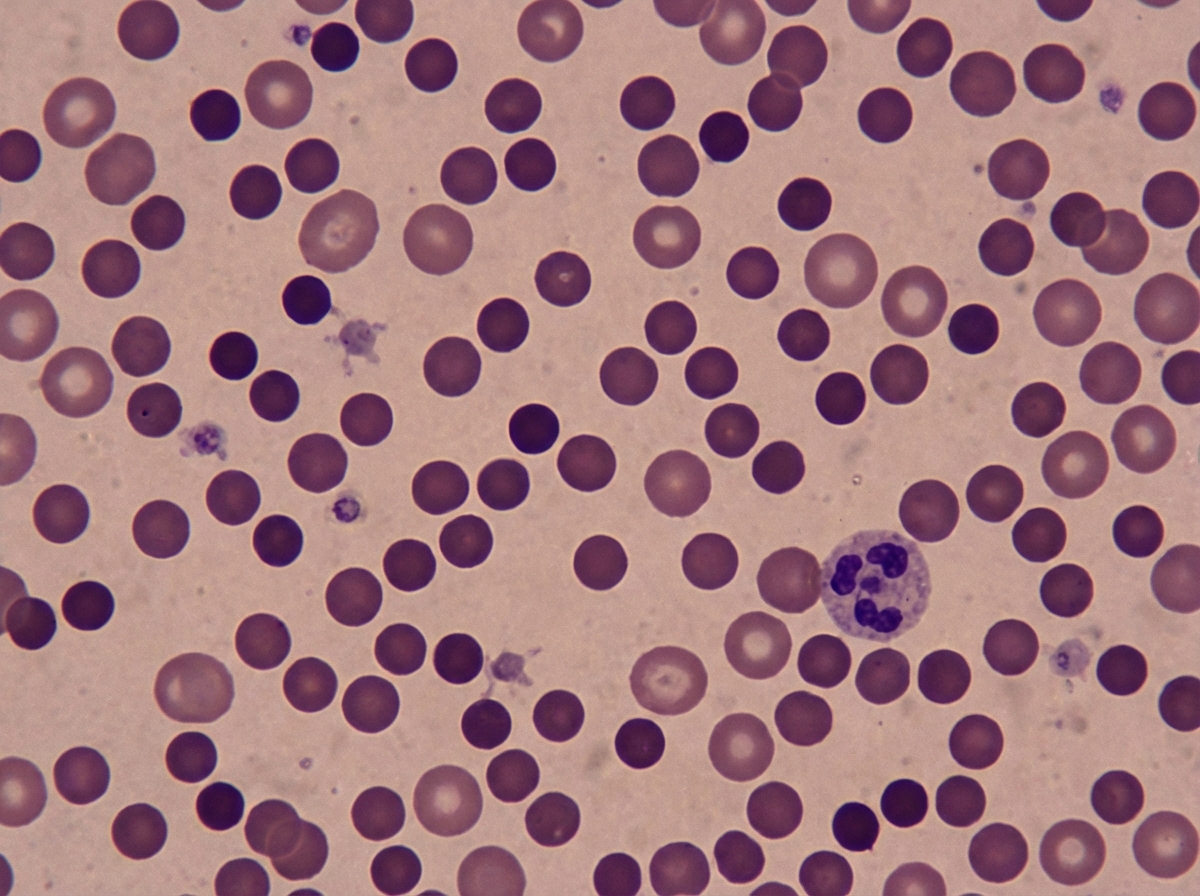
A 34-year-old female with a past medical history of a gastric sleeve operation for morbid obesity presents for pre-surgical clearance prior to a knee arthroplasty. Work-up reveals a hemoglobin of 8.7 g/dL, hematocrit of 26.1%, and MCV of 106 fL. With concern for folate deficiency, she is started on high dose folate supplementation, and her follow-up labs are as follows: hemoglobin of 10.1 g/dL, hematocrit of 28.5%, and MCV of 96 fL. Given her history of gastric sleeve surgery and associated malabsorption risks, she is at long-term risk for which complication?
A 32-year-old woman complains of fatigue and pallor. She says symptoms that started several months ago and have been becoming more serious with time. She reports that she has been exercising regularly and has been adhering to a strict vegan diet. The patient has no significant past medical history and takes no current medications. She denies any smoking history, alcohol use, or recreational drug use. She is tachycardic, but otherwise, her physical examination is unremarkable. A complete blood count (CBC) shows anemia with a low MCV (mean corpuscular volume), and a peripheral blood smear shows small erythrocytes. Which of the following is the most likely diagnosis in this patient?
A 35-year-old woman is involved in a car accident and presents with an open fracture of the left femur and severe bleeding from the left femoral artery. No past medical history or current medications. Her blood pressure is 90/60 mm Hg, pulse is 110/min, and respirations are 21/min. On physical examination, the patient is lethargic, confused, and poorly responds to commands. Peripheral pulses are 1+ in the left lower extremity below the level of the knee and 2+ elsewhere. When she arrives at the hospital, a stat hemoglobin level shows 6 g/dL. Which of the following is most correct about the patient’s condition?
A 62-year-old man, a retired oil pipeline engineer, presents to his primary care physician with complaints of headaches, fatigue, and constant ringing in his ears. Recurrently he has developed pruritus, usually after a hot shower. He also noted a constant burning sensation in his fingers and toes, independent of physical activity. On examination, he has a red face and his blood pressure levels are 147/89 mm Hg. A CBC revealed that his Hb is 19.0 g/dL and Hct is 59%. Because of his condition, his physician prescribes him 81 mg of aspirin to be taken daily in addition to therapeutic phlebotomy. Which of the statements below is true about this patient’s condition?
A 4-year-old boy is brought to the physician for the evaluation of fatigue since he returned from visiting family in South Africa one week ago. The day after he returned, he had fever, chills, and diffuse joint pain for 3 days. His symptoms improved with acetaminophen. He was born at term and has been healthy. His immunizations are up-to-date. His temperature is 37.6°C (99.68°F), pulse is 100/min, and blood pressure is 100/60 mm Hg. Examination shows conjunctival pallor. The remainder of the examination shows no abnormalities. Laboratory studies show: Hemoglobin 10.8 g/dL Mean corpuscular volume 68 μm3 Red cell distribution width 14% (N = 13%–15%) Hemoglobin A2 6% (N < 3.5%) A peripheral smear shows microcytic, hypochromic erythrocytes, some of which have a darkly stained center and peripheral rim, separated by a pale ring. Which of the following is the most appropriate next step in the management of this patient?
A 33-year-old G2P2 woman presents with a history of fatigue and difficulty breathing upon exertion. She was not able to tolerate antenatal vitamin supplements due to nausea and constipation. Her vital signs include: temperature 37.0°C (98.6°F), blood pressure 112/64 mm Hg, and pulse 98/min. Physical examination reveals conjunctival pallor and spoon nails. Laboratory findings are significant for the following: Hemoglobin 9.1 g/dL Hematocrit 27.3% Mean corpuscular volume (MCV) 73 μm3 Mean corpuscular hemoglobin (MCH) 21 pg/cell Red cell distribution width (RDW) 17.5% (ref: 11.5–14.5%) Serum ferritin 9 ng/mL Which of the following would most likely be seen on a peripheral blood smear in this patient?
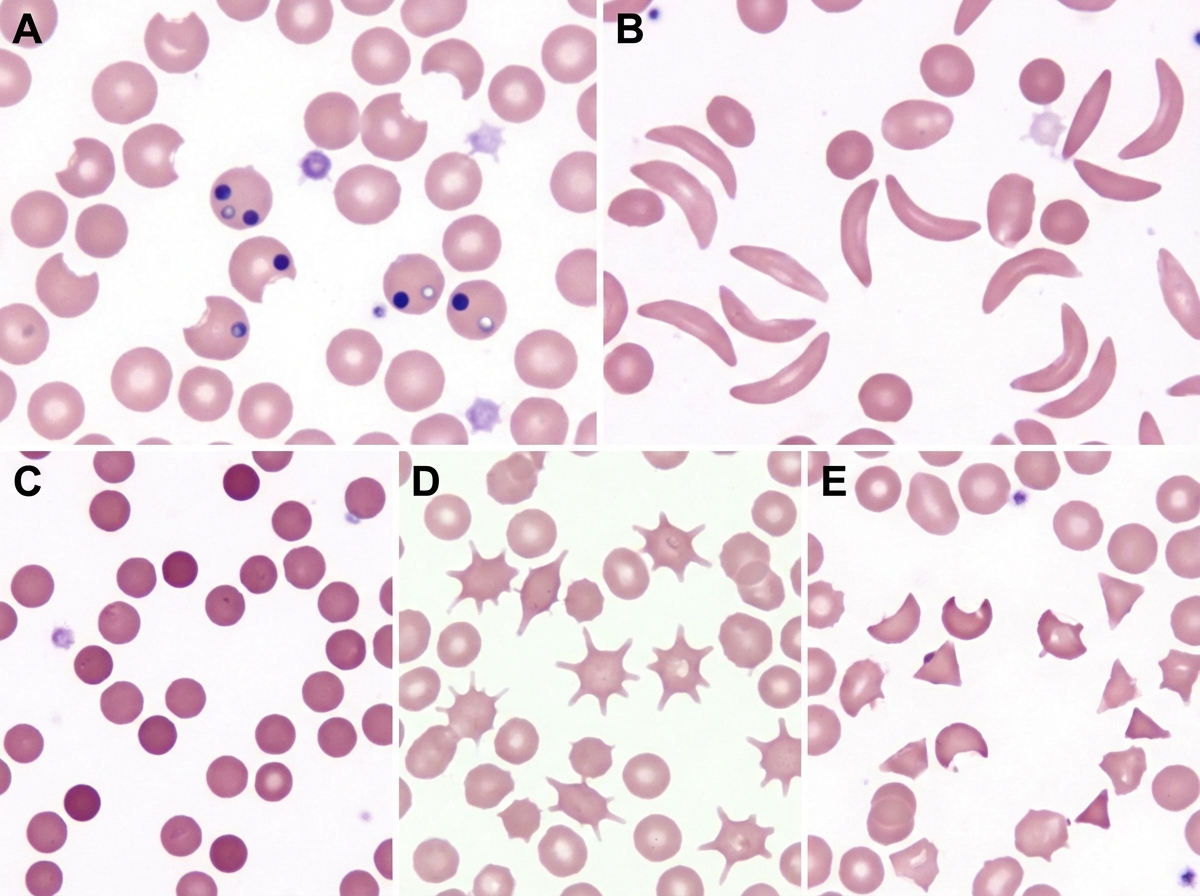
A 68-year-old man of Mediterranean descent comes to the clinic with complaints of fatigue for the past month. He reports that it is increasingly difficult for him to complete his after-dinner walks as he would get breathless and tired around 10 minutes. He endorses dizziness and an upper respiratory infection last week for which he “took a lot of aspirin.” Past medical history is significant for malaria 10 years ago (for which he was adequately treated with anti-malarial medications) and aortic stenosis status post prosthetic valve replacement 5 months ago. When asked if he has had similar episodes before, he claims, “Never! I’ve been as healthy as a horse until my heart surgery.” Physical examination is significant for mild scleral icterus bilaterally and a faint systolic murmur. Which of the following images represents a potential peripheral smear in this patient?
A 43-year-old man comes to the physician for a 1-week history of swelling around his eyes and decreased urination. His pulse is 87/min, and blood pressure is 152/95 mm Hg. Physical examination shows 1+ periorbital and pretibial edema. Serum studies show a urea nitrogen concentration of 21 mg/dL and a creatinine concentration of 1.4 mg/dL. Urinalysis shows 3+ blood and 1+ protein. Further evaluation of this patient is most likely to show which of the following?
Want unlimited practice?
Get full access to all questions, explanations, and performance tracking.
Scan to download app