
Myeloproliferative neoplasms — MCQs

A 40-year-old man comes to the physician because of fatigue, increased sweating, and itching in his legs for the past 2 years. He has chronic bronchitis. He has smoked two packs of cigarettes daily for 24 years and drinks one to two beers every night. His only medication is a tiotropium bromide inhaler. His vital signs are within normal limits. He is 175 cm (5 ft 9 in) tall and weighs 116 kg (256 lb); BMI is 38 kg/m2. Physical examination shows facial flushing and bluish discoloration of the lips. Scattered expiratory wheezing and rhonchi are heard throughout both lung fields. Abdominal examination shows no abnormalities. Laboratory studies show: Erythrocyte count 6.9 million/mm3 Hemoglobin 20 g/dL Mean corpuscular volume 91 μm3 Leukocyte count 13,000/mm3 Platelet count 540,000/mm3 Serum Ferritin 8 ng/mL Iron 48 μg/dL Iron binding capacity 402 μg/dL (N: 251 - 406 μg/dL) Which of the following is the most appropriate next step in treatment?
A 47-year-old woman presents for a routine wellness checkup. She complains of general fatigue and lethargy for the past 6 months. She does not have a significant past medical history and is currently not taking any medications. The patient reports that she drinks “socially” approx. 6 nights a week. She says she also enjoys a “nightcap,” which is 1–2 glasses of wine before bed every night. She denies any history of drug use or smoking. The patient is afebrile, and her vital signs are within normal limits. A physical examination reveals pallor of the mucous membranes. Her laboratory findings are significant for a mean corpuscular volume of 72 fL, leukocyte count of 5,300/mL, hemoglobin of 11.0 g/dL, and platelet count of 420,000/mL. Which of the following is the most likely cause of this patient’s thrombocytosis?
A 55-year-old man comes to the physician for a routine health visit. He feels well except for occasional left-sided abdominal discomfort and left shoulder pain. He has smoked 1 pack of cigarettes daily for 20 years. He does not drink alcohol. His pulse is 85/min and his blood pressure is 130/70 mmHg. Examination shows a soft, nontender abdomen. The spleen is palpated 5 cm below the costal margin. There is no lymphadenopathy present. The remainder of the examination shows no abnormalities. Laboratory studies show: Hemoglobin 12.2 g/dL Hematocrit 36 % Leukocyte count 34,000/mm3 Platelet count 450,000/mm3 Cytogenetic testing of his blood cells is pending. Further evaluation of this patient is most likely to show which of the following findings?
A 73-year-old man is brought to the emergency department because of fever and a productive cough for 2 days. He has had increasing fatigue and dyspnea for the past 2 weeks. During this time he has lost 3 kg (6.6 lb). He received chemotherapy for myelodysplastic syndrome (MDS) 1 year ago. He is currently on supportive treatment and regular blood transfusions. He does not smoke or drink alcohol. The vital signs include: temperature 38.5℃ (101.3℉), pulse 93/min, respiratory rate 18/min, and blood pressure 110/65 mm Hg. He has petechiae distally on the lower extremities and several purpura on the trunk and extremities. Several enlarged lymph nodes are detected in the axillary and cervical regions on both sides. On auscultation of the lungs, crackles are heard in the left lower lobe area. Physical examination of the heart and abdomen shows no abnormalities. The laboratory studies show the following: Hemoglobin 9 g/dL Mean corpuscular volume 95 μm3 Leukocyte count 18,000/mm3 Platelet count 40,000/mm3 Prothrombin time 11 sec (INR = 1) Based on these findings, this patient is most likely to have developed which of the following?
A 35-year-old male presents to his physician with the complaint of fatigue and weakness for six months. His physician orders a CBC which demonstrates anemia and thrombocytopenia. During the subsequent work up, a bone marrow biopsy is performed which ultimately leads to the diagnosis of acute promyelocytic leukemia. Which of the following translocations and fusion genes would be present in this patient?
A 70-year-old woman presents with a 2-week history of severe fatigue. Over the past month, she has unintentionally lost 2 kg (4.4 lb). Three years ago, she was diagnosed with myelodysplastic syndrome. Currently, she takes no medications other than aspirin for occasional knee pain. She does not smoke or drink alcohol. Her vital signs are within the normal range. On physical examination, her conjunctivae are pale. Petechiae are present on the distal lower extremities and on the soft and hard palates. Palpation reveals bilateral painless cervical lymphadenopathy. Examination of the lungs, heart, and abdomen shows no abnormalities. Laboratory studies show: Hemoglobin 9 g/dL Mean corpuscular volume 90 μm3 Leukocyte count 3000/mm3 Platelet count 20,000/mm3 A Giemsa-stained peripheral blood smear is shown in the image. Which of the following best explains these findings?
A 56-year-old man presents to his general practitioner with frequent episodes of facial flushing for the past 2 weeks. He says the episodes are associated with mild headaches and a sensation of fullness in his head and neck. Additionally, he has developed recurrent, often severe, itching after taking a hot shower. The patient denies any smoking history but says he drinks alcohol socially. His blood pressure is 160/90 mm Hg, and his temperature is 37.0°C (98.6°F). On physical examination, his face and neck appear red. Cardiac examination reveals a regular rate and rhythm. Lungs are clear to auscultation bilaterally. The spleen is noted to be palpable just below the costal margin. A complete blood count shows a hemoglobin level of 19.5 g/dL, a total leukocyte count of 12,000/mm3, and a platelet count of 450,000/mm3. Which of the following sets of abnormalities is most likely present in this patient?
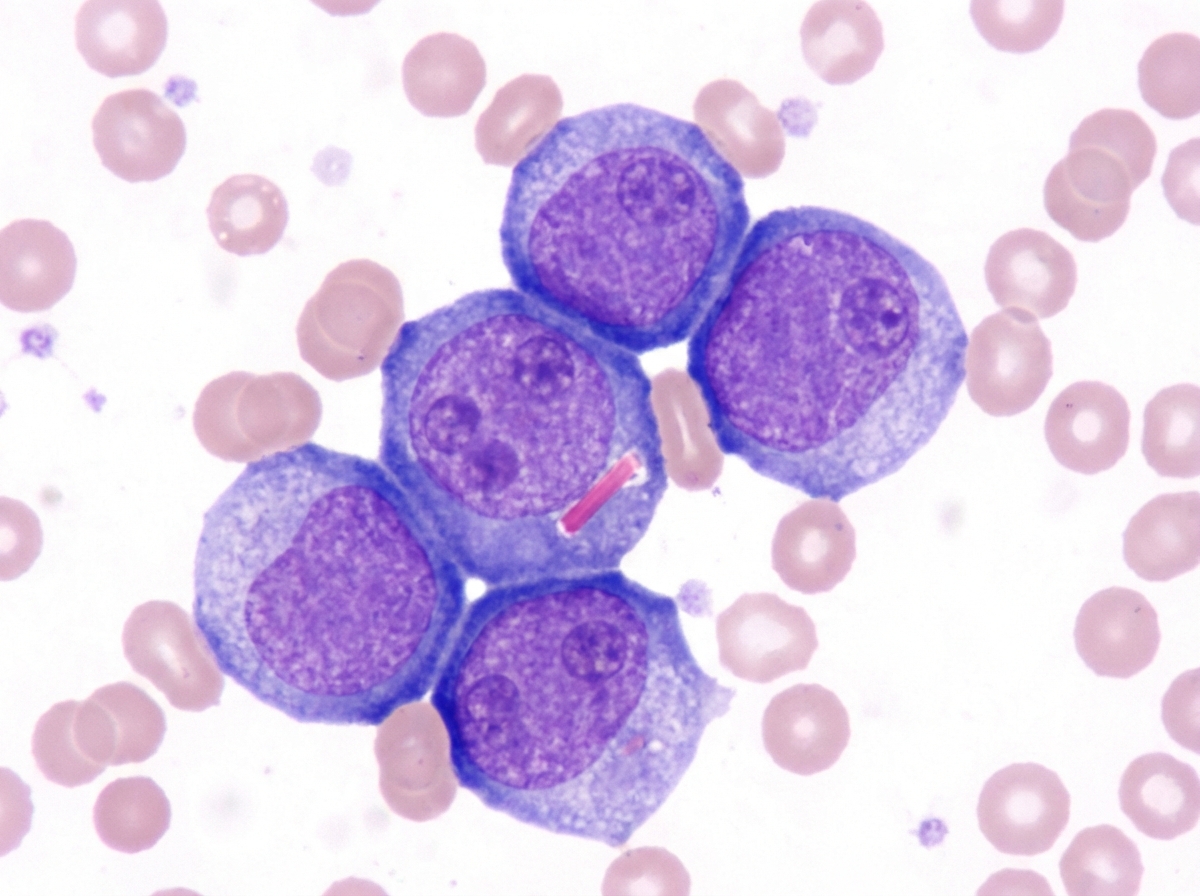
A 67-year-old man comes to the physician because of a 2-month history of generalized fatigue. On examination, he appears pale. He also has multiple pinpoint, red, nonblanching spots on his extremities. His spleen is significantly enlarged. Laboratory studies show a hemoglobin concentration of 8.3 g/dL, a leukocyte count of 81,000/mm3, and a platelet count of 35,600/mm3. A peripheral blood smear shows immature cells with large, prominent nucleoli and pink, elongated, needle-shaped cytoplasmic inclusions. Which of the following is the most likely diagnosis?
A 13-year-old girl is brought to the pediatrician due to a 4-month history of heavy vaginal bleeding during menstrual periods. She endorses episodes of bleeding gums after brushing her teeth and experienced prolonged bleeding after tonsillectomy 6 years ago. Her mother states that she bled significantly during childbirth and that the girl’s older brother has similar symptoms including easy bruising. Vitals were stable and physical exam was not revealing. Laboratory studies show: Platelet count: 72,000/mm^3 Bleeding time: 14 min Prothrombin time: 12 secs (INR = 1) Partial thromboplastin time: 40 secs Blood smear demonstrates increased megakaryocytes and enlarged platelets. Platelets do not aggregate to ristocetin. Which of the following is the most likely diagnosis?
A 67-year-old woman comes to the physician because of a 3-week history of fatigue and worsening back and abdominal pain. During this period, she has also had excessive night sweats and a 4.6-kg (10-lb) weight loss. She has had swelling of the neck for 3 days. She does not smoke or drink alcohol. Vital signs are within normal limits. Physical examination shows a 4-cm, supraclavicular, nontender, enlarged and fixed lymph node. The spleen is palpated 2 cm below the left costal margin. Laboratory studies show: Hemoglobin 10.4 g/dL Mean corpuscular volume 87 μm3 Leukocyte count 5,200/mm3 Platelet count 190,000/mm3 Serum Lactate dehydrogenase 310 U/L A CT scan of the thorax and abdomen shows massively enlarged paraaortic, axillary, mediastinal, and cervical lymph nodes. Histopathologic examination of an excised cervical lymph node shows lymphocytes with a high proliferative index that stain positive for CD20. Which of the following is the most likely diagnosis?
Want unlimited practice?
Get full access to all questions, explanations, and performance tracking.
Scan to download app