
Myelodysplastic syndromes — MCQs

A 45-year-old woman comes to the physician because of a 1-week history of fatigue and bruises on her elbows. Examination shows a soft, nontender abdomen with no organomegaly. Laboratory studies show a hemoglobin concentration of 7 g/dL, a leukocyte count of 2,000/mm3, a platelet count of 40,000/mm3, and a reticulocyte count of 0.2%. Serum electrolyte concentrations are within normal limits. A bone marrow biopsy is most likely to show which of the following findings?
A 24-year-old woman complains of intermittent fever and joint pain. She says that these symptoms have been present for the past month. Before that, she had no signs or symptoms and was completely healthy. She has also lost her appetite and some weight. A complete blood count (CBC) showed severe pancytopenia. What is the next best step in evaluating this patient?
A 76-year-old woman presents to the physician for a follow-up examination. She had a hemoglobin level of 10.5 g/dL last month. She complains of mild dyspnea with exercise. She reports exercising daily for the past 30 years. She is relatively healthy without any significant past medical history. She occasionally takes ibuprofen for knee pain. She denies a prior history of alcohol or tobacco use. Her temperature is 37.1°C (98.8°F), the pulse is 65/min, the respiratory rate is 13/min, and the blood pressure is 115/65 mm Hg. The examination shows no abnormalities. Laboratory studies show: Laboratory test Hemoglobin 10.5 g/dL Mean corpuscular volume 75 μm3 Leukocyte count 6500/mm3 with a normal differential Platelet 400,000/mm3 Serum Iron 35 Total iron-binding capacity 450 μg/dL Ferritin 8 Ca+ 9.0 mg/dL Albumin 3.9 g/dL Urea nitrogen 10 mg/dL Creatinine 0.9 mg/dL Serum protein electrophoresis and immunofixation show a monoclonal protein of 20 g/L (non-IgM). Marrow plasmacytosis is 5%. A skeletal survey shows no abnormalities. In addition to the workup of iron deficiency anemia, which of the following is the most appropriate next step in management?
A 20-year-old woman comes to the physician for the evaluation of fatigue and low energy levels for 2 months. She has not had fever or weight changes. She has no history of serious illness except for an episode of infectious mononucleosis 4 weeks ago. Menses occur at regular 28-day intervals and last 5 days with moderate flow. Her last menstrual period was 3 weeks ago. Her mother has Hashimoto's thyroiditis. Vital signs are within normal limits. Examination shows pale conjunctivae, inflammation of the corners of the mouth, and brittle nails. The remainder of the examination shows no abnormalities. Laboratory studies show: Hemoglobin 10.3 g/dL Mean corpuscular volume 74 μm3 Platelet count 280,000/mm3 Leukocyte count 6,000/mm3 Which of the following is the most appropriate initial step in management?
A 9-year-old boy is brought to the physician by his mother because of a 3-day history of fever and bleeding after brushing his teeth. His mother also reports that her son has asked to be picked up early from soccer practice the past few days because of fatigue. He appears pale and ill. His temperature is 38.3°C (101.1°F), pulse is 115/min, and blood pressure is 100/60 mm Hg. The lungs are clear to auscultation. Examination shows a soft, nontender abdomen with no organomegaly. There are several spots of subcutaneous bleeding on the abdomen and shins. Laboratory studies show a hemoglobin concentration of 7 g/dL, a leukocyte count of 2,000/mm3, a platelet count of 40,000/mm3, and a reticulocyte count of 0.2%. Serum electrolyte concentrations are within normal limits. A bone marrow biopsy is most likely to show which of the following findings?
A 59-year-old man presents with fatigue and tingling in both feet and hands. Past medical history is significant for type 2 diabetes mellitus diagnosed 27 years ago, for which he takes metformin and gliclazide. He denies any smoking, alcohol, or illicit drug use. Physical examination is unremarkable. Laboratory results reveal the following: Hemoglobin 10.4 g/dL Hematocrit 31% Mean corpuscular volume 110 μm3 Corrected reticulocyte index low Leukocyte count 7,500 /mm3 Platelet count 250,000 /mm3 A peripheral blood smear is shown in the exhibit (see image). Which of the following best describes the underlying cause of this patient’s anemia?
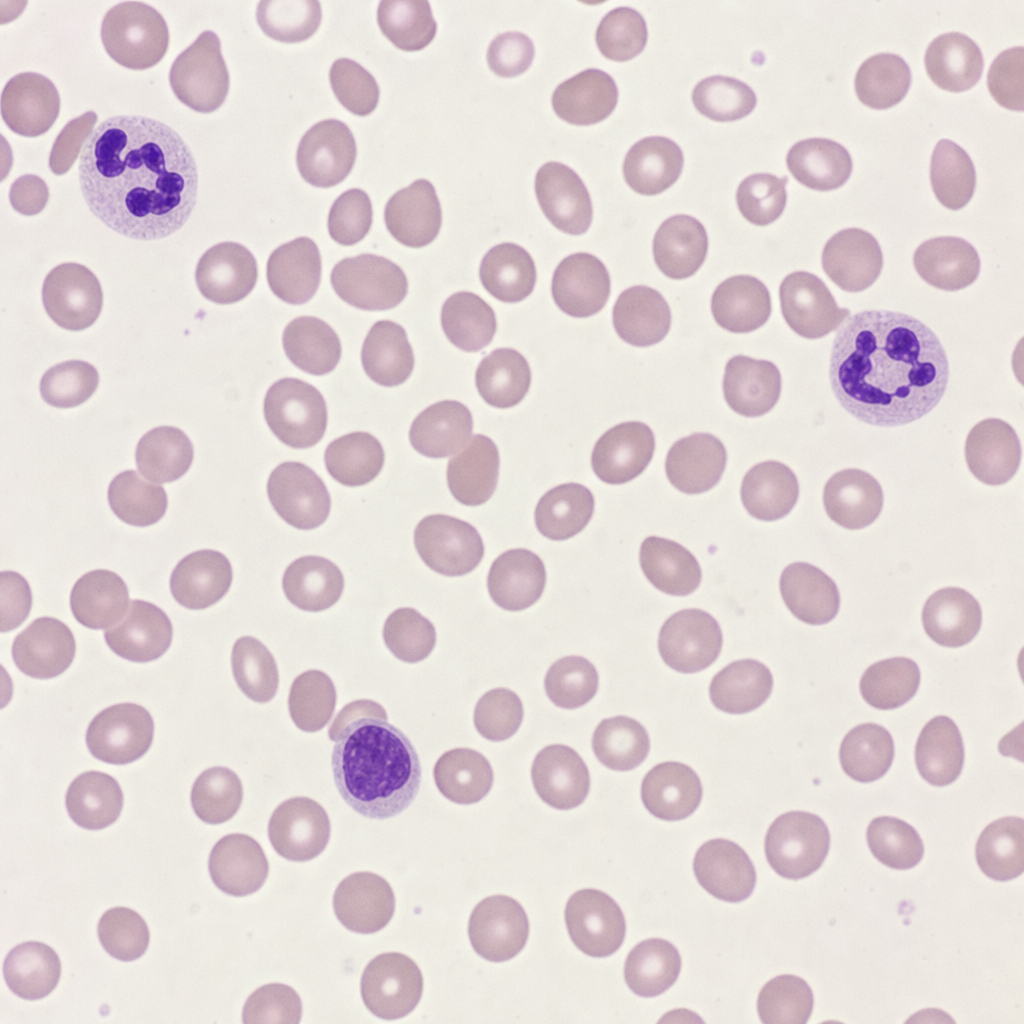
An otherwise healthy 42-year-old man undergoes routine investigations prior to blood donation. His complete blood count is shown: Hemoglobin 9.3 g/dL Mean corpuscular volume (MCV) 71 μm3 Mean corpuscular hemoglobin (MCH) 21 pg/cell White blood cell count 8,200/mm3 Platelet count 317,000/mm3 Iron studies are shown: Serum iron 210 μg/dL Serum ferritin 310 ng/mL Total iron binding capacity (TIBC) 290 μg/dL Transferrin saturation 78% He occasionally drinks alcohol and denies smoking or use of illicit drugs. There is a family history of anemia including his brother and maternal uncle. Examination shows conjunctival pallor, but is otherwise unremarkable. Which of the following is the most likely diagnosis?
A 7-month old boy, born to immigrant parents from Greece, presents to the hospital with pallor and abdominal distention. His parents note that they recently moved into an old apartment building and have been concerned about their son's exposure to chipped paint from the walls. On physical exam, the patient is found to have hepatosplenomegaly and frontal skull bossing. Hemoglobin electrophoresis reveals markedly increased HbF and HbA2 levels. What would be the most likely findings on a peripheral blood smear?
A 71-year-old man comes to the physician for a routine health maintenance examination. He has occasional fatigue but otherwise feels well. He has a history of hypertension and type 2 diabetes mellitus. He is a retired chemist. His only medication is ramipril. His temperature is 37.8°C (100°F), pulse is 72/min, respirations are 18/min, and blood pressure is 130/70 mm Hg. Physical examination shows nontender cervical and axillary lymphadenopathy. The spleen is palpated 7 cm below the costal margin. Laboratory studies show a leukocyte count of 12,000/mm3 and a platelet count of 210,000/mm3. Further evaluation is most likely to show which of the following?
A 13-year-old girl is brought to the pediatrician due to a 4-month history of heavy vaginal bleeding during menstrual periods. She endorses episodes of bleeding gums after brushing her teeth and experienced prolonged bleeding after tonsillectomy 6 years ago. Her mother states that she bled significantly during childbirth and that the girl’s older brother has similar symptoms including easy bruising. Vitals were stable and physical exam was not revealing. Laboratory studies show: Platelet count: 72,000/mm^3 Bleeding time: 14 min Prothrombin time: 12 secs (INR = 1) Partial thromboplastin time: 40 secs Blood smear demonstrates increased megakaryocytes and enlarged platelets. Platelets do not aggregate to ristocetin. Which of the following is the most likely diagnosis?
Want unlimited practice?
Get full access to all questions, explanations, and performance tracking.
Scan to download app