
Hodgkin lymphoma — MCQs

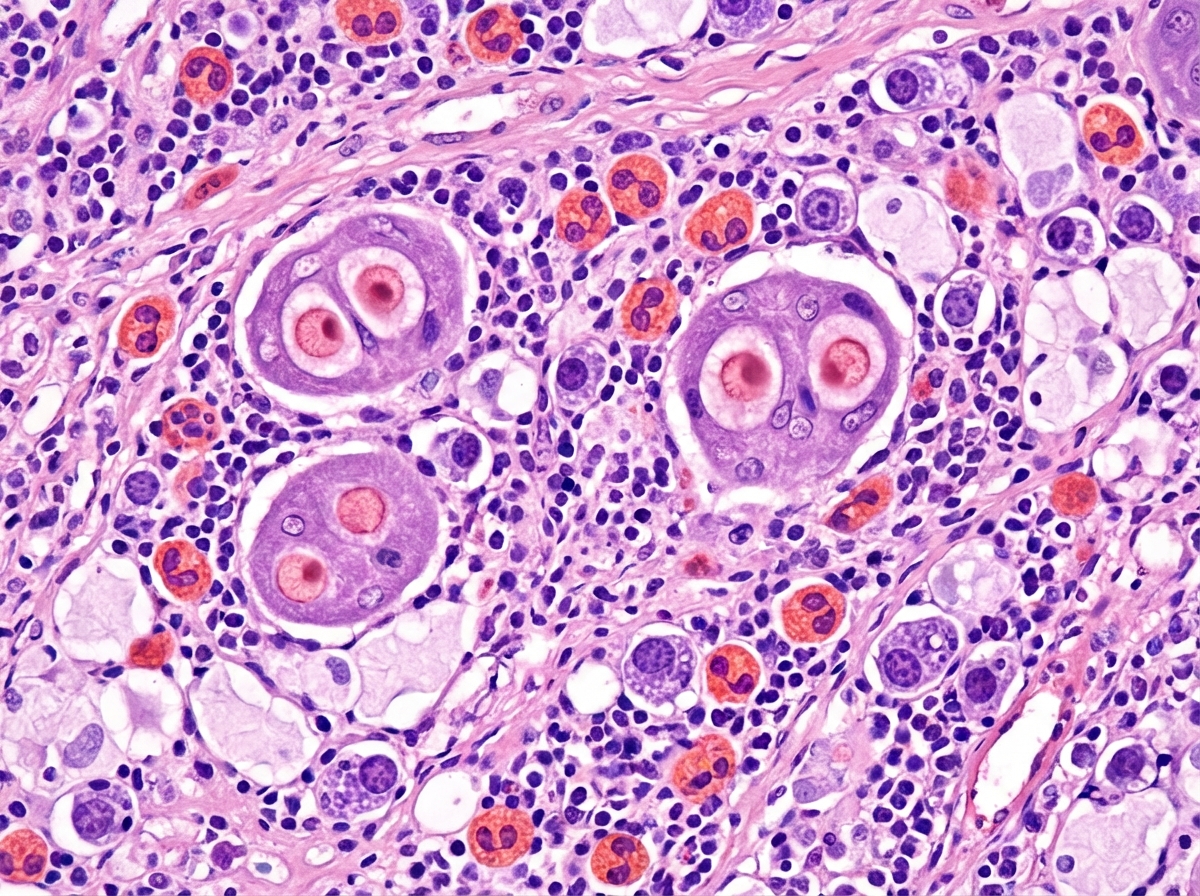
A 58-year-old man presents with a lump on his neck. He says the mass gradually onset 2 months ago and has been progressively enlarging. He denies any pain, weight loss, fevers, chills, or night sweats. Past medical history is significant for HIV, diagnosed 5 years ago, managed on a new HAART regimen he just started. The patient is afebrile and vital signs are within normal limits. Physical examination shows a 3 cm mobile firm mass on the left lateral side of the neck immediately below the level of the thyroid cartilage. A biopsy of the mass is performed and reveals atypical mononuclear cells in a background of eosinophils, plasma cells, histiocytes, atypical T-lymphocytes, and binucleated Reed-Sternberg cells (shown in image). Which of the following is the most likely diagnosis in this patient?
A 35-year-old man presents with a mass on the central part of his neck. He reports it has been growing steadily for the past 2 weeks, and he has also been experiencing fatigue and recurrent fevers. No significant past medical history. The patient denies any smoking history, or alcohol or recreational drug use. He denies any recent travel in the previous 6 months. On physical examination, there are multiple enlarged submandibular and cervical lymph nodes that are firm, mobile, and non-tender. A biopsy of one of the lymph nodes is performed and shows predominantly lymphocytes and histiocytes present in a pattern ‘resembling popcorn’. A flow cytometry analysis demonstrates cells that are CD19 and CD20 positive and CD15 and CD30 negative. Which of the following is the most likely diagnosis in this patient?
A 5-year-old male is brought to his pediatrician after recurrent, prolonged upper respiratory infections over a period of several months. Physical exam reveals petechiae on the patient's legs and arms. Laboratory studies show hemoglobin: 10 g/dL, platelet count: 35,000/mm^3, leukocyte count: 6,600/mm^3. A bone marrow aspiration shows an abundance of lymphoblasts indicative of acute lymphoblastic leukemia (ALL). Positive immunostaining for which of the following would support a diagnosis of precursor B-cell leukemia?
A 29-year-old man comes to the physician because of a 3-month history of fatigue, weight loss, and multiple painless swellings on his neck and axilla. He reports that his swellings become painful after he drinks alcohol. Physical examination shows nontender cervical and axillary lymphadenopathy. A lymph node biopsy specimen shows giant binucleate cells. Which of the following is the most likely diagnosis?
A 37-year old man is being evaluated due to a recent history of fatigue that started 3 weeks ago. The patient presents with a history of HIV, which was first diagnosed 7 years ago. He has been on an antiretroviral regimen and takes it regularly. His CD4+ count is 350 cells/mm3. According to the patient, his partner passed away from a "blood cancer", and he is worried that his fatigue might be connected to a similar pathology. The physician clarifies that there is an increased risk for HIV patients to develop certain kinds of lymphomas. Which one of the conditions below is the patient more likely to develop based on his medical history?
A 67-year-old woman comes to the physician because of a 3-week history of fatigue and worsening back and abdominal pain. During this period, she has also had excessive night sweats and a 4.6-kg (10-lb) weight loss. She has had swelling of the neck for 3 days. She does not smoke or drink alcohol. Vital signs are within normal limits. Physical examination shows a 4-cm, supraclavicular, nontender, enlarged and fixed lymph node. The spleen is palpated 2 cm below the left costal margin. Laboratory studies show: Hemoglobin 10.4 g/dL Mean corpuscular volume 87 μm3 Leukocyte count 5,200/mm3 Platelet count 190,000/mm3 Serum Lactate dehydrogenase 310 U/L A CT scan of the thorax and abdomen shows massively enlarged paraaortic, axillary, mediastinal, and cervical lymph nodes. Histopathologic examination of an excised cervical lymph node shows lymphocytes with a high proliferative index that stain positive for CD20. Which of the following is the most likely diagnosis?
A 65-year-old man presents with painless swelling of the neck over the past week. He also has noted severe night sweats, which require a change of clothes and bed linens the next day. His medical history is significant for long-standing hypertension. He received a kidney transplant 6 years ago. His current medications include amlodipine, metoprolol, furosemide, aspirin, tacrolimus, and mycophenolate. His family history is significant for his sister, who died last year from lymphoma. A review of systems is positive for a 6-kg (13.2-lb) unintentional weight loss over the past 2 months. His vital signs include: temperature 37.8°C (100.0°F) and blood pressure 120/75 mm Hg. On physical examination, there are multiple painless lymph nodes, averaging 2 cm in diameter, palpable in the anterior and posterior triangles of the neck bilaterally. Axillary and inguinal lymphadenopathy is palpated on the right side. Abdominal examination is significant for a spleen of 16 cm below the costal margin on percussion. Laboratory studies are significant for the following: Hemoglobin 9 g/dL Mean corpuscular volume 88 μm3 Leukocyte count 12,000/mm3 Platelet count 130,000/mm3 Creatinine 1.1 mg/dL Lactate dehydrogenase (LDH) 1,000 U/L A peripheral blood smear is unremarkable. Which of the following is the most likely diagnosis in this patient?
An 82-year-old man presents with painless swelling of the neck for the past week. He reports no recent fever, night sweats, or weight loss. He has no significant medical history, and his only medication is daily aspirin. His temperature is 36.8℃ (98.2℉). On physical examination, there are several non-tender lymph nodes, each averaging 2 cm in diameter, which are palpable in the right anterior cervical triangle. No other palpable lymphadenopathy is noted. The remainder of the physical exam is unremarkable. Laboratory studies show the following: Hemoglobin 10 g/dL Leukocyte count 8000/mm3 with a normal differential Platelet count 250,000/mm3 Erythrocyte sedimentation rate 30 mm/h An excisional biopsy of a cervical lymph node reveals the presence of Reed-Sternberg (RS) cells. Computed tomography (CT) scans and positron emission tomography (PET) scans reveal no mediastinal mass or signs of additional disease. Which of the following aspects most strongly indicates a good prognosis for this patient?
A 15-year-old girl comes to the physician because of a sore throat and subjective fevers for the past 2 weeks. She has been feeling lethargic and is unable to attend school. She has a history of multiple episodes of streptococcal pharyngitis treated with amoxicillin. She immigrated with her family to the United States from China 10 years ago. She appears thin. Her temperature is 37.8°C (100°F), pulse is 97/min, and blood pressure is 90/60 mm Hg. Examination shows pharyngeal erythema and enlarged tonsils with exudates and palatal petechiae. There is cervical lymphadenopathy. The spleen is palpated 2 cm below the left costal margin. Her hemoglobin concentration is 12 g/dL, leukocyte count is 14,100/mm3 with 54% lymphocytes (12% atypical lymphocytes), and platelet count is 280,000/mm3. A heterophile agglutination test is positive. The underlying cause of this patient's symptoms is most likely to increase the risk of which of the following conditions?
A 71-year-old man comes to the physician for a routine health maintenance examination. He has occasional fatigue but otherwise feels well. He has a history of hypertension and type 2 diabetes mellitus. He is a retired chemist. His only medication is ramipril. His temperature is 37.8°C (100°F), pulse is 72/min, respirations are 18/min, and blood pressure is 130/70 mm Hg. Physical examination shows nontender cervical and axillary lymphadenopathy. The spleen is palpated 7 cm below the costal margin. Laboratory studies show a leukocyte count of 12,000/mm3 and a platelet count of 210,000/mm3. Further evaluation is most likely to show which of the following?
Want unlimited practice?
Get full access to all questions, explanations, and performance tracking.
Scan to download app