
Molecular diagnostic methods — MCQs

A genetic counselor sees a family for the first time for genetic assessment. The 24-year-old businessman and his 19-year-old sister are concerned about having a mutant allele and have decided to get tested. Their grandfather and great aunt both have Huntington’s disease which became apparent when they turned 52. Their father who is 47 years old appears healthy. The geneticist discusses both the benefits and risks of getting tested and orders some tests. Which of the following tests would best provide evidence for whether the siblings are carriers or not?
A 24-year-old woman presents to the ED with symptoms of pelvic inflammatory disease despite being previously treated with azithromycin for chlamydial infection. Based on your clinical understanding about the epidemiology of PID, you decide to obtain a gram stain which shows a gram-negative diplococci. What is the next step in order to confirm the identity of the organism described?
An investigator is processing a blood sample from a human subject. A reagent is added to the sample and the solution is heated to break the hydrogen bonds between complementary base pairs. This solution is then cooled to allow artificial DNA primers in the solution to attach to the separated strands of the sample DNA molecules. An enzyme derived from the thermophilic bacterium Thermus aquaticus is added and the solution is reheated. These steps are repeated multiple times until the aim of the test is achieved. The investigator most likely used which of the following laboratory procedures on the test sample?
A group of microbiological investigators is studying bacterial DNA replication in E. coli colonies. While the cells are actively proliferating, the investigators stop the bacterial cell cycle during S phase and isolate an enzyme involved in DNA replication. An assay of the enzyme's exonuclease activity determines that it is active on both intact and demethylated thymine nucleotides. Which of the following enzymes have the investigators most likely isolated?
A 3-year-old boy is brought to his pediatrician by his parents for a follow-up visit. Several concerning traits were observed at his last physical, 6 months ago. He had developmental delay, a delay in meeting gross and fine motor control benchmarks, and repetitive behaviors. At birth, he was noted to have flat feet, poor muscle tone, an elongated face with large, prominent ears, and enlarged testicles. He takes a chewable multivitamin every morning. There is one other member of the family, on the mother’s side, with a similar condition. Today, his blood pressure is 110/65 mm Hg, heart rate is 90/min, respiratory rate is 22/min, and temperature of 37.0°C (98.6°F). On physical exam, the boy repetitively rocks back and forth and has difficulty following commands. His heart has a mid-systolic click, followed by a late systolic murmur and his lungs are clear to auscultation bilaterally. Several vials of whole blood are collected for analysis. Which of the following studies should be conducted as part of the diagnostic screening protocol?
A 19-year-old male from rural West Virginia presents to his family medicine doctor to discuss why he is having trouble getting his wife pregnant. On exam, he is 6 feet 2 inches with a frail frame and broad hips for a male his size. He is noted to have mild gynecomastia, no facial hair, and small, underdeveloped testes. He claims that although he has a lower libido than most of his friends, he does have unprotected sex with his wife. His past medical history is notable for developmental delay and difficulties in school. What is the most likely chromosomal abnormality in this patient?
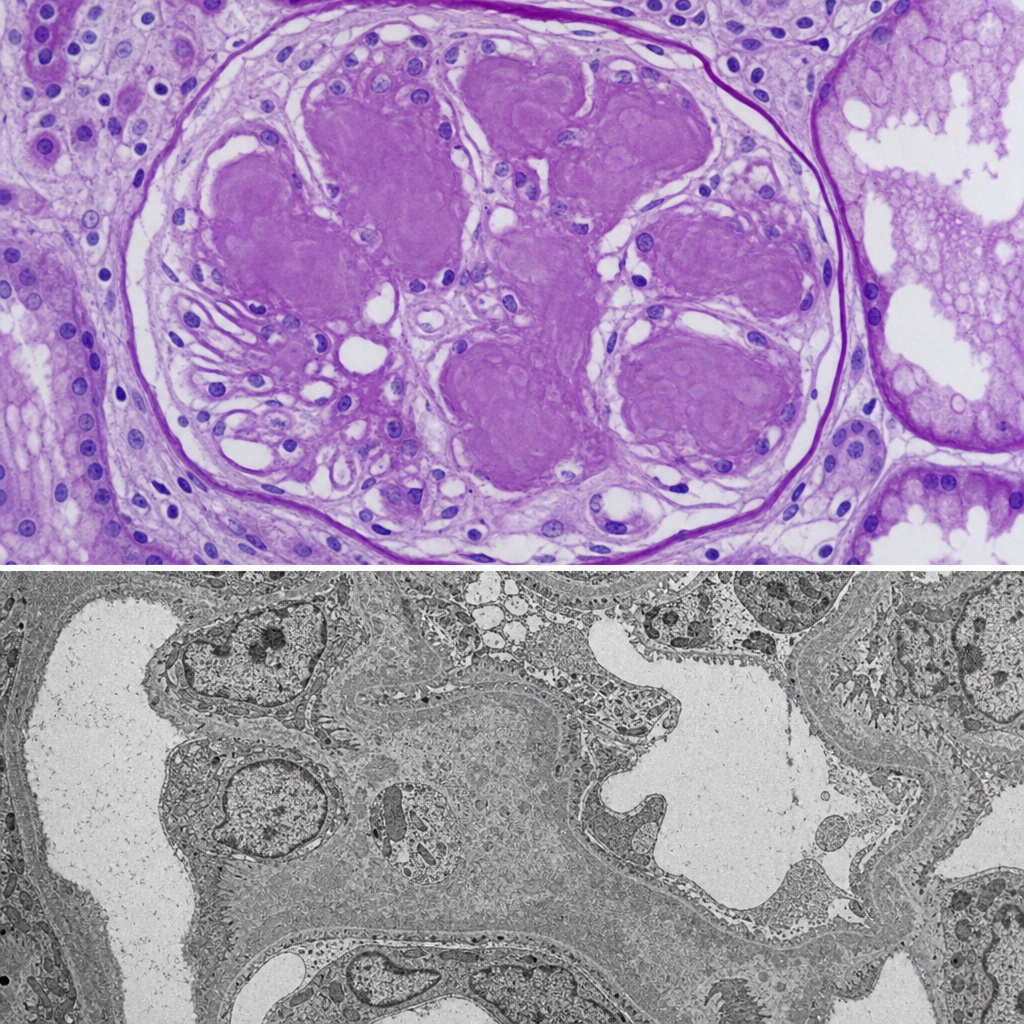
A 62-year-old man with a 20-year history of poorly controlled type 2 diabetes mellitus undergoes renal biopsy for progressive proteinuria and declining GFR. The photomicrograph shows glomeruli with periodic acid-Schiff (PAS)-positive, homogeneous, ovoid deposits in the mesangium that compress the glomerular capillaries; the deposits are acellular and do not stain with Congo red. Electron microscopy shows increased mesangial matrix without electron-dense deposits. Which of the following mechanisms is most directly responsible for the formation of the lesions seen in this biopsy?
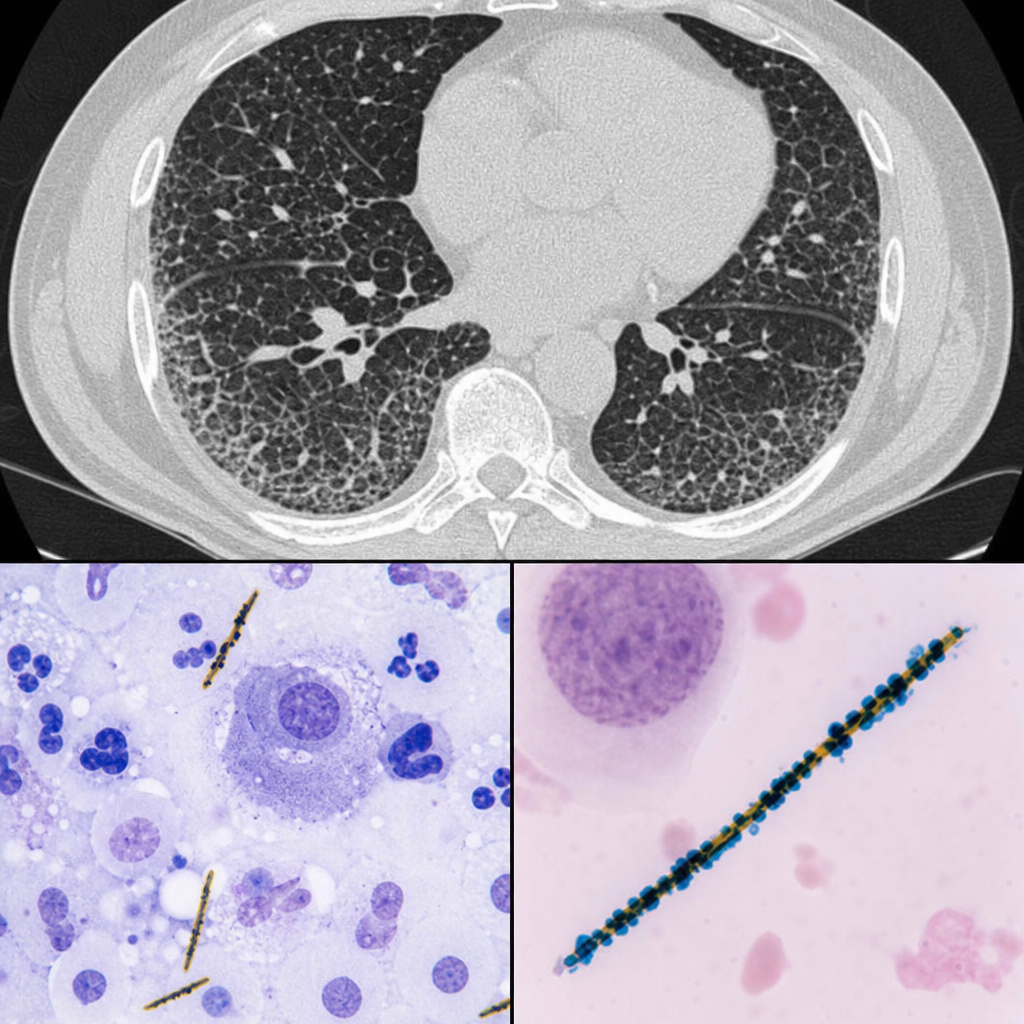
A 58-year-old man with a 40-pack-year smoking history presents with progressive dyspnea and a dry cough. Chest CT reveals bilateral lower lobe interstitial infiltrates. Bronchoalveolar lavage is performed. Prussian blue staining of the lavage material reveals elongated structures with a beaded, golden-brown coating. Which of the following is the most likely mechanism by which these structures form?
A 35-year-old woman with no significant past medical, past surgical, family or social history presents to clinic with a recently identified area of flat, intact, pigmented skin. The patient believes that this is a large freckle, and she states that it becomes darker during the summer when she is outdoors. On physical examination, you measure the lesion to be 6 mm in diameter. Which of the following is the best descriptor of this patient’s skin finding?
A 68-year-old male is brought to his primary care physician by his wife who is concerned that the patient seems more confused and irritable than usual. Three months ago, she started noticing that he appeared confused while doing simple tasks and seemed to be off balance. He has fallen several times over that time period. She has also noticed that if he is startled by one of their grandchildren, his arm starts to twitch uncontrollably. His past medical history is notable for transient ischemic attacks, hypertension, and hyperlipidemia. He takes aspirin, enalapril, hydrochlorothiazide, and rosuvastatin. He has a 30 pack-year smoking history. His family history is notable for Alzheimer’s disease in his mother and maternal uncle. His temperature is 98.6°F (37°C), blood pressure is 130/70 mmHg, pulse is 95/min, and respirations are 16/min. Physical examination reveals dysmetria and an ataxic gait. This patient’s condition is most strongly associated with which of the following findings on brain autopsy?
Want unlimited practice?
Get full access to all questions, explanations, and performance tracking.
Scan to download app