
Genetic disorders — MCQs

A genetic counselor sees a family for the first time for genetic assessment. The 24-year-old businessman and his 19-year-old sister are concerned about having a mutant allele and have decided to get tested. Their grandfather and great aunt both have Huntington’s disease which became apparent when they turned 52. Their father who is 47 years old appears healthy. The geneticist discusses both the benefits and risks of getting tested and orders some tests. Which of the following tests would best provide evidence for whether the siblings are carriers or not?
A 12-year-old boy develops muscle weakness and pain, vomiting, seizures, and severe headache. Additionally, he presents with hemiparesis on one side of the body. A muscle biopsy shows 'ragged red fibers'. What is true about the mode of inheritance of the disease described?
A 32-year-old woman comes to the physician for genetic consultation. She has a history of recurrent generalized seizures, diffuse muscular weakness, and multiple episodes of transient left-sided paresis. She has been hospitalized several times for severe lactic acidosis requiring intravenous fluid hydration. Her 10-year-old daughter also has seizures and muscle weakness. Her 7-year-old son has occasional muscle weakness and headaches but has never had a seizure. Pathologic examination of a biopsy specimen from the woman's soleus muscle shows ragged-appearing muscle fibers. Genetic analysis of the patient's son is most likely to show which of the following?
A 23-year-old woman and her husband come to a genetic counselor because she is concerned about the chance of having an inherited defect if they had a child. Family history reveals no significant family history in her husband; however, her sister had a son who has seizures, failure to thrive, and neurodegeneration. She does not remember the name of the disease but remembers that her nephew had sparse, brittle hair that kinked in odd directions. She does not think that any other members of her family including her sister's husband have had this disorder. If this couple had a son, what is the most likely chance that he would have the same disorder that affected the patient's nephew?
A pathologist performed an autopsy on an 18-month-old infant boy who died of pneumonia. Clinical notes revealed the infant had repeated respiratory infections that started after he was weaned off of breast-milk. Laboratory investigation revealed hypogammaglobulinemia and an absence of B-cells. T-cell levels were normal. Histological evaluation of an axillary lymph node revealed an absence of germinal centers. Which of the following is the mode of inheritance of the disorder that afflicted this infant?
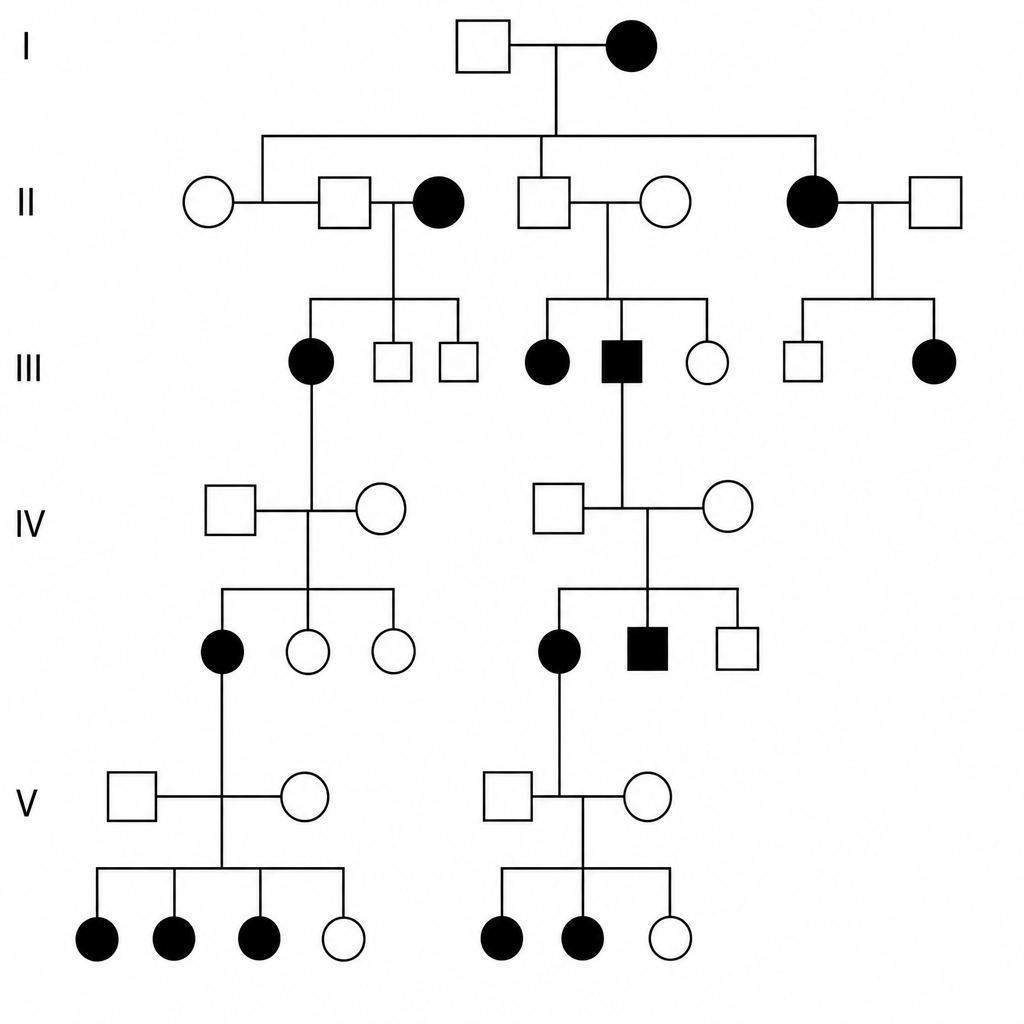
Given the pattern of inheritance shown in the pedigree, where might you find the disease gene in question?
A 36-year-old G4P0A3 woman presents at the prenatal diagnostic center at 18 weeks of gestation for the scheduled fetal anomaly scan. The patient's past medical history reveals spontaneous abortions. She reports that her 1st, 2nd, and 3rd pregnancy losses occurred at 8, 10, and 12 weeks of gestation, respectively. Ultrasonography indicates a female fetus with cystic hygroma (measuring 4 cm x 5 cm in size) and fetal hydrops. Which of the following karyotypes does her fetus most likely carry?
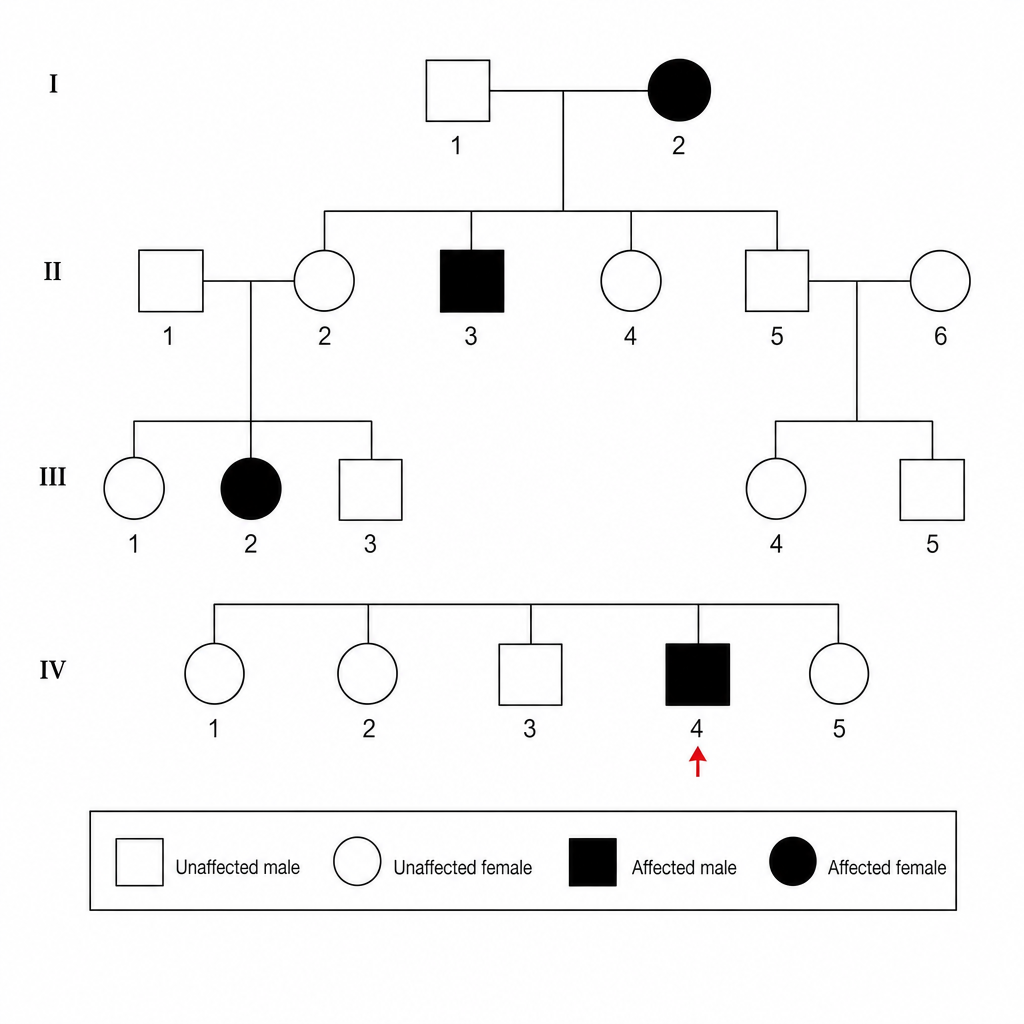
A 4-year-old boy is brought to the physician by his mother for a well-child examination. At the visit, the mother says that she is worried about the child's vision because of an “eye condition that runs in the family.” She says that the child is doing well in all activities at his preschool, except one in which he is required to sort different colored balls into baskets of a corresponding color. A pedigree chart of the family, with the patient identified by a red arrow, is shown. The most likely cause of these changes in the patient's vision involves which of the following modes of inheritance?
A 5-year-old boy is brought to a pediatrician by his parents for evaluation of learning difficulties in school. He has short stature, a flat face, low-set ears, a large tongue, and a single line on the palm. He was born to his parents after 20 years of marriage. You ordered karyotyping which will likely reveal which of the following?
A 6-year-old girl comes with her parents to the physician's office to initiate care with a new physician. The patient was recently adopted and her parents do not know her birth history; however, she has had some issues with fatigue. They were told by the adoption agency that the patient has required blood transfusions for "low blood count" in the past but they are not aware of the reason for these transfusions. Her temperature is 37.8°C (99.8°F), blood pressure is 110/84 mmHg, and pulse is 95/min. Physical examination is notable for conjunctival pallor, pale skin, and mild splenomegaly. A complete blood count is taken in the office with the following results: Hemoglobin: 6.8 g/dL Leukocyte count: 5,000/mm^3 Platelet count: 190,000/mm^3 Peripheral smear shows spherocytes and further analysis reveals rigid red blood cells. The most likely cause of this patient's symptoms has which of the following modes of inheritance?
Want unlimited practice?
Get full access to all questions, explanations, and performance tracking.
Scan to download app