
Amyloidosis — MCQs

A 72-year-old African American man presents with progressive fatigue, difficulty breathing on exertion, and lower extremity swelling for 3 months. The patient was seen at the emergency department 2 times before. The first time was because of back pain, and the second was because of fever and cough. He took medications at the emergency room, but he refused to do further tests recommended to him. He does not smoke or drink alcohol. His family history is irrelevant. His vital signs include a blood pressure of 110/80 mm Hg, temperature of 37.2°C (98.9°F), and regular radial pulse of 90/min. On physical examination, the patient looks pale, and his tongue is enlarged. Jugular veins become distended on inspiration. Pitting ankle edema is present on both sides. Bilateral basal crackles are audible on the chest auscultation. Hepatomegaly is present on abdominal palpation. Chest X-ray shows osteolytic lesions of the ribs. ECG shows low voltage waves and echocardiogram shows a speckled appearance of the myocardium with diastolic dysfunction and normal appearance of the pericardium. Which of the following best describes the mechanism of this patient’s illness?
A 65-year-old man comes to the physician because of increasing swelling of the legs and face over the past 2 months. He has a history of diastolic heart dysfunction. The liver and spleen are palpable 4 cm below the costal margin. On physical examination, both lower limbs show significant pitting edema extending above the knees and to the pelvic area. Laboratory studies show: Serum Cholesterol 350 mg/dL (<200 mg/dL) Triglycerides 290 mg/dL (35–160 mg/dL) Calcium 8 mg/dL Albumin 2.8 g/dL Urea nitrogen 54 mg/dL Creatinine 2.5 mg/dL Urine Blood 3+ Protein 4+ RBC 15–17/hpf WBC 1–2/hpf RBC casts Many Echocardiography shows concentrically thickened ventricles with diastolic dysfunction. Skeletal survey shows no osteolytic lesions. Which of the following best explains these findings?
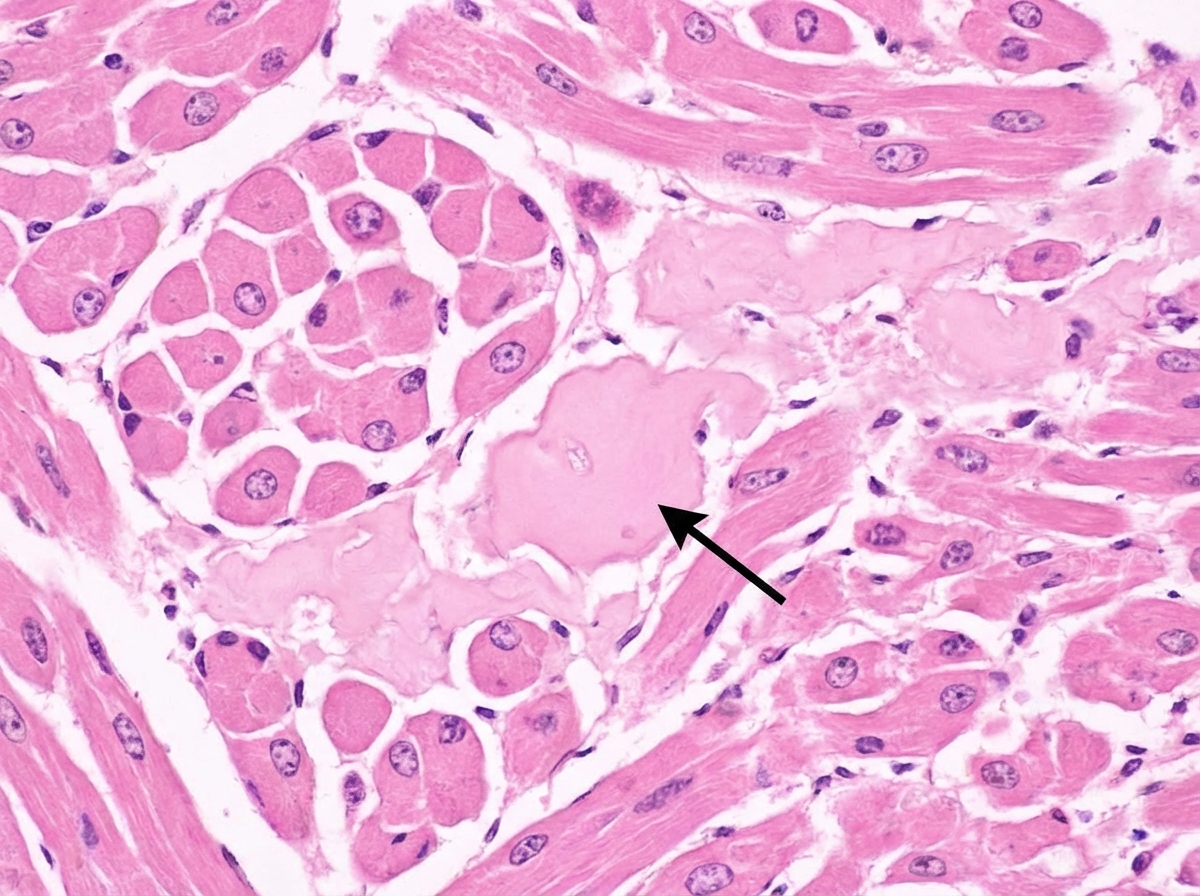
A 79-year-old homeless man is brought to the emergency department by ambulance 30 minutes after being found unresponsive by the police. On arrival, he is apneic and there are no palpable pulses. Despite appropriate life-saving measures, he dies. Examination of the heart during autopsy shows normal ventricles with a sigmoid-shaped interventricular septum. A photomicrograph of a section of the heart obtained at autopsy is shown. Which of the following is the most likely underlying cause for the structure indicated by the arrow?
A 63-year-old man presents to the emergency department with periorbital swelling. He states that he was gardening, came inside, looked in the mirror, and then noticed his eyelids were swollen. He denies pain, pruritus, or visual disturbances. He states that he was drinking “a lot of water" to prevent dehydration, because it was hot outside this morning. His medical history is significant for rheumatoid arthritis. He takes methotrexate and acetaminophen as needed. The patient’s temperature is 98°F (36.7°C), blood pressure is 168/108 mmHg, and pulse is 75/min. Physical examination is notable for periorbital edema, hepatomegaly, and bilateral 1+ pitting lower extremity edema. Labs and a urinalysis are obtained, as shown below: Leukocyte count: 11,000/mm^3 Hemoglobin: 14 g/dL Serum: Na: 138 mEq/L K+: 4.3 mEq/L Cl-: 104 mEq/L HCO3-: 25 mEq/L Urea nitrogen: 26 mg/dL Creatinine: 1.4 mg/dL Glucose: 85 mg/dL Aspartate aminotransferase (AST, GOT): 15 U/L Alanine aminotransferase (ALT, GPT): 19 U/L Albumin: 2.0 g/dL Urine: Protein: 150 mg/dL Creatinine: 35 mg/dL An abdominal ultrasound reveals an enlarged liver with heterogeneous echogenicity and enlarged kidneys with increased echogenicity in the renal parenchyma. A biopsy of the kidney is obtained. Which of the following biopsy findings is associated with the patient’s most likely diagnosis?
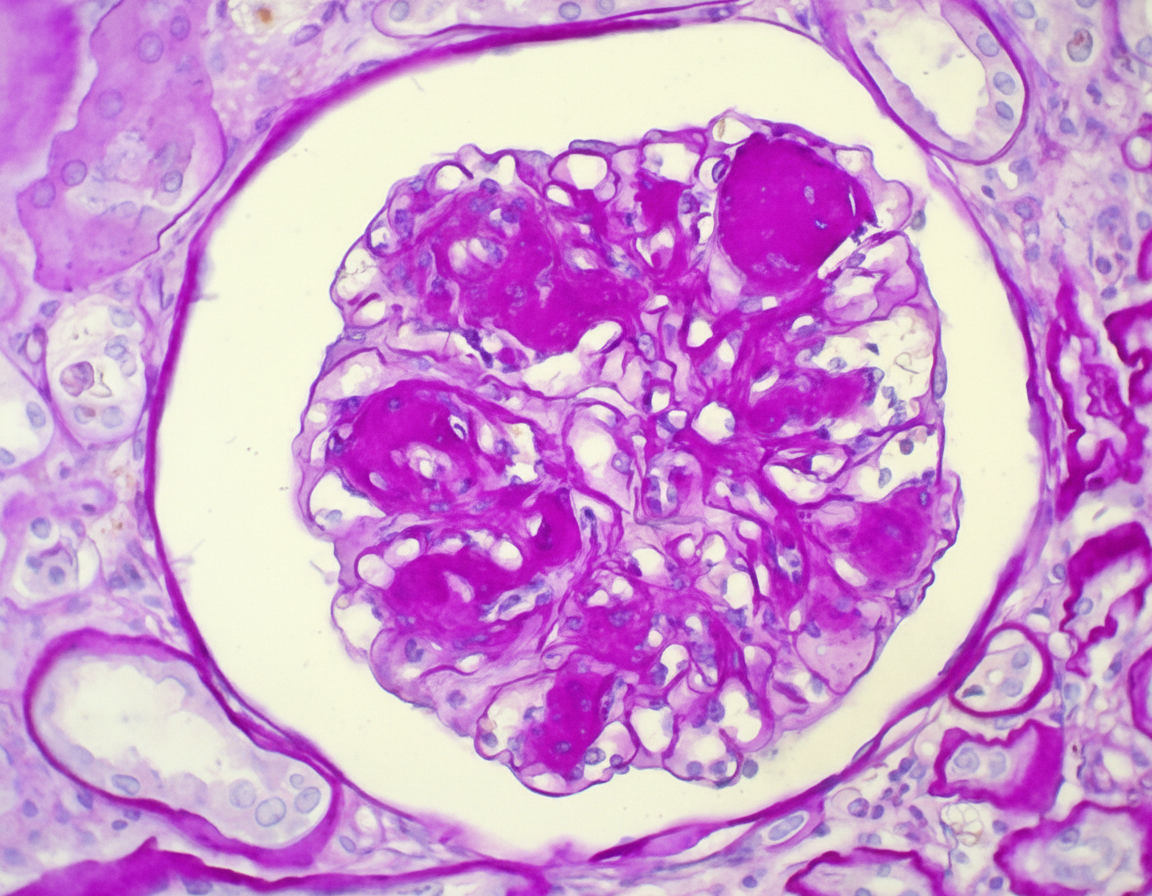
A 64-year-old man comes to the physician because of fatigue and decreased urinary frequency for 6 months. His pulse is 86/min and blood pressure is 150/90 mm Hg. Examination shows 1+ edema on bilateral ankles. His serum creatinine is 2 mg/dL and blood urea nitrogen is 28 mg/dL. Urinalysis shows proteinuria. A photomicrograph of a biopsy specimen from the patient's kidney is shown. Which of the following is the most likely explanation for the patient’s biopsy findings?
A 55-year-old man comes to the physician because of a 3-day history of decreased urine output, progressively worsening bilateral pedal edema, and fatigue. He has a 4-month history of persistent lower back pain. He has hypercholesterolemia and stable angina pectoris. Current medications include atorvastatin, aspirin, and ibuprofen. His pulse is 80/min, respirations are 16/min, and blood pressure is 150/100 mm Hg. Examination shows periorbital and pedal edema and pallor. There is tenderness of the lumbar spinal vertebrae. Straight leg raise test is negative. The remainder of the examination shows no abnormalities. Laboratory studies show: Hemoglobin 8.9 g/dl Serum Urea nitrogen 20 mg/dl Creatinine 2.4 mg/dl Calcium 11.2 mg/dl Alkaline phosphatase 140 U/L X-ray of the spine shows diffuse osteopenia and multiple lytic lesions. Which of the following is most likely to confirm the diagnosis?
A 60-year-old African American woman presents to her family physician with shortness of breath on exertion. She also describes shortness of breath when she lies down to go to bed at night, as well as recent swelling in her ankles. Past medical history is significant for long-standing hypertension, for which she takes amlodipine and lisinopril. Her temperature is 36.8°C (98.2°F), the heart rate is 90/min, the respiratory rate is 15/min, and the blood pressure is 135/80 mm Hg. The physical exam is significant for JVD, lower extremity pitting edema, laterally displaced PMI, left ventricular heave, bilateral pulmonary crackles, and an S4 heart sound. Chest X-ray demonstrates pulmonary vascular congestion, Kerley B lines, and cardiomegaly. Echocardiogram demonstrates a preserved ejection fraction. Kidney biopsy would likely demonstrate which of the following?
A 51-year-old African American man with a history of poorly controlled hypertension presents to the emergency room with blurry vision and dyspnea. He reports rapid-onset blurred vision and difficulty breathing 4 hours prior to presentation. He takes lisinopril, hydrochlorothiazide, and spironolactone but has a history of poor medication compliance. He has a 50 pack-year smoking history and drinks 4-6 shots of vodka per day. His temperature is 99.2°F (37.3°C), blood pressure is 195/115 mmHg, pulse is 85/min, and respirations are 20/min. On exam, he is ill-appearing and pale. He is intermittently responsive and oriented to person but not place or time. Fundoscopic examination reveals swelling of the optic disc with blurred margins. A biopsy of this patient’s kidney would most likely reveal which of the following?
A 41-year-old African American woman presents to her primary care physician with a 3-week history of lower extremity edema and shortness of breath. She says that she has also noticed that she gets fatigued more easily and has been gaining weight. Her past medical history is significant for sickle cell disease and HIV infection for which she is currently taking combination therapy. Physical exam is significant for periorbital and lower extremity edema. Laboratory testing is significant for hypoalbuminemia, and urinalysis demonstrates 4+ protein. Which of the following would most likely be seen on kidney biopsy in this patient?
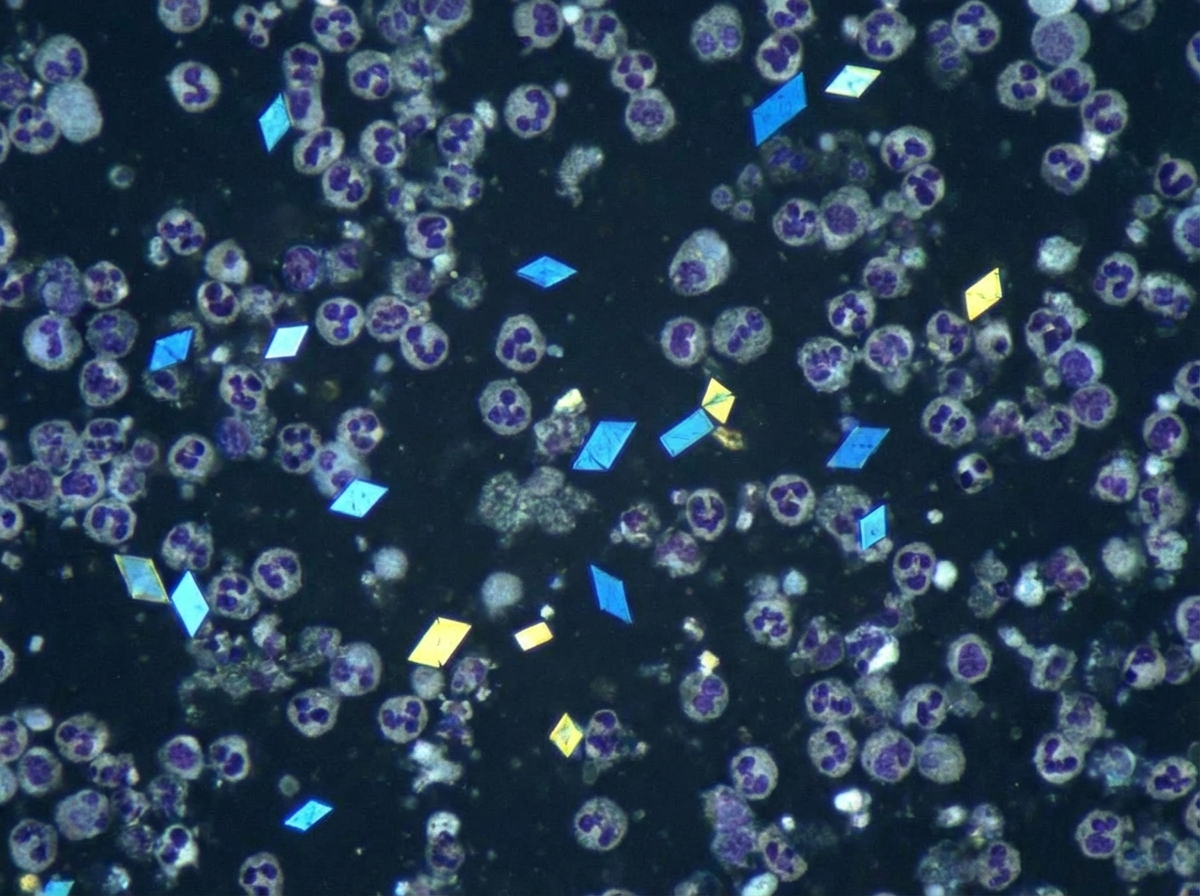
A 62-year-old man comes to the physician because of a swollen and painful right knee for the last 3 days. He has no history of joint disease. His vital signs are within normal limits. Examination shows erythema and swelling of the right knee, with limited range of motion due to pain. Arthrocentesis of the right knee joint yields 7 mL of cloudy fluid with a leukocyte count of 29,000/mm3 (97% segmented neutrophils). Compensated polarized light microscopy of the aspirate is shown. Which of the following is the most likely underlying mechanism of this patient's knee pain?
Want unlimited practice?
Get full access to all questions, explanations, and performance tracking.
Scan to download app