
Multiple endocrine neoplasia syndromes — MCQs

A 27-year-old man comes to the physician because of worsening abdominal pain over the last several months. He has also had recent feelings of sadness and a lack of motivation at work, where he is employed as a computer programmer. He denies suicidal thoughts. He has a history of multiple kidney stones. He has a family history of thyroid cancer in his father and uncle, who both underwent thyroidectomy before age 30. His temperature is 37°C (98°F), blood pressure is 138/86 mm Hg, and pulse is 87/min. Physical examination shows diffuse tenderness over the abdomen and obesity but is otherwise unremarkable. Serum studies show: Na+ 141 mEq/L K+ 3.6 mEq/L Glucose 144 mg/dL Ca2+ 12.1 mg/dL Albumin 4.1 g/dL PTH 226 pg/mL (normal range 12–88 pg/mL) Results of a RET gene test return abnormal. The physician refers him to an endocrine surgeon. Which of the following is the most appropriate next step in diagnosis?
A 37-year-old woman comes to the physician for a 6-month history of headaches, anorexia, and vomiting. She has had a 10-kg (22-lb) weight loss during this period. She has type 1 diabetes mellitus for which she takes insulin. The patient's mother and sister have hypothyroidism. Her blood pressure is 80/60 mm Hg. Physical examination shows hyperpigmentation of the lips and oral mucosa. Serum studies show a parathyroid hormone level of 450 pg/mL and antibodies directed against 21-hydroxylase. Which of the following is the most likely diagnosis?
A 10-year-old boy is brought by his mother to his pediatrician for "skin growths." His mother reports that she started noticing small lumps arising from the patient's lips and eyelids several months ago. She also notes that he seems to suffer from frequent constipation and appears "weaker" than many of his peers. The boy's past medical history is unremarkable. His father and paternal grandmother have a history of medullary thyroid carcinoma. His height and weight are in the 85th and 45th percentiles, respectively. His temperature is 99°F (37.1°C), blood pressure is 110/65 mmHg, pulse is 90/min, and respirations are 18/min. On examination, he has an elongated face with protruding lips. There are numerous sessile painless nodules on the patient's lips, tongue, and eyelids. This patient's condition is most strongly associated with a mutation in which of the following genes?
A 74-year-old retired female teacher is referred to the endocrinology clinic. She is very concerned about a large mass in her neck that has progressively enlarged over the past 2 weeks. She also reports a 15 pound weight loss over the last 3 months. She now has hoarseness and difficulty swallowing her food, giving her a sensation that food gets stuck in her windpipe when she swallows. There is no pain associated with swallowing. Her speech is monotonous. No other gait or language articulation problems are noted. Testing for cranial nerve lesions is unremarkable. On palpation, a large, fixed and non-tender mass in the thyroid is noted. Cervical lymph nodes are palpable bilaterally. The patient is urgently scheduled for an ultrasound-guided fine needle aspiration to guide management. Which of the following is the most likely gene mutation to be found in this mass?
A 45-year-old woman comes to see you for a second opinion regarding an upcoming surgery for pancreatic insulinoma. While taking a surgical history, she tells you she previously had a pituitary tumor resected. For which additional neoplasms might you consider testing her?
A 27-year-old man comes to the physician because of a 4-month history of recurrent episodes of headaches, palpitations, and sweating. He was adopted shortly after birth and does not know his biological parents. His pulse is 103/min and blood pressure is 160/105 mm Hg. Physical examination shows multiple soft, yellow papules on the tip of the tongue. There is a 2-cm, firm thyroid nodule. He has long and slender upper extremities, and his elbows and knees can be hyperextended. The most likely cause of this patient's condition is a mutation in which of the following genes?
A 38-year-old female presents to her primary care physician with complaints of several episodes of palpitations accompanied by panic attacks over the last month. She also is concerned about many instances over the past few weeks where food has been getting stuck in her throat and she has had trouble swallowing. She denies any prior medical problems and reports a family history of cancer in her mother and maternal grandfather but cannot recall any details regarding the type of cancer(s) or age of diagnosis. Her vital signs at today's visit are as follows: T 37.6 deg C, HR 106, BP 158/104, RR 16, SpO2 97%. Physical examination is significant for a nodule on the anterior portion of the neck that moves with swallowing, accompanied by mild lymphadenopathy. A preliminary work-up is initiated, which shows hypercalcemia, elevated baseline calcitonin, and an inappropriately elevated PTH level. Diagnostic imaging shows bilateral adrenal lesions on an MRI of the abdomen/pelvis. Which of the following is the most likely diagnosis in this patient?
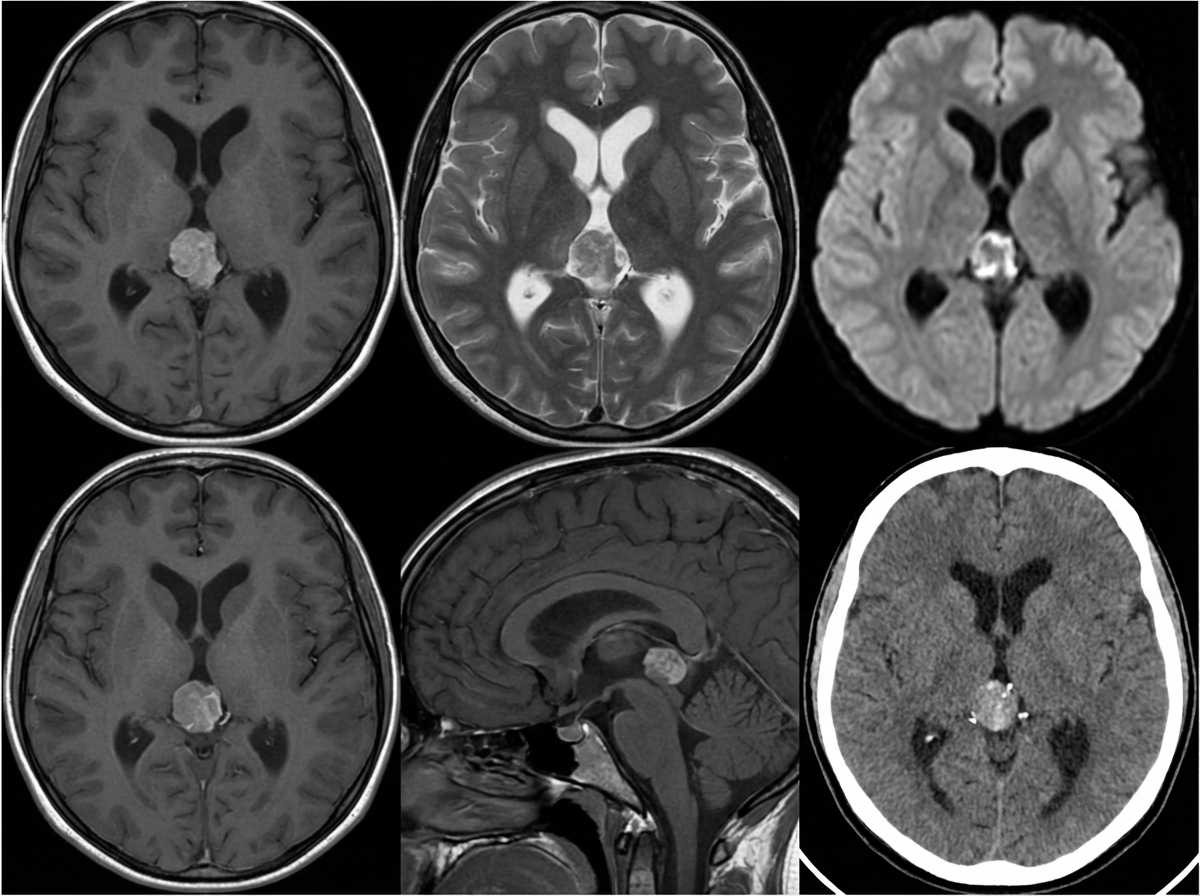
A 10-year-old girl is brought to the physician by her parents due to 2 months of a progressively worsening headache. The headaches were initially infrequent and her parents attributed them to stress from a recent move. However, over the last week the headaches have gotten significantly worse and she had one episode of vomiting this morning when she woke up. Her medical history is remarkable for a hospitalization during infancy for bacterial meningitis. On physical exam, the patient has difficulty looking up. The lower portion of her pupil is covered by the lower eyelid and there is sclera visible below the upper eyelid. A magnetic resonance imaging (MRI) of the brain is shown. Which of the following is the most likely diagnosis?
A 40-year-old man presents with a painless firm mass in the right breast. Examination shows retraction of the nipple and the skin is fixed to the underlying mass. The axillary nodes are palpable. Which of the following statements is FALSE regarding the above condition?
A 4-month-old boy with a history of multiple infections presents with muscle stiffness. On physical exam, he is found to have carpopedal spasm as well as a heart murmur. Based on your clinical suspicion you decide to obtain a chest X-ray which shows a diminished shadow in the mediastinum. A mutation in which of the following chromosomes is the most likely cause of this patient's presentation?
Want unlimited practice?
Get full access to all questions, explanations, and performance tracking.
Scan to download app