
Endocrine disorders in pregnancy — MCQs

A 27-year-old G1P0 at 12 weeks estimated gestational age presents for prenatal care. The patient says she has occasional nausea and vomiting and a few episodes of palpitations and diarrhea this last week. Physical examination is unremarkable, except for a heart rate of 145/min. Basic thyroid function tests are shown in the table below. Which of the following additional laboratory tests would be most useful in assessing this patient's condition? Thyroid-stimulating hormone (TSH) 0.28 mIU/L (0.3–4.5 mIU/L) Total T4 12 µg/dL (5.4–11.5 µg/dL)
A 25-year-old pregnant woman at 28 weeks gestation presents with a headache. Her pregnancy has been managed by a nurse practitioner. Her temperature is 99.0°F (37.2°C), blood pressure is 164/104 mmHg, pulse is 100/min, respirations are 22/min, and oxygen saturation is 98% on room air. Physical exam is notable for a comfortable appearing woman with a gravid uterus. Laboratory tests are ordered as seen below. Hemoglobin: 12 g/dL Hematocrit: 36% Leukocyte count: 6,700/mm^3 with normal differential Platelet count: 100,500/mm^3 Serum: Na+: 141 mEq/L Cl-: 101 mEq/L K+: 4.4 mEq/L HCO3-: 25 mEq/L BUN: 21 mg/dL Glucose: 99 mg/dL Creatinine: 1.0 mg/dL AST: 32 U/L ALT: 30 U/L Urine: Color: Amber Protein: Positive Blood: Negative Which of the following is the most likely diagnosis?
A 30-year-old woman presents for pregnancy counseling. She says she has an 8-week history of chronic diarrhea. She is also found to be intolerant to heat and has been significantly losing her hair. She denies any recent changes to her diet. The patient is afebrile and her vital signs are within normal limits. Her weight today is 45.0 kg (99.2 lb) which is 4.5 kg (10 lb) less than her weight during her last visit 2 months back. On physical examination, the patient is anxious and has a non-intention tremor. Significant exophthalmos is present. Laboratory findings are significant for a low TSH, elevated free T4 and free T3, and a positive thyroid stimulating immunoglobulin assay. She still wants to conceive a baby and asks for an appropriate treatment that is safe in pregnancy. Which of the following best describes the therapy she will most likely receive during her pregnancy for her thyroid disorder?
A 31-year-old G3P2 who is at 24 weeks gestation presents for a regular check-up. She has no complaints, no concurrent diseases, and her previous pregnancies were vaginal deliveries with birth weights of 3100 g and 4180 g. The patient weighs 78 kg (172 lb) and is 164 cm (5 ft 5 in) in height. She has gained 10 kg (22 lb) during the current pregnancy. Her vital signs and physical examination are normal. The plasma glucose level is 190 mg/dL after a 75-g oral glucose load. Which of the listed factors contributes to the pathogenesis of the patient’s condition?
A 23-year-old G1P0 primigravid woman at 28 weeks estimated gestational age presents for a prenatal checkup. She says she has been having occasional headaches but is otherwise fine. The patient says she feels regular fetal movements and mild abdominal pain at times. Her past medical history is unremarkable. Current medications are a prenatal multivitamin and the occasional acetaminophen. Her blood pressure is 148/110 mm Hg today. On her last visit at 24 weeks of gestation, her blood pressure was 146/96 mm Hg. On physical exam, the fundus measures 28 cm above the pubic symphysis. Laboratory findings are significant for the following: Serum Glucose (fasting) 88 mg/dL Sodium 142 mEq/L Potassium 3.9 mEq/L Chloride 101 mEq/L Serum Creatinine 0.9 mg/dL Blood Urea Nitrogen 10 mg/dL Alanine aminotransferase (ALT) 18 U/L Aspartate aminotransferase (AST) 16 U/L Mean Corpuscular Volume (MCV) 85 fL Leukocyte count 4,200/mm3 Reticulocyte count 1% Erythrocyte count 5.1 million/mm3 Platelet count 95,000mm3 Urinalysis show: Proteins 2+ Glucose negative Ketones negative Leucocytes negative Nitrites negative Red Blood Cells (RBCs) negative Casts negative Which of the following medications would be the next best step in the treatment of this patient?
A 34-year-old woman, who had her first child 2 weeks ago, visits her family physician with concerns about constant fatigue and difficulty with breastfeeding. She was discharged from the intensive care unit after hospitalization for severe postpartum hemorrhage. Since then, she has tried multiple pumps and self-stimulation to encourage breast milk production; however, neither of these strategies has worked. Her blood pressure is 88/56 mm Hg and heart rate is 120/min. Which of the following best explains the underlying condition of this patient?
A 26-year-old primigravid woman at 25 weeks' gestation comes to the physician for a prenatal visit. She has no history of serious illness and her only medication is a daily prenatal vitamin. A 1-hour 50-g glucose challenge shows a glucose concentration of 167 mg/dL (N < 135). A 100-g oral glucose tolerance test shows glucose concentrations of 213 mg/dL (N < 180) and 165 mg/dL (N < 140) at 1 and 3 hours, respectively. If she does not receive adequate treatment for her condition, which of the following complications is her infant at greatest risk of developing?
A 43-year-old man presents to the emergency department following a work-related accident in which both arms were amputated. The patient lost a substantial amount of blood prior to arrival, and his bleeding is difficult to control due to arterial damage and wound contamination with debris. His complete blood count (CBC) is significant for a hemoglobin (Hgb) level of 5.3 g/dL. The trauma surgery resident initiates the massive transfusion protocol and orders whole blood, O negative, which she explains is the universal donor. The patient receives 6 units of O negative blood prior to admission. He subsequently develops fever, chills, hematuria, and pulmonary edema. Several hours later, the patient goes into hemodynamic shock requiring the emergent administration of vasopressors. Of the following options, which hypersensitivity reaction occurred?
As part of a clinical research study, microscopic analysis of tissues obtained from surgical specimens is performed. Some of these tissues have microscopic findings of an increase in the size of numerous cells within the tissue with an increase in the amount of cytoplasm, but the nuclei are uniform in size. Which of the following processes shows such microscopic findings?
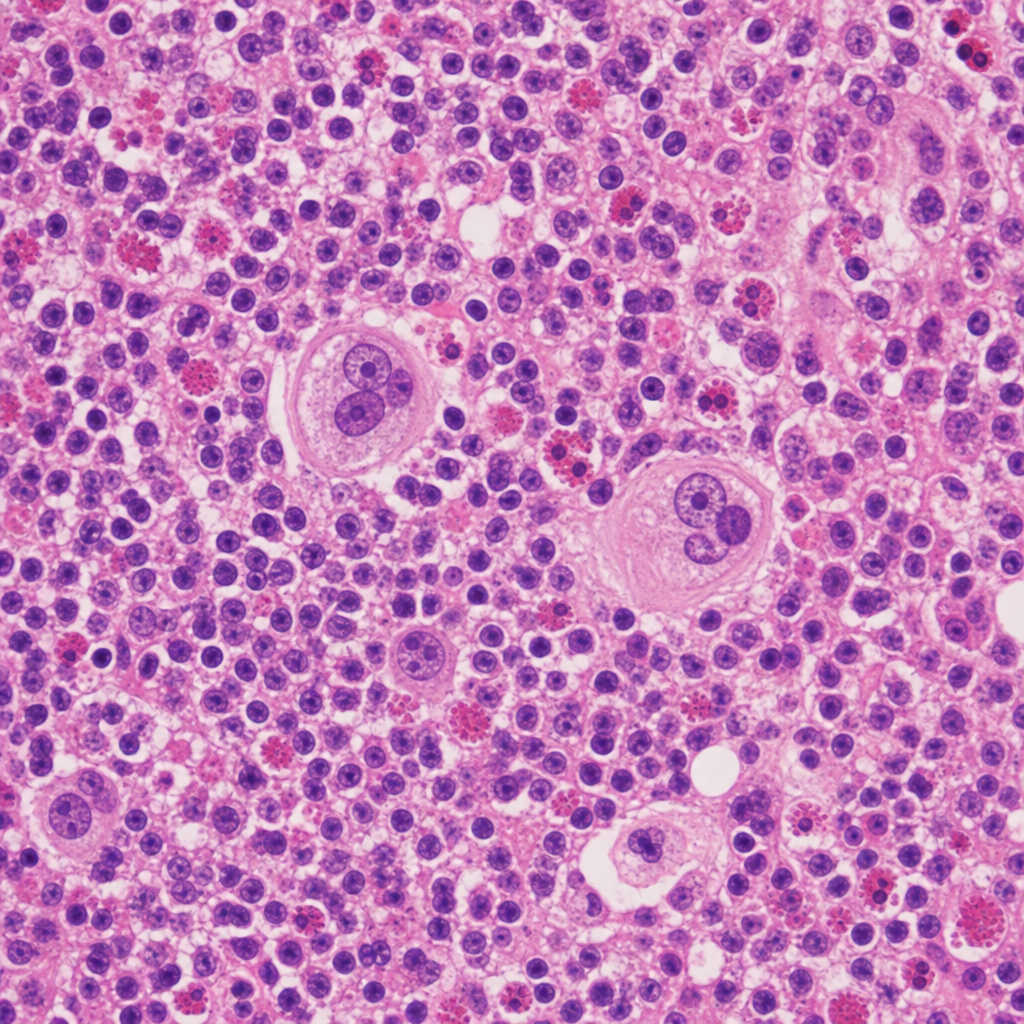
A 28-year-old man presents with painless cervical lymphadenopathy. Excisional lymph node biopsy is performed. The photomicrograph shows effacement of normal nodal architecture by a mixed infiltrate of lymphocytes, plasma cells, eosinophils, and neutrophils. Scattered among the infiltrate are large binucleated cells with prominent eosinophilic 'owl-eye' nucleoli. Immunohistochemistry shows these large cells are CD15+, CD30+, CD20−, and CD45−. Which of the following cell types represents the malignant population in this lesion?
Want unlimited practice?
Get full access to all questions, explanations, and performance tracking.
Scan to download app