
Pathologic calcification — MCQs

A 57-year-old man comes to the emergency department for the evaluation of worsening fatigue, urinary frequency, and constipation over the past 5 days. He was recently diagnosed with metastatic bladder cancer and is currently awaiting treatment. He has smoked 1 pack of cigarettes daily for 35 years. Physical examination shows dry mucous membranes and diffuse abdominal tenderness. An ECG shows a shortened QT interval. Which of the following sets of serum findings is most likely in this patient? $$$ Calcium %%% Phosphorus %%% Parathyroid hormone %%% 1,25-dihydroxyvitamin D $$$
A 17-year-old boy comes to the physician for a follow-up examination. Two months ago, he suffered a spinal fracture after a fall from the roof. He feels well. His father has multiple endocrine neoplasia type 1. Vital signs are within normal limits. Examination shows no abnormalities. Laboratory studies show: Hemoglobin 13.7 g/dL Serum Creatinine 0.7 mg/dL Proteins Total 7.0 g/dL Albumin 4.1 g/dL Calcium 11.4 mg/dL Phosphorus 5.3 mg/dL Alkaline phosphatase 100 U/L Which of the following is the most likely cause of these findings?
A 37-year-old female presents to her primary care physician with constipation and abdominal pain. She notes that the pain has been present for several days and is not related to food. She also reports increased urinary frequency without incontinence, as well as increased thirst. She takes no medications, but notes taking vitamin supplements daily. Her vital signs are: BP 130/72 mmHg, HR 82 bpm, T 97.0 degrees F, and RR 12 bpm. Lab studies reveal: Na 139, K 4.1, Cl 104, HCO3 25, Cr 0.9, and Ca 12.4. Further studies show an increased ionized calcium, decreased PTH, and normal phosphate. What is the most likely cause of this patient's symptoms?
A 28-year-old African American woman presents to her primary care physician with two weeks of nausea, abdominal pain, and increased urination. She states she has had kidney stones in the past and is concerned because her current pain is different in character from what she had experienced then. In addition she reports increasing weakness and fatigue over the past several months as well as mild shortness of breath. Chest radiography shows bilateral hilar adenopathy. Which of the following processes is most likely responsible for her current symptoms?
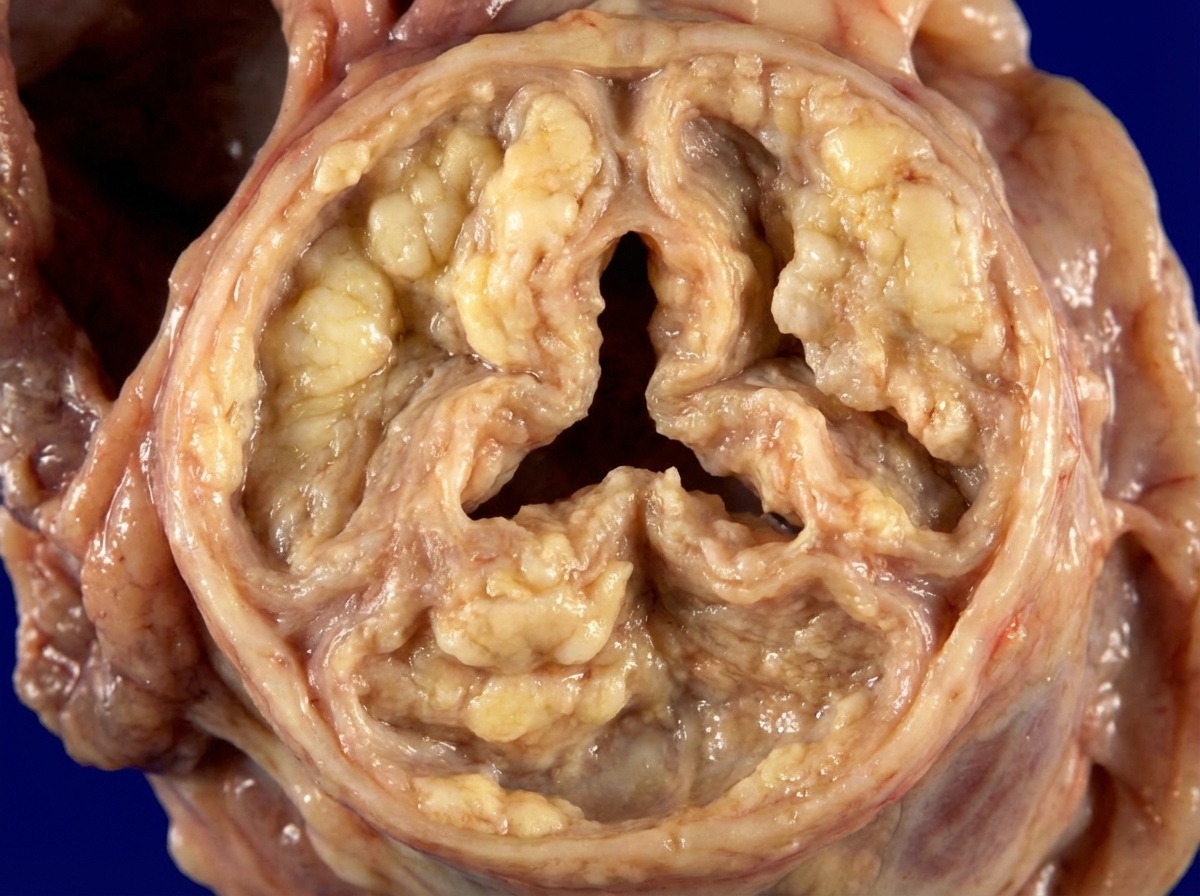
A 72-year-old man who was involved in a traffic collision is brought to the emergency room by the ambulance service. He was in shock and comatose at the time of presentation. On examination, the heart rate is 60/min, and the blood pressure is 70/40 mm Hg. The patient dies, despite resuscitative efforts. Autopsy reveals multiple internal hemorrhages and other evidence of ischemic damage affecting the lungs, kidneys, and brain. The patient’s heart shows evidence of gross anomaly similar to the picture. While acute hypovolemia is the likely cause of the ischemic changes seen in the lungs, kidneys, and brain, which of the following best explains the gross anomaly of his heart?
A 65-year-old man comes to the physician for evaluation of a neck mass and weight loss. He first noticed the growing mass 2 months ago. The mass is not painful. He also has decreased appetite and intermittent abdominal pain. He has lost 10 kg (22 lb) of weight over the past 3 months. Sometimes, he wakes up in the morning drenched in sweat. He takes daily over-the-counter multivitamins. He appears pale. His pulse is 65/min, blood pressure is 110/70 mm Hg, and temperature is 38.1°C (100.6°F). Physical exam shows a painless, golf ball-sized mass in the anterior triangle of the neck. A biopsy shows large cells with a bilobed nucleus that are CD15-positive and CD30-positive. Laboratory analysis of serum shows a calcium level of 14.5 mg/dL and a parathyroid hormone level of 40 pg/mL. Which of the following is the most likely explanation of this patient's laboratory findings?
An 11-year-old male is brought in by ambulance to the emergency department after being a restrained passenger in a motor vehicle accident. His father was driving him to soccer practice when they were hit by a wrong way driver. On presentation, his temperature is 101°F (38.3°C), blood pressure is 100/62 mmHg, pulse is 108/min, and respirations are 21/min. He is found to be agitated and complains of nausea, severe epigastric pain, and lower extremity pain. Physical exam reveals lacerations and ecchymosis on his left forehead, right flank, and lower extremities. Radiographs demonstrate an open book fracture of the pelvis as well as bilateral femur fractures. Despite multiple interventions, his condition deteriorates and he passes away from his injuries. Post-mortem pathologic examination of abdominal tissues reveals white deposits containing calcium. Abnormal activity of which of the following proteins is most likely responsible for these deposits?
A 13-year-old girl is brought to the outpatient clinic by her parents with a complaint of episodic spasm in her fingers for the past few months. Upon further questioning, her mother notes that the girl has not been doing well at school. She also believes that the girl is shorter than the other children in her class. On examination, her pulse is 72/min, temperature 37.6°C (99.7°F), respiratory rate 16/min, and blood pressure 120/88 mm Hg. The girl has short 4th and 5th fingers on both hands, a round face, and discolored teeth. Her height is 135 cm (4 ft 5 in) and she weighs 60 kg (132 lb). Investigation reports show the following values: Hemoglobin (Hb%) 12.5 g/dL White blood cell total count 10,000/mm3 Platelets 260,000/mm3 Calcium, serum (Ca2+) 4.0 mg/dL Serum albumin 4.0 g/dL Alanine aminotransferase (ALT), serum 15 U/L Aspartate aminotransferase (AST), serum 8 U/L Serum creatinine 0.5 mg/dL Urea 27 mg/dL Sodium 137 mEq/L Potassium 4.5 mEq/L Magnesium 2.5 mEq/L Parathyroid hormone, serum, N-terminal 930 pg/mL (normal: 230-630 pg/mL) Serum vitamin D 45 ng/dL Which of the following is the mode of inheritance of the disease this patient has?
A 32-year-old woman presents to her primary care physician for an annual checkup. She reports that she has been feeling well and has no medical concerns. Her past medical history is significant for childhood asthma but she has not experienced any symptoms since she was a teenager. Physical exam reveals a 1-centimeter hard mobile mass in the left upper outer quadrant of her breast. A mammogram was performed and demonstrated calcifications within the mass so a biopsy was obtained. The biopsy shows acinar proliferation with intralobular fibrosis. Which of the following conditions is most likely affecting this patient?
A 36-year-old man is admitted to the hospital because of a 1-day history of epigastric pain and vomiting. He has had similar episodes of epigastric pain in the past. He drinks 8 oz of vodka daily. Five days after admission, the patient develops aspiration pneumonia and sepsis. Despite appropriate therapy, the patient dies. At autopsy, the pancreas appears gray, enlarged, and nodular. Microscopic examination of the pancreas shows localized deposits of calcium. This finding is most similar to an adaptive change that can occur in which of the following conditions?
Want unlimited practice?
Get full access to all questions, explanations, and performance tracking.
Scan to download app