
Autophagy mechanisms — MCQs

An investigator is studying the function of the endoplasmic reticulum in genetically modified lymphocytes. A gene is removed that facilitates the binding of ribosomes to the endoplasmic reticulum. Which of the following processes is most likely to be impaired as a result of this genetic modification?
A medical student is studying digestive enzymes at the brush border of the duodenum. He isolates and inactivates an enzyme in the brush border that has a high affinity for the pancreatic proenzyme trypsinogen. When the enzyme is inactivated, trypsinogen is no longer converted to its active form. Which of the following is the most likely underlying mechanism of this enzyme?
DNA replication is a highly complex process where replication occurs on both strands of DNA. On the leading strand of DNA, replication occurs uninterrupted, but on the lagging strand, replication is interrupted and occurs in fragments called Okazaki fragments. These fragments need to be joined, which of the following enzymes is involved in the penultimate step before ligation can occur?
A 59-year-old man is brought to the physician by his wife for a psychiatric evaluation. Over the past 12 months, his behavior has become increasingly disruptive. His wife no longer brings him along shopping because he has attempted to grope a female cashier on 2 occasions. He has begun to address the mail carrier using a racial epithet. Three years later, the patient dies. Light microscopy of sections of the frontal and temporal lobes shows intracellular inclusions of transactive response DNA binding protein (TDP-43). These proteins are bound to a regulatory molecule that usually marks them for degradation. The regulatory molecule in question is most likely which of the following?
An investigator is studying a hereditary defect in the mitochondrial enzyme succinyl-CoA synthetase. In addition to succinate, the reaction catalyzed by this enzyme produces a molecule that is utilized as an energy source for protein translation. This molecule is also required for which of the following conversion reactions?
A group of scientists is studying the mechanism of action of various pancreatic hormones in rats. The scientists studied hormone A, which is secreted by the β-cells of the pancreas, and found that hormone A binds to a complex dimeric receptor on the cell membrane and exerts its effects via phosphorylation and subsequent downstream signaling that includes dephosphorylation of different intracellular proteins. Now they are studying hormone B, which is secreted by the α-cells and antagonizes the actions of hormone A. Which 2nd messenger system would hormone B utilize to exert its cellular effects?
In large neurons the nucleus can be found a large distance away from the terminal end of its axon. The body has a complex system of intracellular transporters that are able to carry essential proteins from the nucleus to the distal edge of the cell and back. Which of the following proteins are essential for this function?
A startup is working on a novel project in which they claim they can replicate the organelle that is defective in MELAS syndrome. Which of the following metabolic processes must they be able to replicate if their project is to mimic the metabolic processes of this organelle?
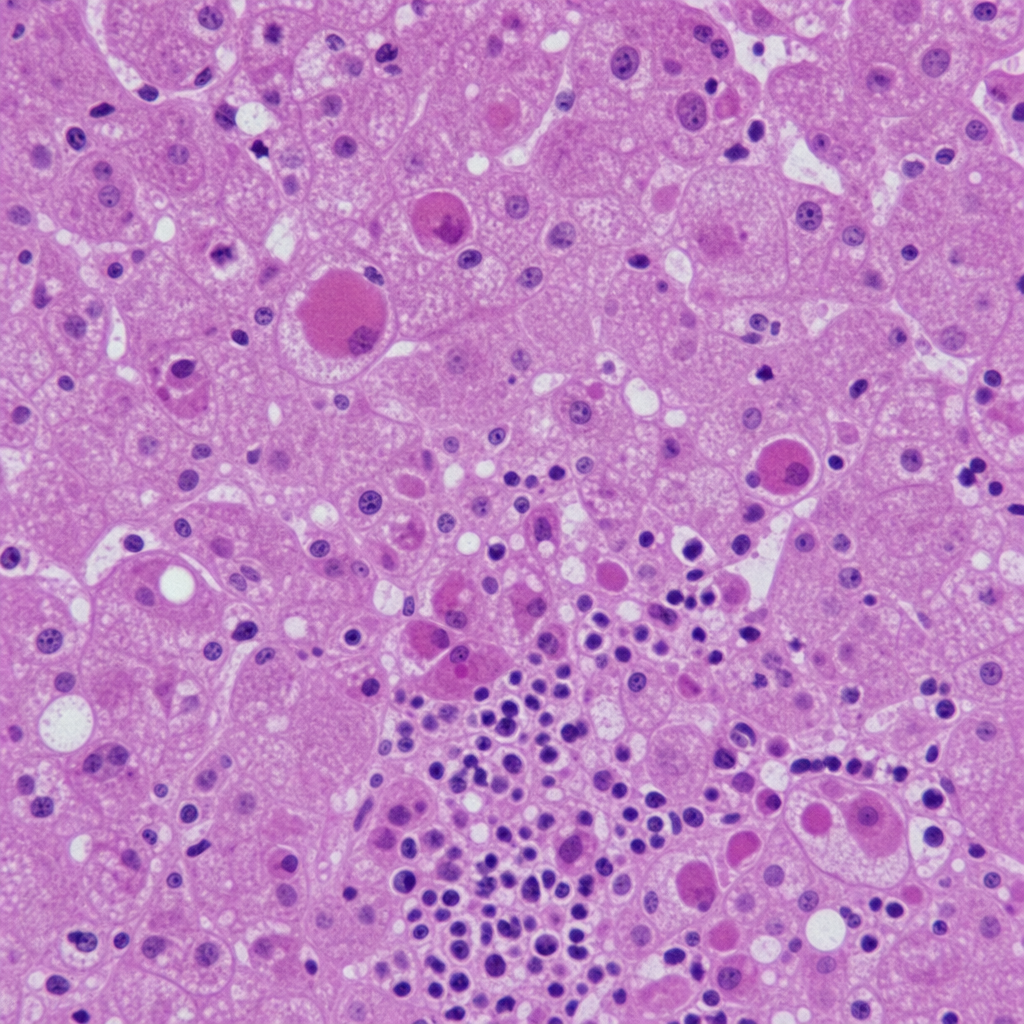
A 55-year-old man with a long history of alcohol use disorder presents with jaundice, tender hepatomegaly, and fever. A liver biopsy is performed. The biopsy demonstrates hepatocytes containing irregular rope-like eosinophilic cytoplasmic inclusions, ballooning degeneration of hepatocytes, neutrophilic infiltration predominantly in zone 3 (centrilobular region), and scattered acidophil bodies. Which of the following best identifies the cytoplasmic inclusions depicted and their composition?
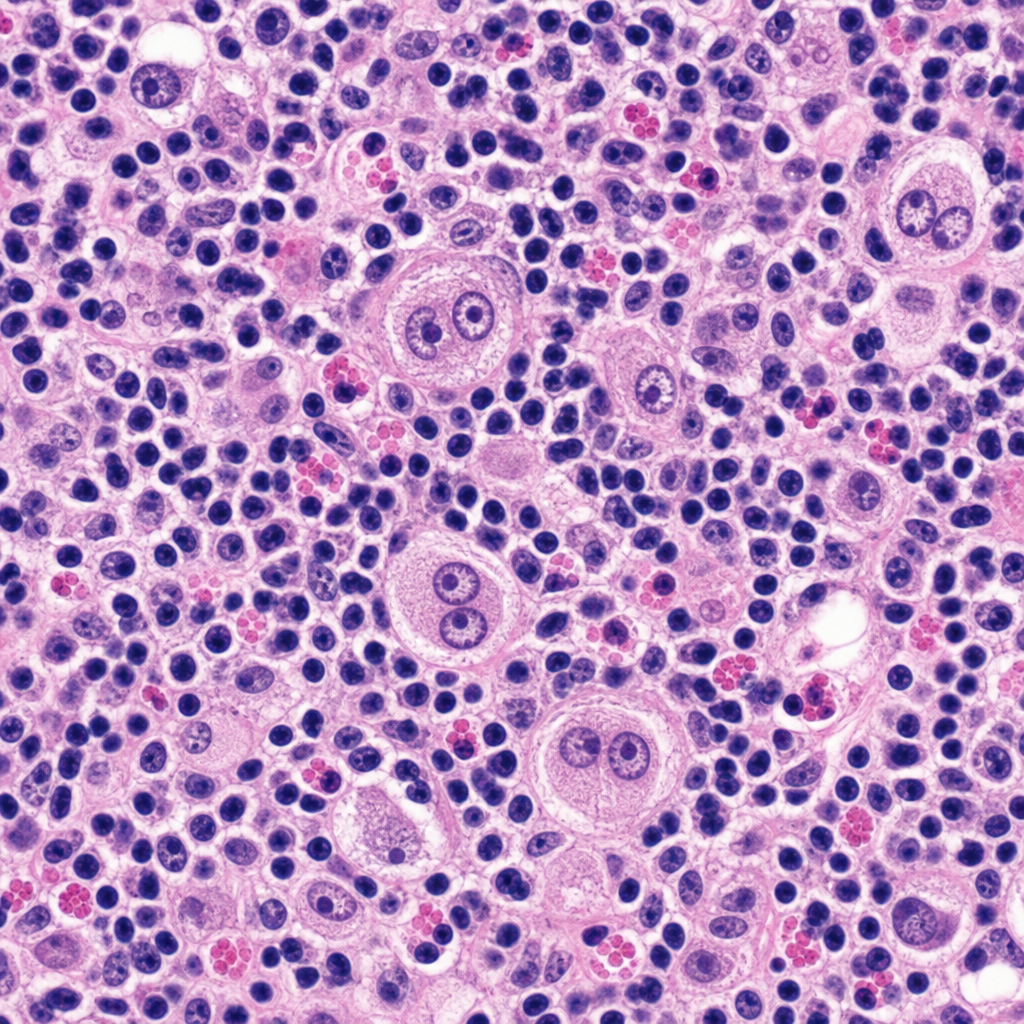
A 34-year-old woman presents with fatigue, night sweats, and a painless cervical lymph node enlargement for 3 months. A lymph node biopsy is performed. The photomicrograph shows a mixed cellular infiltrate of lymphocytes, plasma cells, eosinophils, and scattered large binucleated cells with prominent eosinophilic 'owl-eye' nucleoli; the large cells stain positive for CD15 and CD30 and negative for CD45. Which of the following cell types is the neoplastic cell of origin in this condition?
Want unlimited practice?
Get full access to all questions, explanations, and performance tracking.
Scan to download app