
Congenital heart defects — MCQs

A 2-year-old boy is presented to the pediatrician due to poor weight gain and easy fatigability. His mother states that the patient barely engages in any physical activity as he becomes short of breath easily. The prenatal and birth histories are insignificant. Past medical history includes a few episodes of upper respiratory tract infection that were treated successfully. The patient is in the 10th percentile for weight and 40th percentile for height. The vital signs include: heart rate 122/min and respirations 32/min. Cardiac auscultation reveals clear lungs and a grade 2/6 holosystolic murmur loudest at the left lower sternal border. The remainder of the physical examination is negative for clubbing, cyanosis, and peripheral edema. Which of the following is the most likely diagnosis in this patient?
A 38-year-old woman, gravida 2, para 1, at 24 weeks' gestation comes to the physician for a routine prenatal evaluation. She has no history of major medical illness and takes no medications. Fetal ultrasonography shows a cardiac defect resulting from abnormal development of the endocardial cushions. This defect is most likely to result in which of the following?
A 9-year-old boy is brought to the office due to exertional dyspnea and fatigability. He tires easily when walking or playing. His parents say that he was diagnosed with a congenital heart disease during his infancy, but they refused any treatment. They do not remember much about his diagnosis. The patient also had occasional respiratory infections throughout childhood that did not require hospitalization. He takes no medications. The patient has no family history of heart disease. His vital signs iclude: heart rate 98/min, respiratory rate 16/min, temperature 37.2°C (98.9°F), and blood pressure of 110/80 mm Hg. Physical examination shows toe cyanosis and clubbing but no finger abnormalities. Cardiac auscultation reveals a continuous machine-like murmur. All extremity pulses are full and equal. Which of the following is the most likely diagnosis?
A 4-year-old Caucasian male suffers from cyanosis and dyspnea relieved by squatting. Which of the following abnormalities is most likely present?
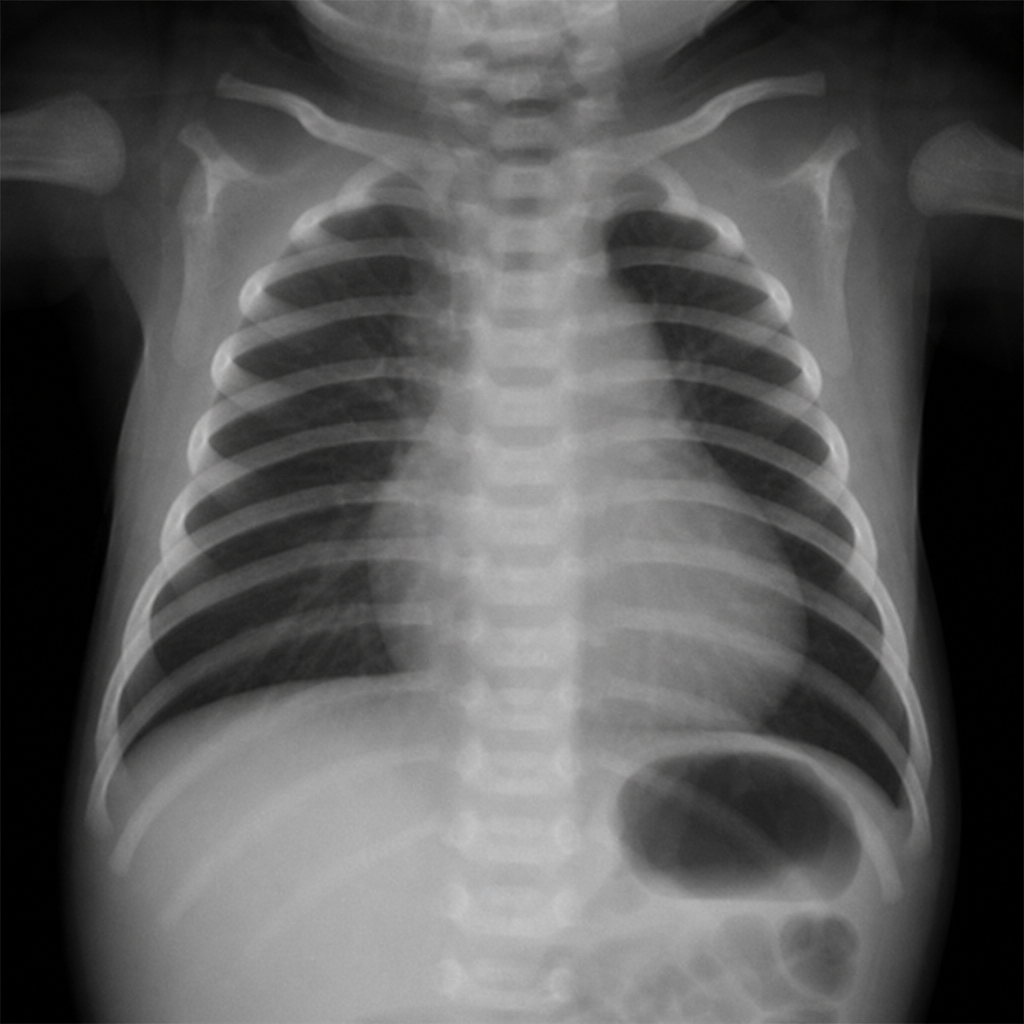
A 1-day-old infant born at full term by uncomplicated spontaneous vaginal delivery is noted to have cyanosis of the oral mucosa. The baby otherwise appears comfortable. On examination, his respiratory rate is 40/min and pulse oximetry is 80%. His left thumb is displaced and hypoplastic. A right ventricular lift is palpated, S1 is normal, S2 is single, and a harsh 3/6 systolic ejection murmur is heard at the left upper sternal border. Chest X-ray is shown. Which of the following is the most likely diagnosis?
A 3-year-old boy is brought to the physician because of recurrent nosebleeds and fatigue for the past 2 months. He also frequently complains his head hurts. The patient has met all motoric milestones for his age but does not like to run because his legs start to hurt if he does. He is at the 40th percentile for both height and weight. His temperature is 37.0°C (98.6°F), pulse is 125/min, respirations are 32/min, and blood pressure in the right arm is 130/85 mm Hg. A grade 2/6 systolic murmur is heard in the left paravertebral region. Further evaluation of this patient is most likely to show which of the following findings?
A 1-year-old infant is brought to the emergency department by his parents because of fever and rapid breathing for the past 2 days. He had a mild seizure on the way to the emergency department and developed altered sensorium. His mother states that the patient has had recurrent respiratory infections since birth. He was delivered vaginally at term and without complications. He is up to date on his vaccines and has met all developmental milestones. His temperature is 37.0°C (98.6°F), pulse rate is 200/min, and respirations are 50/min. He is lethargic, irritable, and crying excessively. Physical examination is notable for a small head, an elongated face, broad nose, low set ears, and cleft palate. Cardiopulmonary exam is remarkable for a parasternal thrill, grade IV pansystolic murmur, and crackles over both lung bases. Laboratory studies show hypocalcemia and lymphopenia. Blood cultures are drawn and broad-spectrum antibiotics are started, and the child is admitted to the pediatric intensive care unit. The intensivist suspects a genetic abnormality and a fluorescence in situ hybridization (FISH) analysis is ordered which shows 22q11.2 deletion. Despite maximal therapy, the infant succumbs to his illness. The parents of the child request an autopsy. Which of the following findings is the most likely to be present on autopsy?
A 25-year-old woman, gravida 2, para 1, comes to the physician for her initial prenatal visit at 18 weeks’ gestation. She is a recent immigrant from Thailand. Her history is significant for anemia since childhood that has not required any treatment. Her mother and husband have anemia, as well. She has no history of serious illness and takes no medications. Her vital signs are within normal limits. Fundal height measures at 22 weeks. Ultrasound shows polyhydramnios and pleural and peritoneal effusion in the fetus with fetal subcutaneous edema. Which of the following is the most likely clinical course for this fetus?
A 74-year-old man presents with complaints of sudden severe crushing retrosternal pain. The pain radiated to his left arm shortly after it began, and he was subsequently rushed to the emergency department for evaluation. His troponins and creatine kinase-MB (CK-MB) were elevated. Unfortunately, the patient died within the next 2 hours and an autopsy was performed immediately. The gross examination of the heart will show?
A 20-year-old man comes to the emergency room because of palpitations and mild dyspnea for the last 2 hours. He has had similar episodes in the past that resolved within 20 minutes, but they have been worsening since he started training for his first marathon 1 month ago. Ten years ago, he was treated for streptococcal pharyngitis with a 10-day course of penicillin. His maternal uncle passed away unexpectedly from a heart condition at age 40. He is 180 cm (5 ft 11 in) tall and weighs 85 kg (187 lb); BMI is 26.2 kg/m2. His temperature is 36.5°C (97.7°F), pulse is 70/min, respirations are 18/min, and blood pressure is 132/60 mm Hg. On examination, there is a decrescendo early diastolic murmur heard best along the left sternal border. His head slightly bobs about every second. The remainder of the examination shows no abnormalities. Which of the following is most likely to be present?
Want unlimited practice?
Get full access to all questions, explanations, and performance tracking.
Scan to download app