
First stage of labor — MCQs

A 36-year-old primigravid woman at 26 weeks' gestation comes to the physician complaining of absent fetal movements for the last 2 days. Pregnancy was confirmed by ultrasonography 14 weeks earlier. She has no vaginal bleeding or discharge. She has a history of type 1 diabetes mellitus controlled with insulin. Vital signs are all within the normal limits. Pelvic examination shows a soft, 2-cm long cervix in the midline with a cervical os measuring 3 cm and a uterus consistent in size with 24 weeks' gestation. Transvaginal ultrasonography shows a fetus with no cardiac activity. Which of the following is the most appropriate next step in management?
A 34-year-old pregnant woman with unknown medical history is admitted to the hospital at her 36th week of gestation with painful contractions. She received no proper prenatal care during the current pregnancy. On presentation, her vital signs are as follows: blood pressure is 110/60 mm Hg, heart rate is 102/min, respiratory rate is 23/min, and temperature is 37.0℃ (98.6℉). Fetal heart rate is 179/min. Pelvic examination shows a closed non-effaced cervix. During the examination, the patient experiences a strong contraction accompanied by a high-intensity pain after which contractions disappear. The fetal heart rate becomes 85/min and continues to decrease. The fetal head is now floating. Which of the following factors would most likely be present in the patient’s history?
A 39-year-old woman, gravida 5, para 4, at 41 weeks' gestation is brought to the hospital because of regular uterine contractions that started 2 hours ago. Pregnancy has been complicated by iron deficiency anemia treated with iron supplements. Pelvic examination shows the cervix is 90% effaced and 7-cm dilated; the vertex is at -1 station. Fetal heart tracing is shown. The patient is repositioned, O2 therapy is initiated, and amnioinfusion is done. A repeat assessment after 20 minutes shows a similar cervical status, and no changes in the fetal heart tracing, and less than 5 contractions in a period of 10 minutes.What is the most appropriate next step in management?
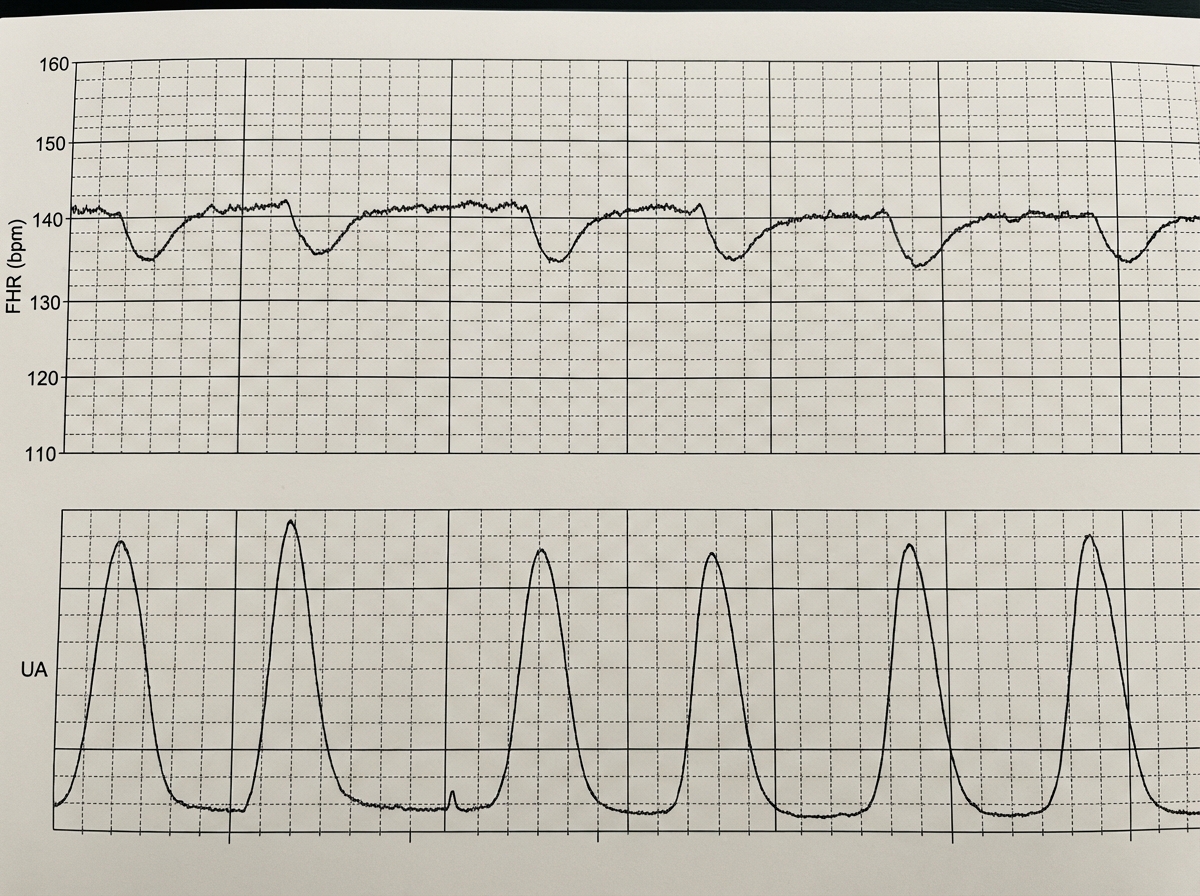
A 24-year-old woman, gravida 1, at 35 weeks gestation is admitted to the hospital with regular contractions and pelvic pressure for the last 5 hours. Her pregnancy has been uncomplicated and she has attended many prenatal appointments and followed the physician's advice about screening for diseases, laboratory testing, diet, and exercise. She has had no history of fluid leakage or bleeding. At the hospital, her temperature is 37.2°C (99.0°F), blood pressure is 108/60 mm Hg, pulse is 88/min, and respirations are 16/min. Cervical examination shows 60% effacement and 5 cm dilation with intact membranes. Cardiotocography shows a contraction amplitude of 220 MVU in 10 minutes. Which of the following is the most appropriate pharmacotherapy at this time?
A 30-year-old woman, gravida 2, para 1, at 38 weeks' gestation comes to the hospital for regular, painful contractions that have been increasing in frequency. Her pregnancy has been complicated by gestational diabetes treated with insulin. Pelvic examination shows the cervix is 50% effaced and 4 cm dilated; the vertex is at -1 station. Ultrasonography shows no abnormalities. A tocometer and Doppler fetal heart monitor are placed on the patient's abdomen. The fetal heart rate monitoring strip shows a baseline heart rate of 145/min with a variability of ≥ 15/min. Within a 20-minute recording, there are 7 uterine contractions, 4 accelerations, and 3 decelerations that have a nadir occurring within half a minute. The decelerations occur at differing intervals relative to the contractions. Which of the following is the most appropriate next step in the management of this patient?
A 26-year-old gravida 1 at 36 weeks gestation is brought to the emergency department by her husband complaining of contractions lasting up to 2 minutes. The contractions are mostly in the front of her abdomen and do not radiate. The frequency and intensity of contractions have not changed since the onset. The patient worries that she is in labor. The blood pressure is 125/80 mm Hg, the heart rate is 96/min, the respiratory rate is 15/min, and the temperature 36.8°C (98.2℉). The physical examination is unremarkable. The estimated fetal weight is 3200 g (6.6 lb). The fetal heart rate is 146/min. The cervix is not dilated. The vertex is at the -4 station. Which of the following would be proper short-term management of this woman?
A 28-year-old woman, gravida 2, para 1, at 14 weeks' gestation, comes to the physician with a 3-day history of abnormal vaginal discharge. She has not had fever, chills, or abdominal pain. One week ago, her 2-year-old daughter had a urinary tract infection that quickly resolved after antibiotic therapy. The patient reports that she is sexually active with one male partner and they do not use condoms. Vital signs are within normal limits. Pelvic examination shows an inflamed and friable cervix. There is mucopurulent, foul-smelling discharge from the cervical os. There is no uterine or cervical motion tenderness. Vaginal pH measurement shows a pH of 3.5. Which of the following is the most appropriate initial step in management?
A 54-year-old male comes to the clinic to initiate care with a new physician. He has no complaints at this time. When taking his history, the patient says his medical history is notable for diabetes and hypertension both of which are well managed on his medications. His medications are metformin and lisinopril. A review of systems is negative. While taking the social history, the patient hesitates when asked about alcohol consumption. Further gentle questioning by the physician leads the patient to admit that he drinks 5-6 beers per night and up to 10-12 drinks per day over the weekend. He says that he has been drinking like this for “years.” He becomes emotional and says that his alcohol is negatively affecting his relationship with his wife and children; however, when asked about efforts to decrease his consumption, the patient says he has not tried in the past and doesn’t think he has “the strength to stop”. Which of the following stages of change most accurately describes this patient’s behavior?
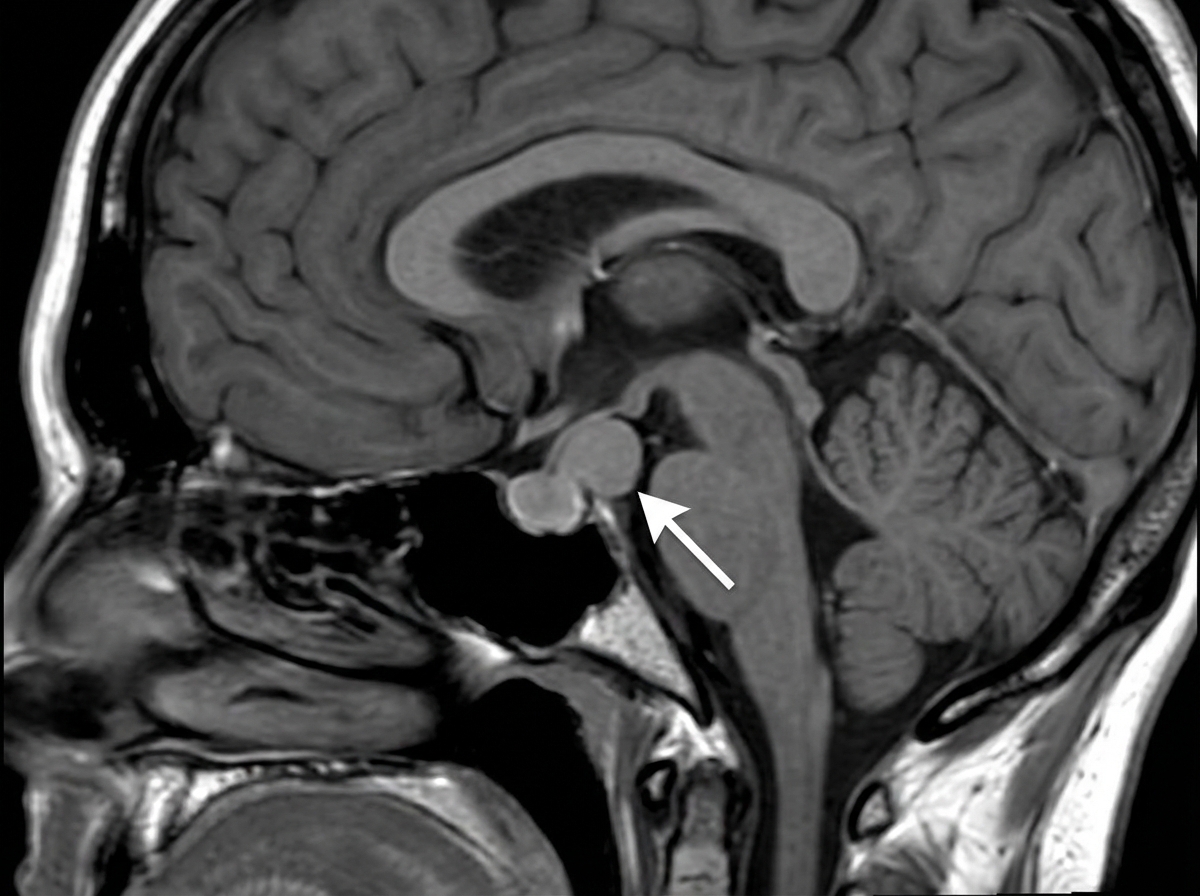
A 17-year-old teenager presents to the clinic with her parents complaining of headaches and loss of vision which began insidiously 3 months ago. She describes her headaches as throbbing, mostly on her forehead, and severe enough to affect her daily activities. She has not experienced menarche. Past medical history is noncontributory. She takes no medication. Both of her parents are alive and well. Today, her blood pressure is 110/70 mm Hg, the heart rate is 90/min, the respiratory rate is 17/min, and the temperature is 37.0°C (98.6°F). Breasts and pubic hair development are in Tanner stage I. Blood work is collected and an MRI is performed (the result is shown). Decreased production of which of the following hormones is the most likely explanation for the patient's signs and symptoms?
A 3-year-old girl is brought to the physician by her mother two days after the sudden onset of a rash. The mother says that the rash developed an hour after she bathed the child in hot water. Two weeks ago, the patient was diagnosed with a skin infection and was treated with penicillin V. She has been otherwise healthy but has missed several well-child examinations. She lives with her single mother, who recently lost her job and is now dependent on social assistance. The patient's mother has major depressive disorder and her maternal aunt has systemic lupus erythematosus. The girl's temperature is 36.8°C (98.2°F), pulse is 112/min, and blood pressure is 108/62 mm Hg. She has poor eye contact. Physical examination shows sharply delineated erythema on the lower extremities up to the umbilicus with sparing of the knees and flexor surfaces. Further evaluation is most likely to reveal which of the following?
Want unlimited practice?
Get full access to all questions, explanations, and performance tracking.
Scan to download app