
Thyroid disorders in pregnancy — MCQs

A 23-year-old primigravida presents to her physician’s office at 12 weeks gestation complaining of increased sweating and palpitations for the last week. She does not have edema or dyspnea, and had no pre-existing illnesses. The patient says that the symptoms started a few days after several episodes of vomiting. She managed the vomiting at home and yesterday the vomiting stopped, but the symptoms she presents with are persistent. The pre-pregnancy weight was 54 kg (119 lb). The current weight is 55 kg (121 lb). The vital signs are as follows: blood pressure 130/85 mm Hg, heart rate 113/min, respiratory rate 15/min, and temperature 37.0℃ (98.6℉). The physical examination is significant for diaphoresis, an irregular heartbeat, and a fine resting tremor of the hands. The neck is not enlarged and the thyroid gland is not palpable. The ECG shows sinus tachyarrhythmia. The thyroid panel is as follows: Thyroid stimulating hormone (TSH) < 0.1 mU/L Total T4 178 nmol/L Free T4 31 pmol/L Which of the following is indicated?
A 28-year-old gravida-2-para-1 at 12 weeks gestation presents for a prenatal visit. Over the past week, she has felt increasingly tired, even after waking up in the morning. She is vegan and avoids all animal products. She was diagnosed with Graves’ disease 6 months ago. Before conception, methimazole was switched to propylthiouracil (PTU). Other medications include folic acid and a multivitamin. The vital signs include: temperature 37.1℃ (98.8℉), pulse 72/min, respiratory rate 12/min, and blood pressure 110/75 mm Hg. The conjunctivae and nail beds are pale. Petechiae are present over the distal lower extremities. The pelvic examination reveals a uterus consistent in size with a 12-week gestation. Examination of the neck, lungs, heart, and abdomen shows no abnormalities. The laboratory studies show the following: Laboratory test Hemoglobin 9.0 g/dL Mean corpuscular volume 90 μm3 Leukocyte count 4,000/mm3 Segmented neutrophils 55% Lymphocytes 40% Platelet count 110,000/mm3 Serum Thyroid-stimulating hormone 0.1 μU/mL Thyroxine (T-4) 8 μg/dL Lactate dehydrogenase 60 U/L Total bilirubin 0.5 mg/dL Iron 100 μg/dL Ferritin 110 ng/mL Total iron-binding capacity 250 μg/dL Which of the following best explains these findings?
A 28-year-old G1P0 woman comes to the emergency department complaining that her water just broke. She reports irregular prenatal care due to her erratic schedule. She is also unsure of her gestational age but claims that her belly began to show shortly after she received her thyroidectomy for her Graves disease about 9 months ago. She denies any known fevers, chills, abnormal vaginal discharge/bleeding, or sexually transmitted infections. She develops frequent and regular contractions and subsequently goes into active labor. A fetus was later vaginally delivered with a fetal heart rate of 180 bpm. A neonatal physical examination demonstrates a lack of a sagittal cranial suture and an APGAR score of 8 and 8, at 1 and 5 minutes respectively. What findings would you expect in the baby?
A 26-year-old G1P0 presents to her first obstetric visit after having a positive urine pregnancy test at home. Her last menstrual period was 9 weeks ago. She has no past medical history, but her mother has rheumatoid arthritis. The patient states that for several weeks, she has felt especially warm, even when her co-workers do not, and had muscle weakness. She also complains of mood swings and fatigue. At this visit, her temperature is 99.0°F (37.2°C), blood pressure is 140/81 mmHg, pulse is 106/min, and respirations are 17/min. Physical exam is notable for 3+ deep tendon reflexes bilaterally and 4/5 strength in both hips and shoulders. Ultrasound confirms the presence of a heart beat and shows a crown rump length that is consistent with a gestational age of 9 weeks and 3 days. Which of the following is the best therapy for this patient?
A 28-year-old woman, gravida 1, para 0, at 10 weeks gestation comes to the physician for her first prenatal visit. Today, she feels well. She has no history of serious illness. Her pulse is 75/min and blood pressure is 110/74 mm Hg. Examination shows no abnormalities. Ultrasonography shows a pregnancy consistent in size with a 10-week gestation. Serum studies in this patient are most likely to show which of the following sets of laboratory values? $$$ Thyroid-binding globulin %%% Free Triiodothyronine (T3) %%% Free Thyroxine (T4) %%% Total T3+T4 $$$
A 25-year-old woman presents to her physician with a missed mense and occasional morning nausea. Her menstrual cycles have previously been normal and on time. She has hypothyroidism resulting from Hashimoto thyroiditis diagnosed 2 years ago. She receives levothyroxine (50 mcg daily) and is euthyroid. She does not take any other medications, including birth control pills. At the time of presentation, her vital signs are as follows: blood pressure 120/80 mm Hg, heart rate 68/min, respiratory rate 12/min, and temperature 36.5℃ (97.7℉). The physical examination shows slight breast engorgement and nipple hyperpigmentation. The gynecologic examination reveals cervical softening and increased mobility. The uterus is enlarged. There are no adnexal masses. The thyroid panel is as follows: Thyroid stimulating hormone (TSH) 3.41 mU/L Total T4 111 nmol/L Free T4 20 pmol/L Which of the following adjustments should be made to the patient’s therapy?
A 25-year-old woman, gravida 2, para 1, at 25 weeks' gestation comes to the emergency department because of a 1-day history of fever and right-sided flank pain. During this period, she also had chills, nausea, vomiting, and burning on urination. Her last prenatal visit was 10 weeks ago. Pregnancy and delivery of her first child were uncomplicated. Her temperature is 39°C (102.2°F), pulse is 110/min, respirations are 20/min, and blood pressure is 110/70 mm Hg. Physical examination shows costovertebral angle tenderness on the right. The abdomen is soft and nontender, and no contractions are felt. Pelvic examination shows a uterus consistent in size with a 25-week gestation. Fetal heart rate is 170/min. Laboratory studies show: Leukocyte count 15,000/mm3 Urine Nitrite 2+ Protein 1+ Blood 1+ RBC 5/hpf WBC 500/hpf Blood and urine samples are obtained for culture and drug sensitivity. Which of the following is the most appropriate next step in management?
A researcher is studying physiologic and hormonal changes that occur during pregnancy. Specifically, they examine the behavior of progesterone over the course of the menstrual cycle and find that it normally decreases over time; however, during pregnancy this decrease does not occur in the usual time frame. The researcher identifies a circulating factor that appears to be responsible for this difference in progesterone behavior. In order to further examine this factor, the researcher denatures the circulating factor and examines the sizes of its components on a western blot as compared to several other hormones. One of the bands the researcher identifies in this circulating factor is identical to that of another known hormone with which of the following sites of action?
A 36-year-old primigravida presents to her obstetrician for antenatal care. She is at 24 weeks of gestation and does not have any current complaint except for occasional leg cramps. She does not smoke or drink alcohol. Family history is irrelevant. Her temperature is 36.9°C (98.42°F), blood pressure is 100/60 mm Hg, and pulse of 95/minute. Her body mass index is 21 kg/m² (46 pounds/m²). Physical examination reveals a palpable uterus above the umbilicus with no other abnormalities. Which of the following screening tests is suitable for this patient?
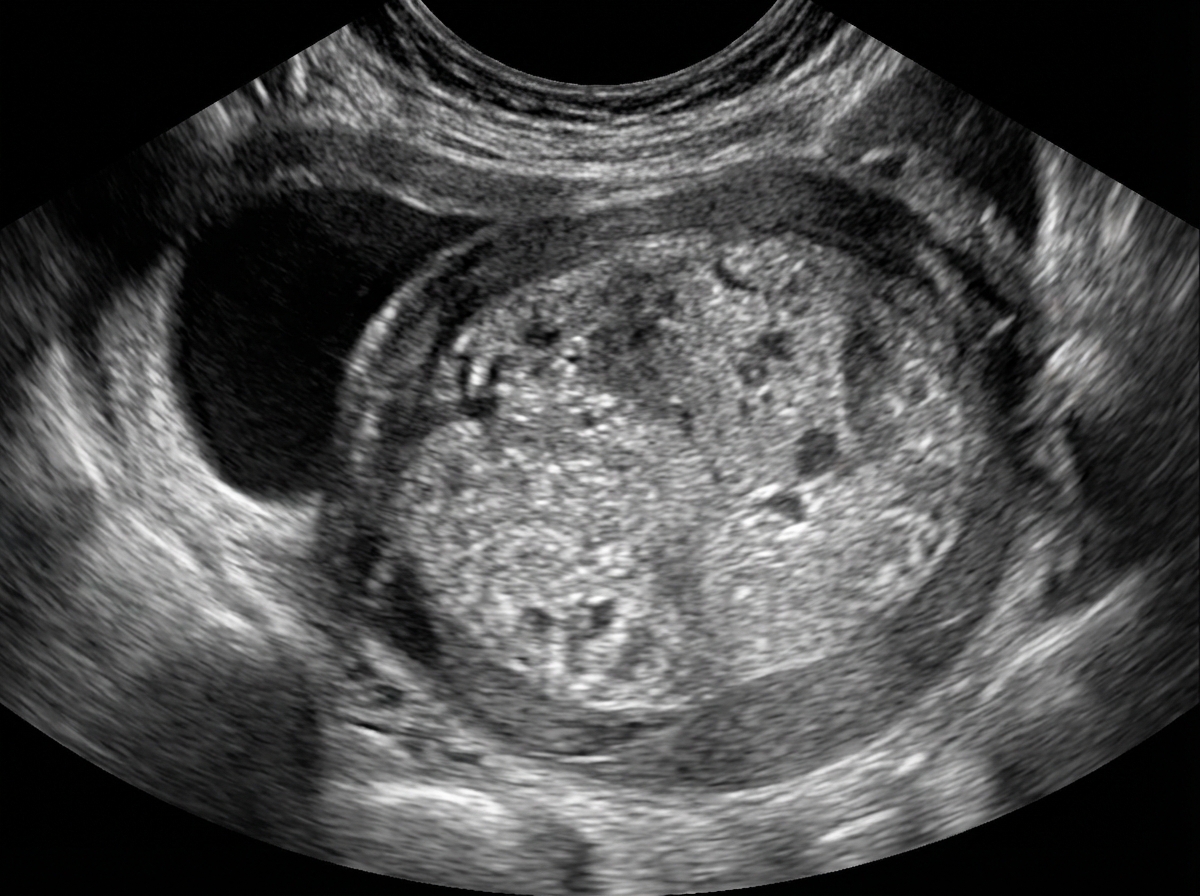
A 28-year-old primigravid woman comes to the emergency department because of a 12-hour history of lower abdominal pain and vaginal bleeding. She also had nausea and fatigue for the past 3 weeks. Her last menstrual period was 8 weeks ago. Prior to that, her menses occurred regularly at 30-day intervals and lasted for 4 days. There is no history of medical illness, and she takes no medications. Her temperature is 37°C (98.6°F), pulse is 95/min, and blood pressure is 100/70 mm Hg. Pelvic examination is painful and shows a uterus consistent in size with a 13-week gestation. A urine pregnancy test is positive. β-HCG level is 106,000 mIU/mL (N < 5 mIU/mL). Transvaginal ultrasonography shows unclear, amorphous fetal parts and a large placenta with multiple cystic spaces. Which of the following is the most likely cause of this patient's condition?
Want unlimited practice?
Get full access to all questions, explanations, and performance tracking.
Scan to download app