
Cardiac disease in pregnancy — MCQs

A 27-year-old primigravid woman at 32 weeks' gestation comes to the physician for a prenatal visit. She has had swollen legs, mild shortness of breath, and generalized fatigue for the past 2 weeks. Medications include iron supplements and a multivitamin. Her temperature is 37.2°C (99°F), pulse is 93/min, respirations are 20/min, and blood pressure is 108/60 mm Hg. There is 2+ pitting edema of the lower extremities, but no erythema or tenderness. The lungs are clear to auscultation. Cardiac examination shows an S3 gallop. Pelvic examination shows a uterus consistent in size with a 32-week gestation. Which of the following is the most appropriate next step in management for this patient's symptoms?
A 27-year-old P1G1 who has had minimal prenatal care delivers a newborn female infant. Exam reveals a dusky child who appears to be in distress. Her neck veins are distended and you note an enlarged v wave. She has a holosystolic murmur. Following echocardiogram, immediate surgery is recommended. For which of the following conditions was the mother likely receiving treatment during pregnancy?
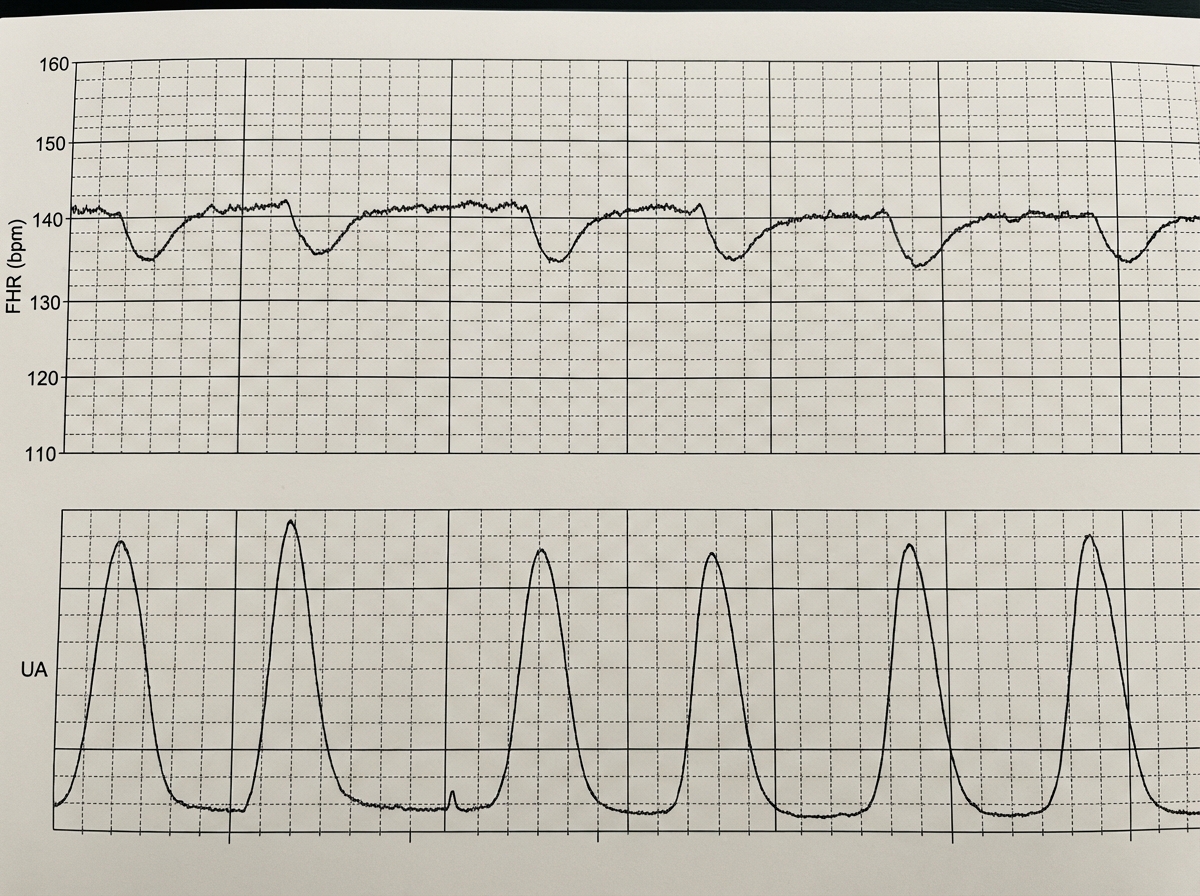
A 39-year-old woman, gravida 5, para 4, at 41 weeks' gestation is brought to the hospital because of regular uterine contractions that started 2 hours ago. Pregnancy has been complicated by iron deficiency anemia treated with iron supplements. Pelvic examination shows the cervix is 90% effaced and 7-cm dilated; the vertex is at -1 station. Fetal heart tracing is shown. The patient is repositioned, O2 therapy is initiated, and amnioinfusion is done. A repeat assessment after 20 minutes shows a similar cervical status, and no changes in the fetal heart tracing, and less than 5 contractions in a period of 10 minutes.What is the most appropriate next step in management?
A 34-year-old primigravida presents with progressive shortness of breath on exertion and while sleeping. The patient says that she uses 2 pillows to breathe comfortably while sleeping at night. These symptoms started in the 3rd week of the 2nd trimester of pregnancy. She does not have any chronic health problems. She denies smoking and alcohol intake. Vital signs include: blood pressure 110/50 mm Hg, temperature 36.9°C (98.4°F), and regular pulse 90/min. Previous physical examination in the 1st trimester had disclosed no cardiac abnormalities, but on current physical examination, she has a loud S1 and a 2/6 diastolic rumble over the cardiac apex. A transthoracic echocardiogram shows evidence of mitral valve stenosis. Which of the following is the best initial treatment for this patient?
A 27-year-old woman G2P1 at 34 weeks estimated gestational age presents with bouts of sweating, weakness, and dizziness lasting a few minutes after lying down on the bed. She says symptoms resolve if she rolls on her side. She reports that these episodes have occurred several times over the last 3 weeks. On lying down, her blood pressure is 90/50 mm Hg and her pulse is 50/min. When she rolls on her side, her blood pressure slowly increases to 120/65 mm Hg, and her pulse increases to 72/min. Which of the following best describes the mechanism which underlies this patient’s most likely condition?
A 44-year-old woman with high blood pressure and diabetes presents to the outpatient clinic and informs you that she is trying to get pregnant. Her current medications include lisinopril, metformin, and sitagliptin. Her blood pressure is 136/92 mm Hg and heart rate is 79/min. Her physical examination is unremarkable. What should you do regarding her medication for high blood pressure?
A 25-year-old woman, gravida 2, para 1, at 25 weeks' gestation comes to the emergency department because of a 1-day history of fever and right-sided flank pain. During this period, she also had chills, nausea, vomiting, and burning on urination. Her last prenatal visit was 10 weeks ago. Pregnancy and delivery of her first child were uncomplicated. Her temperature is 39°C (102.2°F), pulse is 110/min, respirations are 20/min, and blood pressure is 110/70 mm Hg. Physical examination shows costovertebral angle tenderness on the right. The abdomen is soft and nontender, and no contractions are felt. Pelvic examination shows a uterus consistent in size with a 25-week gestation. Fetal heart rate is 170/min. Laboratory studies show: Leukocyte count 15,000/mm3 Urine Nitrite 2+ Protein 1+ Blood 1+ RBC 5/hpf WBC 500/hpf Blood and urine samples are obtained for culture and drug sensitivity. Which of the following is the most appropriate next step in management?
A 25-year-old woman presents to her physician with a missed mense and occasional morning nausea. Her menstrual cycles have previously been normal and on time. She has hypothyroidism resulting from Hashimoto thyroiditis diagnosed 2 years ago. She receives levothyroxine (50 mcg daily) and is euthyroid. She does not take any other medications, including birth control pills. At the time of presentation, her vital signs are as follows: blood pressure 120/80 mm Hg, heart rate 68/min, respiratory rate 12/min, and temperature 36.5℃ (97.7℉). The physical examination shows slight breast engorgement and nipple hyperpigmentation. The gynecologic examination reveals cervical softening and increased mobility. The uterus is enlarged. There are no adnexal masses. The thyroid panel is as follows: Thyroid stimulating hormone (TSH) 3.41 mU/L Total T4 111 nmol/L Free T4 20 pmol/L Which of the following adjustments should be made to the patient’s therapy?
A 28-year-old primigravida presents to the office with complaints of heartburn while lying flat on the bed at night and mild constipation that started a couple of weeks ago. She is 10 weeks pregnant, as determined by her last menstrual period. Her first menstruation was at 13 years of age and she has always had regular 28-day cycles. Her past medical history is insignificant. She does not smoke cigarettes or drink alcohol and does not take any medications. Her father died of colon cancer at 70 years of age, while her mother has diabetes and hypertension. Her vital signs include: temperature 36.9℃ (98.4℉), blood pressure 98/52 mm Hg, pulse 113/minute, oxygen saturation 99%, and respiratory rate 12 /minute. The physical examination was unremarkable, except for a diastolic murmur heard over the apex. Which of the following is considered abnormal in this woman?
A 33-year-old G1P0 at 32 weeks gestation presents to her OB/GYN for a prenatal check-up. Her medical history is significant for type II pregestational diabetes mellitus, which has been well-controlled with diet and insulin so far throughout her pregnancy. Which of the following is the recommended future follow-up for this patient?
Want unlimited practice?
Get full access to all questions, explanations, and performance tracking.
Scan to download app