
Viral replication cycles — MCQs

Part of the success of the Streptococcus pyogenes bacterium lies in its ability to evade phagocytosis. Which of the following helps in this evasion?
A virology student is asked to identify a sample of virus. When subjected to a nonionic detergent, which disrupts lipid membranes, the virus was shown to lose infectivity. The student then purified the genetic material from the virus and subjected it to treatment with RNase, an enzyme that cleaves the phosphodiester linkages in the RNA backbone. A minute amount of the sample was then injected into a human cell line and was found to produce viral particles a few days later. Which of the following viruses was in the unknown sample?
An outbreak of diphtheria has occurred for the third time in a decade in a small village in South Africa. Diphtheria is endemic to the area with many healthy villagers colonized with different bacterial strains. Vaccine distribution in this area is difficult due to treacherous terrain. A team of doctors is sent to the region to conduct a health campaign. Toxigenic strains of C. diphtheria are isolated from symptomatic patients. Which of the following best explains the initial emergence of a pathogenic strain causing such outbreaks?
An investigator studying viral replication isolates the genetic material of an unidentified virus strain. After exposing a cell culture to the isolated, purified viral genetic material, the cells begin to produce viral polymerase and subsequently replicate the viral genome. Infection with the investigated strain is most likely to cause which of the following conditions?
A 3-year-old boy presents to an urgent care clinic with his mother. She states that his behavior has been lethargic for the past 3 days. She also notes that he has had a runny nose, mild cough, and sore throat during this time. She does not believe that he has been febrile. His temperature is 99.1°F (37.2°C), blood pressure is 105/67 mmHg, pulse is 100/min, respirations are 18/min, and SpO2 97% on room air. Which nucleic acid structure most accurately describes the most likely virus responsible for this boy’s clinical condition?
Two viruses, X and Y, infect the same cell and begin to reproduce within the cell. As a result of the co-infection, some viruses are produced where the genome of Y is surrounded by the nucleocapsid of X and vice versa with the genome of X and nucleocapsid of Y. When the virus containing genome X surrounded by the nucleocapsid of Y infects another cell, what is the most likely outcome?
A 16-year-old Mexican female presents with symptoms of the common cold after the patient's respiratory epithelial cells were infected with Rhinovirus. Due to the presence of the virus, her respiratory epithelial cells begin producing interferon. Which of the following is LEAST likely to be an outcome of the activation of the interferon response?
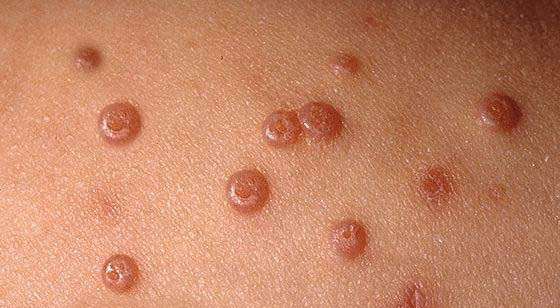
A 24-year-old man presents to the clinic with the complaint of a new rash. The lesions are not bothersome, but he is worried as he has never seen anything like this on his body. Upon further questioning the patient states has been generally healthy except for a one time "horrible" flu-like episode two months ago in June. He has since gotten better. On physical exam the following rash is observed (Figure 1). What is the cause of this patient's rash?
A scientist performed an experiment to produce hybrid viruses by mixing two different serotypes of influenza virus, H1N1 and H2N2, in a respiratory epithelium cell line. Several days later, the scientist collected the media and analyzed the viral progeny. She found the following serotypes of virus: H1N1, H2N2, H1N2, and H2N1. Which of the following terms best explains the appearance of new serotypes?
When hepatitis D was injected into an immunocompromised mouse, there was no detectable hepatitis D RNA in the blood at any time point during the next several months. When co-injected with hepatitis B, hepatitis D RNA was detected in the blood. Which of the following best describes this phenomenon?
Want unlimited practice?
Get full access to all questions, explanations, and performance tracking.
Scan to download app