
Measles, mumps, rubella — MCQs

A 35-year-old woman from San Francisco has been refusing to vaccinate her children due to the claims that vaccinations may cause autism in children. Her 10-year-old male child began developing a low-grade fever with a rash that started on his face; as the rash began to spread to his limbs, it slowly disappeared from his face. When the child was taken to a clinic, the physician noticed swollen lymph nodes behind the ears of the child. Which of the following are characteristics of the virus causing these symptoms?
A 4-month-old boy is brought to the physician by his parents for a well-child examination. He has cystic fibrosis diagnosed by newborn screening. His parents report frequent feedings and large-volume and greasy stools. His 4-year-old brother has autism. Current medications include bronchodilators, pancreatic enzyme supplements, and fat-soluble vitamins. He is at the 18th percentile for height and 15th percentile for weight. Scattered wheezes are heard throughout both lung fields. Examination shows a distended and tympanic abdomen with no tenderness or guarding. Which of the following is a contraindication for administering one or more routine vaccinations?
A 2-year-old boy is brought to the physician because of the rash shown in the picture for 2 days. His mother says that the rash initially appeared on his face and neck. He has had fever, cough, and poor appetite for 5 days. The boy's family recently immigrated from Asia and is unable to provide his vaccination records. His temperature is 38.8°C (102.0°F), pulse is 105/min, and respiratory rate is 21/min. Physical examination shows fading of the rash over the face and neck without any desquamation. Examination of the oropharynx shows tiny rose-colored lesions on the soft palate. Enlarged tender lymph nodes are palpated in the suboccipital, postauricular and anterior cervical regions. The clinical presentation in this patient is most compatible with which of the following diseases?
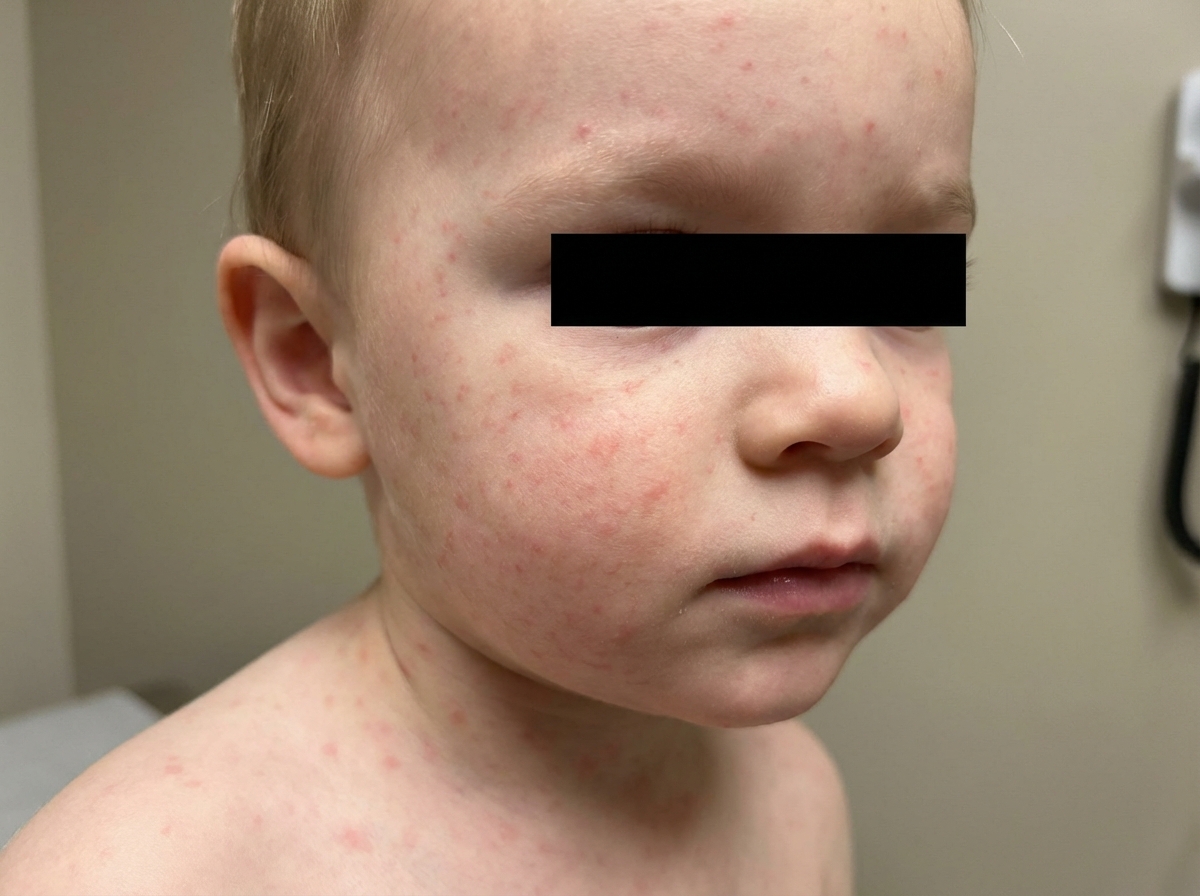
A 2-year-old boy presents to the pediatrician for evaluation of an elevated temperature, sore throat, runny nose, and lacrimation for the past week, and a rash which he developed yesterday. The rash began on the patient’s face and spread down to the trunk, hands, and feet. The patient’s mother gave him ibuprofen to control the fever. The child has not received mumps, measles, and rubella vaccinations because he was ill when the vaccine was scheduled and was later lost to follow-up. The vital signs include blood pressure 90/50 mm Hg, heart rate 110/min, respiratory rate 22/min, and temperature 37.8°C (100.0℉). On physical examination, the child was drowsy. His face, trunk, and extremities were covered with a maculopapular erythematous rash. Two irregularly-shaped red dots were also noted on the mucosa of the lower lip. The remainder of the physical examination was within normal limits. What is the probable causative agent for this child’s condition?
A 3000-g (6.6-lb) female newborn is delivered at term to a 23-year-old primigravid woman. The mother has had no prenatal care. Immunization records are not available. Cardiac examination shows a continuous heart murmur. There are several bluish macules on the skin that do not blanch with pressure. Slit lamp examination shows cloudy lenses in both eyes. The newborn does not pass his auditory screening tests. Which of the following is the most likely diagnosis?
A previously healthy 5-year-old boy is brought to the physician because of increasing weakness and a retroauricular rash that started 2 days ago. The rash spread rapidly and involves the trunk and extremities. Last week, he had a mild sore throat, pink eyes, and a headache. His family recently immigrated from Ethiopia. His immunization status is unknown. The patient appears severely ill. His temperature is 38.5°C (101.3°F). Examination shows tender postauricular and suboccipital lymphadenopathy. There is a nonconfluent, maculopapular rash over the torso and extremities. Infection with which of the following is the most likely cause of this patient's symptoms?
A 32-year-old pregnant woman at 32 weeks gestation presents with a 2-day history of low-grade fever, headache, and myalgias. She works at a daycare where several children recently had 'slapped cheek' rash. Laboratory studies show hemoglobin 8.5 g/dL (baseline 12 g/dL), reticulocyte count 0.1%, and positive parvovirus B19 IgM. Fetal ultrasound shows hydrops fetalis with ascites, pleural effusions, and severe anemia on cordocentesis. Evaluate the pathophysiologic mechanism and management approach that best addresses both maternal and fetal complications.
A public health official must design a vaccination strategy for a refugee camp with 10,000 children under 5 years old. Resources allow for only one vaccine initially. Current diseases in the camp include measles (15 cases/week), diphtheria (5 cases/week), pertussis (20 cases/week), and rotavirus diarrhea (100 cases/week). Three children have died from measles, two from pertussis, and ten from dehydration due to diarrhea. Evaluate which vaccine should be prioritized and justify the decision.
A hospital infection control committee reviews a cluster of 5 cases of invasive pneumococcal disease over 6 months, all caused by serotype 19A, in vaccinated children aged 3-5 years who received all recommended doses of PCV13. All isolates show resistance to penicillin and macrolides. The committee must evaluate the outbreak and recommend interventions. Which factor most likely explains this outbreak despite appropriate vaccination?
A 65-year-old man with diabetes mellitus and chronic kidney disease presents with sudden onset right-sided facial weakness, inability to close his right eye, and loss of taste on the anterior two-thirds of his tongue. He has vesicular lesions in his right external auditory canal. He received varicella vaccine 20 years ago and had shingles on his trunk 5 years ago. Analyze the relationship between his current presentation and his varicella vaccination history.
Want unlimited practice?
Get full access to all questions, explanations, and performance tracking.
Scan to download app