
Schistosomiasis — MCQs

A 34-year-old man comes to the physician because of progressive swelling of the left lower leg for 4 months. One year ago, he had an episode of intermittent fever and tender lymphadenopathy that occurred shortly after he returned from a trip to India and resolved spontaneously. Physical examination shows 4+ nonpitting edema of the left lower leg. His leukocyte count is 8,000/mm3 with 25% eosinophils. A blood smear obtained at night confirms the diagnosis. Treatment with diethylcarbamazine is initiated. Which of the following is the most likely route of transmission of the causal pathogen?
A 19-year-old woman presents to the emergency department with chronic diarrhea, fatigue, and weakness. She also had mild lower extremity edema. On examination, she was noted to be pale. Blood testing revealed peripheral eosinophilia (60%) and a Hb concentration of 8 g/dL. The stool examination revealed Fasciolopsis buski eggs. Which of the following drugs would most likely be effective?
A 30-year-old man presents to the physician after he discovered a raised, red, string-shaped lesion beneath the skin on his right foot. The lesion seems to move from one location to another over the dorsum of his foot from day to day. He says that the lesion is extremely itchy and has not responded to over the counter topical treatment. He and his wife recently returned from a honeymoon in southern Thailand, where they frequented the tropical beaches. The physician diagnoses him with a parasitic infection and prescribes albendazole for the patient. With which of the following organisms is the patient most likely infected?
A 32-year-old man presents to the physician with a history of fever, malaise, and arthralgia in the large joints for the last 2 months. He also mentions that his appetite has been significantly decreased during this period, and he has lost considerable weight. He also informs the physician that he often experiences tingling and numbness in his right upper limb, and his urine is also dark in color. The past medical records show that he was diagnosed with an infection 7 months before and recovered well. On physical examination, the temperature is 37.7°C (99.8°F), the pulse rate is 86/min, the respiratory rate is 14/min, and the blood pressure is 130/94 mm Hg. Which of the following infections has most likely caused the condition the patient is suffering from?
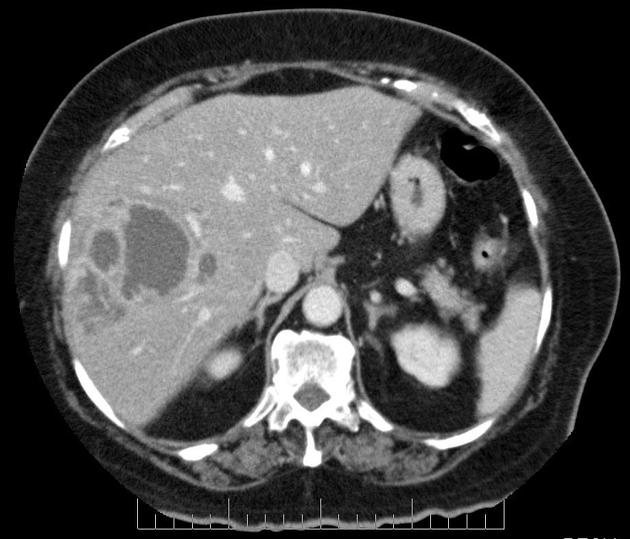
A 40-year-old man presents to the office with complaints of epigastric discomfort for the past 6 months. He adds that the discomfort is not that bothersome as it does not interfere with his daily activities. He does not have any other complaints at the moment. The past medical history is insignificant. He is a non-smoker and does not consume alcohol. He recently came back from a trip to South America where he visited a relative who owned a sheep farm. On physical examination, he has a poorly palpable epigastric non-tender mass with no organomegaly. The hepatitis B and C serology are negative. The liver CT scan and MRI are shown. What is the most likely diagnosis?
A 31-year-old man comes to the physician because of a 2-day history of nausea, abdominal discomfort, and yellow discoloration of the eyes. Six weeks ago, he had an episode of fever, joint pain, swollen lymph nodes, and an itchy rash on his trunk and extremities that persisted for 1 to 2 days. He returned from a backpacking trip to Colombia two months ago. His temperature is 39°C (101.8°F). Physical examination shows scleral icterus. Infection with which of the following agents is the most likely cause of this patient's findings?
A 45-year-old man presents to the emergency department with abdominal distension. The patient states he has had gradually worsening abdominal distension with undulating pain, nausea, and vomiting for the past several months. The patient does not see a physician typically and has no known past medical history. He works as a farmer and interacts with livestock and also breeds dogs. His temperature is 98.7°F (37.1°C), blood pressure is 159/90 mmHg, pulse is 88/min, respirations are 15/min, and oxygen saturation is 99% on room air. Physical exam is notable for mild abdominal distension and discomfort to palpation of the upper abdominal quadrants. Laboratory values are ordered and are notable for a mild eosinophilia. A CT scan of the abdomen demonstrates multiple small eggshell calcifications within the right lobe of the liver. Which of the following is the most likely etiology of this patient's symptoms?
A 29-year-old internal medicine resident presents to the emergency department with complaints of fevers, diarrhea, abdominal pain, and skin rash for 2 days. He feels fatigued and has lost his appetite. On further questioning, he says that he returned from his missionary trip to Brazil last week. He is excited as he talks about his trip. Besides a worthy clinical experience, he also enjoyed local outdoor activities, like swimming and rafting. His past medical history is insignificant. The blood pressure is 120/70 mm Hg, the pulse is 100/min, and the temperature is 38.3°C (100.9°F). On examination, there is a rash on the legs. The rest of the examination is normal. Which of the following organisms is most likely responsible for this patient’s condition?
A 27-year-old woman comes to the physician for a 1-week-history of painful urination and urinary frequency. She has no history of serious illness and takes no medications. She is sexually active with her boyfriend. Her temperature is 36.7°C (98.1°F). There is no costovertebral angle tenderness. Urine dipstick shows leukocyte esterase. A Gram stain does not show any organisms. Which of the following is the most likely causal pathogen?
A 46-year-old woman comes to the physician for a 6-month history of worsening bronchial asthma control. Before this issue began, she only used her salbutamol inhaler once a day. Now, she has to use it multiple times daily and also reports frequent nighttime awakening. Seven months ago, she moved to an apartment that is damp and has mold on some of the walls. The physician injects 0.1 mL of Candida albicans extract on the mid-volar surface of the right arm intradermally. After 48 hours there is a palpable induration of 17 mm. This reaction is most likely a result of release of which of the following substances?
Want unlimited practice?
Get full access to all questions, explanations, and performance tracking.
Scan to download app