
Epstein-Barr virus — MCQs

A 20-year-old man presents to the emergency department with complaints of severe malaise, fevers, and sore throat for the past 7 days. He also has had episodes of nausea and vomiting during this period. He does not smoke or drink alcohol. There is no family history of liver disease. His blood pressure is 130/80 mm Hg, temperature is 38.3℃ (100.9℉), pulse is 102/min, and respiratory rate is 20/min. On physical examination, he appears ill with bilateral cervical lymphadenopathy. His tonsils are erythematous and enlarged. There is no jaundice and he is mildly dehydrated. Abdominal examination demonstrates splenomegaly. The laboratory findings are shown below: Hemoglobin 15 g/dL Platelet count 95,000/mm³ Leukocytes 13,500/mm³ Neutrophils 50% Atypical lymphocytes 34% AST 232 U/L ALT 312 U/L ALP 120 U/L GGT 35 U/L Total bilirubin 1.2 mg/dL Direct bilirubin 0.2 mg/dL PT 12 seconds The serologic test for hepatitis A, B, and C, CMV, and leptospirosis are negative. Serology for both serum IgM and IgG antibodies for EBV capsid antigen are positive, but the heterophile antibody test is negative. What is the most likely reason for the negative heterophile test?
A 17-year-old boy comes to the physician because of body aches and sore throat for 1 week. He has no history of serious illness and takes no medications. He lives with his parents; they recently adopted a cat from an animal shelter. He is sexually active with one female partner, and they use condoms consistently. His temperature is 38.7°C (101.7°F), pulse is 99/min, and blood pressure is 110/72 mm Hg. Examination shows bilateral posterior cervical lymphadenopathy. The pharynx is red and swollen. Laboratory studies show: Hemoglobin 15 g/dL Leukocyte count 11,500/mm3 Segmented neutrophils 48% Band forms 2% Basophils 0.5% Eosinophils 1% Lymphocytes 45% Monocytes 3.5% When the patient's serum is added to a sample of horse erythrocytes, the cells aggregate together. Which of the following is the most likely causal pathogen?
A 28-year-old male with a history of HIV infection is found to have a CD4+ T lymphocyte count of 68 cells per microliter. As a consequence of his HIV infection, this patient is at increased risk of malignancy due to which of the following?
An 82-year-old woman is brought to the physician by her daughter because of a 3-day history of a runny nose, headache, and cough. The patient's grandson recently had similar symptoms. Her vital signs are within normal limits. Pulse oximetry on room air shows an oxygen saturation of 99%. Lungs are clear to auscultation. Testing of nasal secretions is performed to identify the viral strain. Electron microscopy shows a non-enveloped RNA virus with an icosahedral capsid. Binding to which of the following is responsible for the virulence of this virus?
A 6-year-old boy is brought to a primary care provider by his adoptive parents for evaluation of a 3-month history of jaw swelling. He has a travel history of recent immigration from equatorial Africa where his deceased mother was positive for HIV and died from related complications. On physical exam, extensive lymph node swelling on the left side of his jaw is noted. There is also an ulceration that appears to be infected. Fine needle biopsy of the lymph node yields a diagnosis of Burkitt’s lymphoma by the pathologist. Which of the following is most likely associated with the involvement of lymph nodes around his jaw?
A 22-year-old man presents to the emergency department with a fever and a sore throat. He has had these symptoms for the past 2 weeks and has felt progressively more fatigued. His temperature is 102°F (38.9°C), blood pressure is 120/68 mmHg, pulse is 100/min, respirations are 17/min, and oxygen saturation is 98% on room air. Physical exam is notable for tonsillar exudates, posterior cervical lymphadenopathy, and splenomegaly. Which of the following is the most appropriate next step in management for this patient?
A 16-year-old male is brought to the clinic by his mother for the complaints of fever, nonproductive cough, fatigue, lack of appetite, and sore throat for the past 2 months. Several other students at his high school have had similar symptoms. Physical exam shows a whitish membrane in his oropharynx, bilateral enlarged cervical lymphadenopathy, and mild splenomegaly. Which of the following tests is most likely to diagnose his condition?
An investigator is studying the effect that mutations in different parts of the respiratory tract have on susceptibility to infection. A mutation in the gene encoding for the CD21 protein is induced in a sample of cells obtained from the nasopharyngeal epithelium. This mutation is most likely to prevent infection with which of the following viruses?
A 63-year-old man presents to his primary care physician because he has been having headaches and hearing loss. In addition, he says that he has been having difficulty opening his jaw to eat and recurrent middle ear infections. Physical exam reveals enlarged neck lymph nodes and a mass in the nasopharynx. Biopsy of the mass reveals undifferentiated squamous epithelial cells. The organism that is most likely associated with this patient's disease is also associated with which of the following disorders?
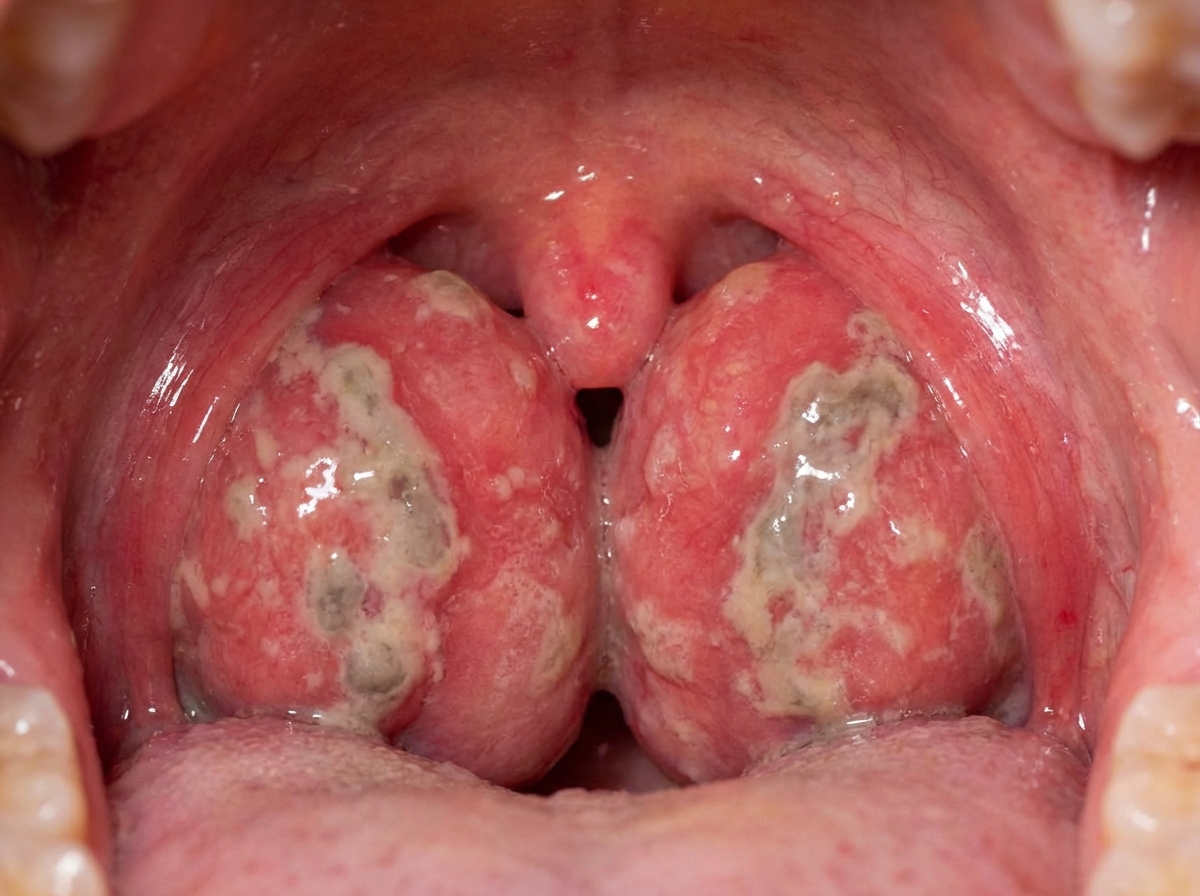
A 19-year-old woman presents to the family medical center with a 2-week history of a sore throat. She says that she has felt increasingly tired during the day and has a difficult time staying awake during her classes at the university. She appears well-nourished with a low energy level. Her vital signs include the following: the heart rate is 82/min, the respiratory rate is 14/min, the temperature is 37.8°C (100.0°F), and the blood pressure is 112/82 mm Hg. Inspection of the pharynx is depicted in the picture. Palpation of the neck reveals posterior cervical lymphadenopathy. The membrane does not bleed upon scraping. What is the most specific finding for detecting the syndrome described in the vignette?
Want unlimited practice?
Get full access to all questions, explanations, and performance tracking.
Scan to download app