
Group A streptococci — MCQs

A 7-year-old boy is brought to the physician because of a 5-day history of fever, malaise, and joint pain. He had a sore throat 4 weeks ago that resolved without treatment. His temperature is 38.6°C (101.5°F) and blood pressure is 84/62 mm Hg. Physical examination shows several firm, painless nodules under the skin near his elbows and the dorsal aspect of both wrists. Cardiopulmonary examination shows bilateral basilar crackles and a blowing, holosystolic murmur heard best at the cardiac apex. Both knee joints are warm. Laboratory studies show an erythrocyte sedimentation rate of 129 mm/h. The immune response seen in this patient is most likely due to the presence of which of the following?
Physical exam of a 15-year-old female reveals impetigo around her mouth. A sample of the pus is taken and cultured. Growth reveals gram-positive cocci in chains that are bacitracin sensitive. Which of the following symptoms would be concerning for a serious sequela of this skin infection?
A 15-year-old boy is brought to the office by his mother with complaints of facial puffiness and smoky urine. The mother noticed puffiness on her son’s face a week ago, and it has been progressively worsening since then. She also states that her son had a sore throat 3 weeks ago. The patient does not have fever/chills, changes in urinary frequency, or abdominal discomfort. On physical examination, facial edema is noted. The vital signs include: blood pressure 145/85 mm Hg, pulse 96/min, temperature 36.7°C (98.1°F), and respiratory rate 20/min. A complete blood count report shows: Hemoglobin 10.1 g/dL RBC 4.9 million cells/µL Hematocrit 46% Total leukocyte count 6,800 cells/µL Neutrophils 70% Lymphocytes 26% Monocytes 3% Eosinophil 1% Basophils 0% Platelets 210,000 cells/µL ESR 18 mm (1st hour) Urinalysis shows: pH 6.4 Color dark brown RBC plenty WBC 3–4/HPF Protein absent Cast RBC and granular casts Glucose absent Crystal none Ketone absent Nitrite absent Which of the following laboratory findings can be expected in this patient?
A previously healthy 17-year-old boy is brought to the emergency department because of fever, nausea, and myalgia for the past day. His temperature is 39.5°C (103.1°F), pulse is 112/min, and blood pressure is 77/55 mm Hg. Physical examination shows scattered petechiae over the anterior chest and abdomen. Blood culture grows an organism on Thayer-Martin agar. Which of the following virulence factors of the causal organism is most likely responsible for the high mortality rate associated with it?
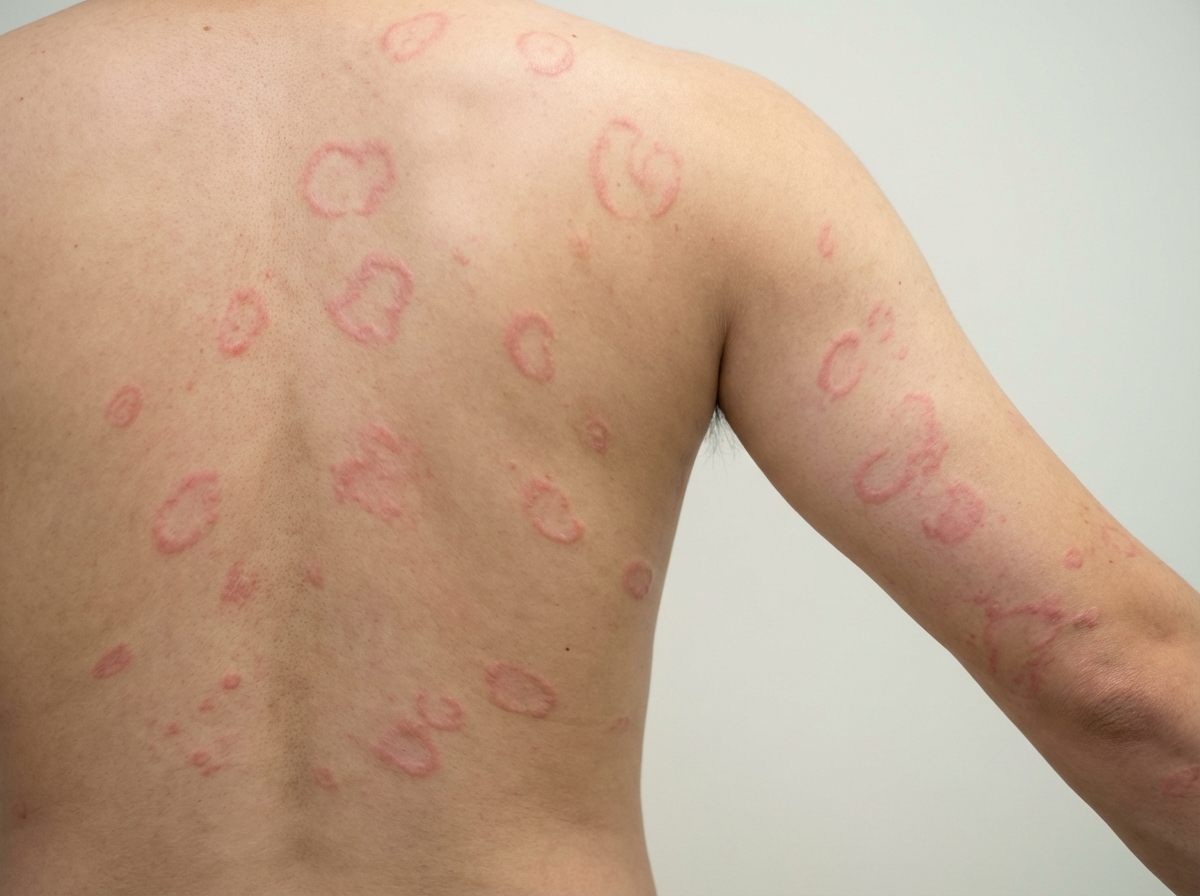
An 11-year-old boy presents with fever and joint pain for the last 3 days. His mother says that he had a sore throat 3 weeks ago but did not seek medical care at that time. The family immigrated from the Middle East 3 years ago. The patient has no past medical history. The current illness started with a fever and a swollen right knee that was very painful. The following day, his knee improved but his left elbow became swollen and painful. While in the waiting room, his left knee is also becoming swollen and painful. Vital signs include: temperature 38.7°C (101.6°F), and blood pressure 110/80 mm Hg. On physical examination, the affected joints are swollen and very tender to touch, and there are circular areas of redness on his back and left forearm (as shown in the image). Which of the following is needed to establish a diagnosis of acute rheumatic fever in this patient?
A 63-year-old man with aortic valve disease is admitted to the hospital for a 3-week history of progressively worsening fatigue, fever, and night sweats. He does not smoke, drink alcohol, or use illicit drugs. Temperature is 38.2°C (100.8°F). Physical examination shows a systolic murmur and tender, erythematous nodules on the finger pads. Blood cultures show alpha-hemolytic, gram-positive cocci that are catalase-negative and optochin-resistant. Which of the following is the most likely causal organism?
A 27-year-old woman comes to the physician because of a 3-day history of a sore throat and fever. Her temperature is 38.5°C (101.3°F). Examination shows edematous oropharyngeal mucosa and enlarged tonsils with purulent exudate. There is tender cervical lymphadenopathy. If left untreated, which of the following conditions is most likely to occur in this patient?
A 5-year-old boy presents to your office with his mother. The boy has been complaining of a sore throat and headache for the past 2 days. His mother states that he had a fever of 39.3°C (102.7°F) and had difficulty eating. On examination, the patient has cervical lymphadenopathy and erythematous tonsils with exudates. A streptococcal rapid antigen detection test is negative. Which of the following is the most likely causative agent?
A 16-year-old male is brought to the clinic by his mother for the complaints of fever, nonproductive cough, fatigue, lack of appetite, and sore throat for the past 2 months. Several other students at his high school have had similar symptoms. Physical exam shows a whitish membrane in his oropharynx, bilateral enlarged cervical lymphadenopathy, and mild splenomegaly. Which of the following tests is most likely to diagnose his condition?
A 54-year-old woman comes to the physician because of lower back pain, night sweats, and a 5-kg (11-lb) weight loss during the past 4 weeks. She has rheumatoid arthritis treated with adalimumab. Her temperature is 38°C (100.4°F). Physical examination shows tenderness over the T10 and L1 spinous processes. Passive extension of the right hip causes pain in the right lower quadrant. The patient's symptoms are most likely caused by an organism with which of the following virulence factors?
Want unlimited practice?
Get full access to all questions, explanations, and performance tracking.
Scan to download app