
Vibrio species — MCQs

A 7-year-old boy is brought to the emergency room because of severe, acute diarrhea. He is drowsy with a dull, lethargic appearance. He has sunken eyes, poor skin turgor, and dry oral mucous membranes and tongue. He has a rapid, thready pulse with a systolic blood pressure of 60 mm Hg and his respirations are 33/min. His capillary refill time is 6 sec. He has had no urine output for the past 24 hours. Which of the following is the most appropriate next step in treatment?
A 47-year-old woman presents to a local medical shelter while on a mission trip with her church to help rebuild homes after a hurricane. She has been experiencing severe nausea, vomiting, and diarrhea for the last 2 days and was feeling too fatigued to walk this morning. On presentation, her temperature is 99.2°F (37.3°C), blood pressure is 95/62 mmHg, pulse is 121/min, and respirations are 17/min. Physical exam reveals decreased skin turgor, and a stool sample reveals off-white watery stools. Gram stain reveals a gram-negative, comma-shaped organism that produces a toxin. Which of the following is consistent with the action of the toxin most likely involved in the development of this patient's symptoms?
A 25-year-old man presents to the physician with 2 days of profuse, watery diarrhea. He denies seeing blood or mucus in the stools. On further questioning, he reveals that he eats a well-balanced diet and generally prepares his meals at home. He remembers having some shellfish from a street vendor 3 days ago. He takes no medications. His past medical history is unremarkable. Which of the following mechanisms most likely accounts for this patient’s illness?
A stool sample was taken from a 19-year-old male who presented with profuse watery diarrhea. He recently returned from a trip to Central America. A microbiologist identified the causative agent as a gram-negative, oxidase-positive, comma-shaped bacteria that is able to grow well in a pH > 8. Which of the following is a mechanism of action of the toxin produced by this bacteria?
A 57-year-old HIV-positive male with a history of intravenous drug abuse presents to the emergency room complaining of arm swelling. He reports that he developed progressively worsening swelling and tenderness over the right antecubital fossa three days prior. He recently returned from a trip to Nicaragua. His past medical history is notable for an anaphylactoid reaction to vancomycin. His temperature is 101.4°F (38.6°C), blood pressure is 140/70 mmHg, pulse is 110/min, and respirations are 20/min. Physical examination reveals an erythematous, fluctuant, and tender mass overlying the right antecubital fossa. Multiple injection marks are noted across both upper extremities. He undergoes incision and drainage and is started on an antibiotic that targets the 50S ribosome. He is discharged with plans to follow up in one week. However, five days later he presents to the same emergency room complaining of abdominal cramps and watery diarrhea. Which of the following classes of pathogens is most likely responsible for this patient’s current symptoms?
A 17-year-old girl comes to the physician because of a 12-hour history of profuse watery diarrhea with flecks of mucus that started shortly after she returned from a trip to South America. She has not had any fever or nausea. Pulse is 104/min and blood pressure is 110/65 mm Hg. Physical examination shows dry mucous membranes and decreased skin turgor. Stool culture shows gram-negative, comma-shaped, flagellated bacilli. Therapy with oral rehydration solution is initiated. Which of the following is the most likely mechanism of this patient's diarrhea?
A 45-year-old woman comes to the emergency department because of abdominal cramping, vomiting, and watery diarrhea for the past 4 hours. One day ago, she went to a seafood restaurant with her family to celebrate her birthday. Three of the attendees have developed similar symptoms. The patient appears lethargic. Her temperature is 38.8°C (101.8°F). Which of the following organisms is most likely responsible for this patient's current symptoms?
A 24-year-old woman presents with 3 days of diarrhea. She was recently on vacation in Peru and admits that on her last day of the trip she enjoyed a dinner of the local food and drink. Upon return to the United States the next day, she developed abdominal cramps and watery diarrhea, occurring about 3-5 times per day. She has not noticed any blood or mucous in her stool. Vital signs are stable. On physical examination, she is well appearing in no acute distress. Which of the following is commonly associated with the likely underlying illness?
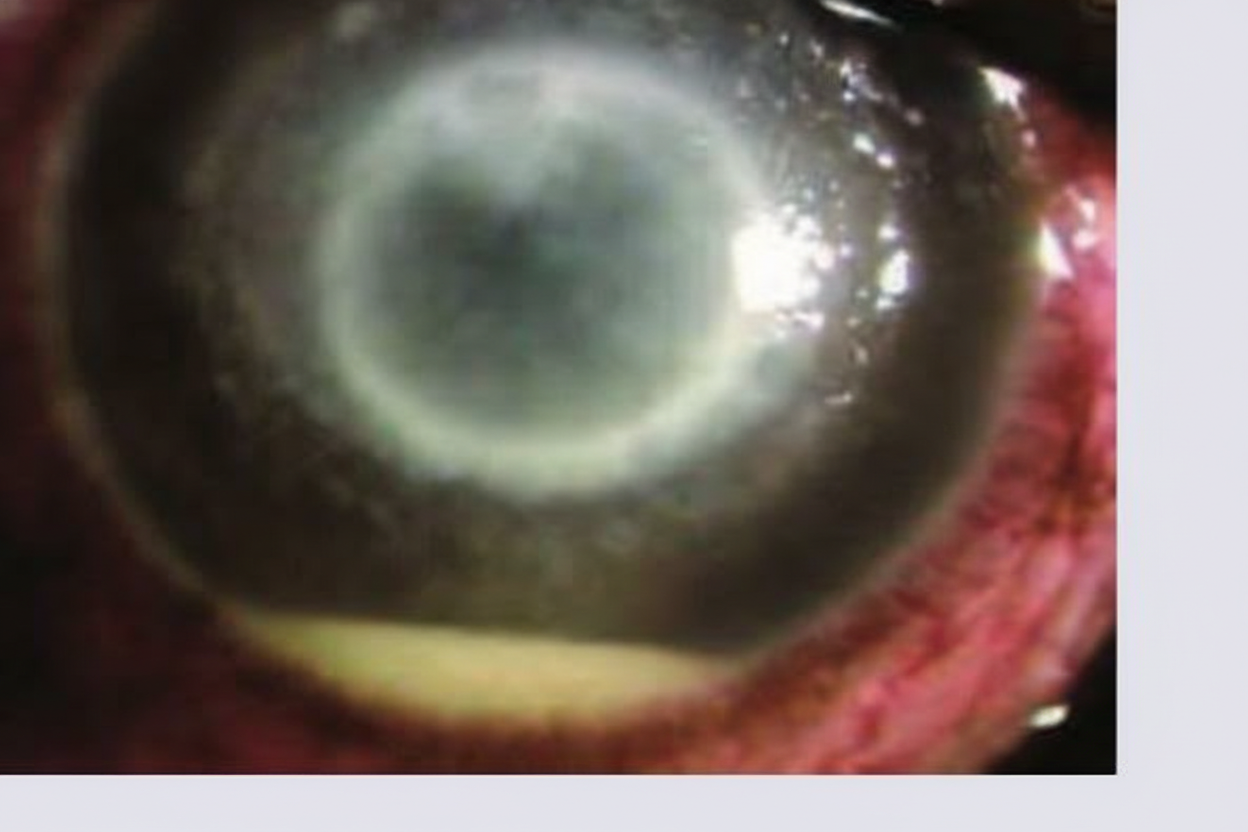
A 45-year-old man comes to the physician because of a 1-day history of progressive pain and blurry vision of his right eye. He has difficulties opening the eye because of pain. His left eye is asymptomatic. He wears contact lenses. He has bronchial asthma treated with inhaled salbutamol. He works as a kindergarten teacher. His temperature is 37°C (98.6°F), pulse is 85/min, and blood pressure is 135/75 mm Hg. Examination shows a visual acuity in the left eye of 20/25 and the ability to count fingers at 3 feet in the right eye. A photograph of the right eye is shown. Which of the following is the most likely diagnosis?
A 23-year-old man comes to the physician because of a 2-day history of profuse watery diarrhea and abdominal cramps. Four days ago, he returned from a backpacking trip across Southeast Asia. Physical examination shows dry mucous membranes and decreased skin turgor. Stool culture shows gram-negative, oxidase-positive, curved rods that have a single polar flagellum. The pathogen responsible for this patient's condition most likely has which of the following characteristics?
Want unlimited practice?
Get full access to all questions, explanations, and performance tracking.
Scan to download app