
Pseudomonas aeruginosa — MCQs

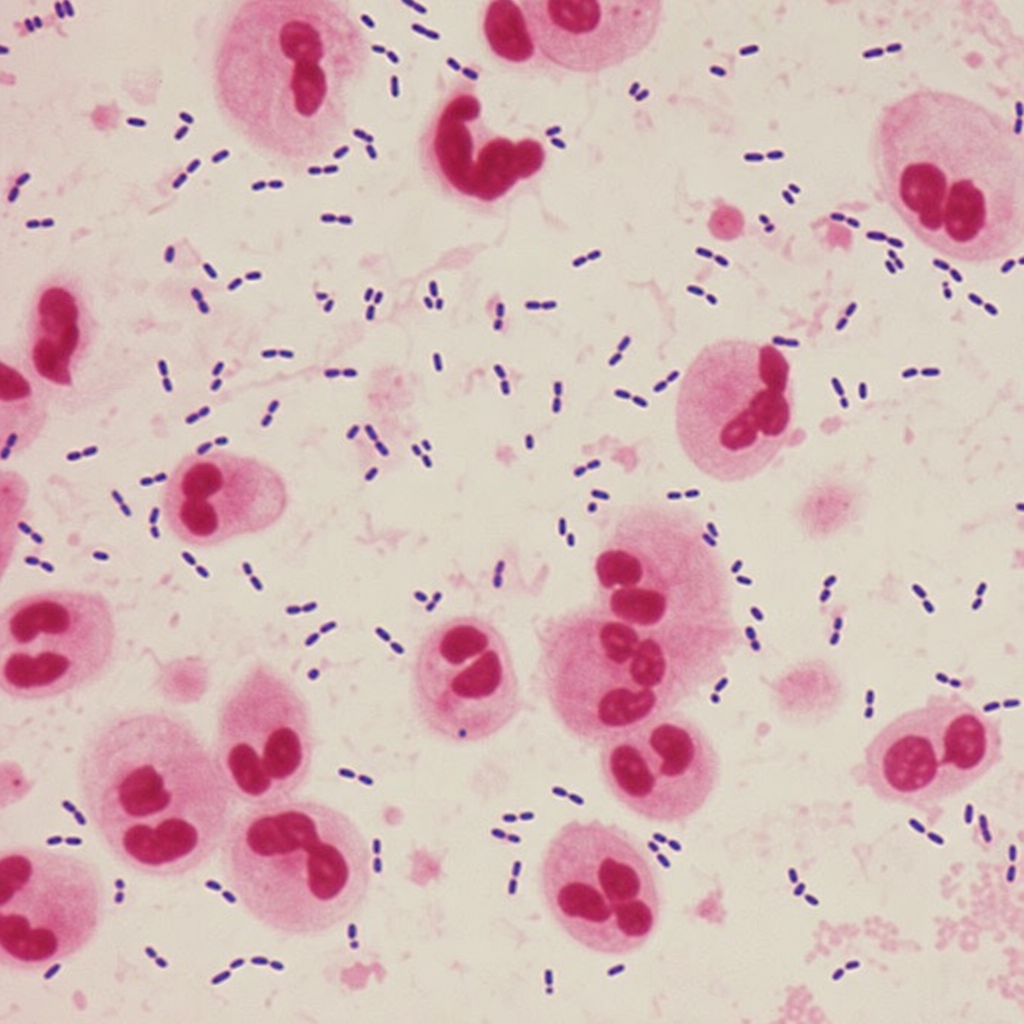
A 60-year-old man presents with fever and cough productive of rust-colored sputum and is diagnosed with community acquired pneumonia. The causative organism is isolated, and a Gram stain is shown in Figure 1. Which of the following most correctly describes additional features of the most likely causative organism?
A 62-year-old woman presents to the emergency department for evaluation of a spreading skin infection that began from an ulcer on her foot. The patient has type 2 diabetes mellitus that is poorly controlled. On examination, there is redness and erythema to the lower limb with skin breakdown along an extensive portion of the leg. The patient’s tissues separate readily from the fascial plane, prompting a diagnosis of necrotizing fasciitis. What is the exotoxin most likely associated with this patient’s presentation?
A 65-year-old man presents with low-grade fever and malaise for the last 4 months. He also says he has lost 9 kg (20 lb) during this period and suffers from extreme fatigue. Past medical history is significant for a mitral valve replacement 5 years ago. His temperature is 38.1°C (100.6°F), respirations are 22/min, pulse is 102/min, and blood pressure is 138/78 mm Hg. On physical examination, there is a new onset 2/6 holosystolic murmur loudest in the apical area of the precordium. Which of the following organisms is the most likely cause of this patient’s condition?
A microbiology student was given a swab containing an unknown bacteria taken from the wound of a soldier and asked to identify the causative agent. She determined that the bacteria was a gram-positive, spore-forming bacilli, but had difficulty narrowing it down to the specific bacteria. The next test she performed was the Nagler's test, in which she grew the bacteria on a plate made from egg yolk, which would demonstrate the ability of the bacteria to hydrolyze phospholipids and produce an area of opacity. Half the plate contained a specific antitoxin which prevented hydrolysis of phospholipids while the other half did not contain any antitoxin. The bacteria produced an area of opacity only on half of the plate containing no antitoxin. Which of the following toxins was the antitoxin targeting?
A 65-year-old woman undergoes an abdominal hysterectomy. She develops pain and discharge at the incision site on the fourth postoperative day. The past medical history is significant for diabetes of 12 years duration, which is well-controlled on insulin. Pus from the incision site is sent for culture on MacConkey agar, which shows white-colorless colonies. On blood agar, the colonies were green. Biochemical tests reveal an oxidase-positive organism. Which of the following is the most likely pathogen?
A 9-year-old boy with cystic fibrosis (CF) presents to the clinic with fever, increased sputum production, and cough. The vital signs include: temperature 38.0°C (100.4°F), blood pressure 126/74 mm Hg, heart rate 103/min, and respiratory rate 22/min. His physical examination is significant for short stature, thin body frame, decreased breath sounds bilateral, and a 2/6 holosystolic murmur heard best on the upper right sternal border. His pulmonary function tests are at his baseline, and his sputum cultures reveal Pseudomonas aeruginosa. What is the best treatment option for this patient?
Blood cultures are sent to the laboratory. Intravenous antibiotic therapy is started. Transesophageal echocardiography shows a large, oscillating vegetation attached to the tricuspid valve. There are multiple small vegetations attached to tips of the tricuspid valve leaflets. There is moderate tricuspid regurgitation. The left side of the heart and the ejection fraction are normal. Which of the following is the most likely causal organism of this patient's condition?
A 13-year-old boy is brought by his mother to the emergency department because he has had fever, chills, and severe coughing for the last two days. While they originally tried to manage his condition at home, he has become increasingly fatigued and hard to arouse. He has a history of recurrent lung infections and occasionally has multiple foul smelling stools. On presentation, his temperature is 102.2 °F (39 °C), blood pressure is 106/71 mmHg, pulse is 112/min, and respirations are 20/min. Physical exam reveals scattered rhonchi over both lung fields, rales at the base of the right lung base and corresponding dullness to percussion. The most likely organism responsible for this patient's symptoms has which of the following characteristics?
A 45-year-old male presents to his primary care physician complaining of drainage from his left great toe. He has had an ulcer on his left great toe for over eight months. He noticed increasing drainage from the ulcer over the past week. His past medical history is notable for diabetes mellitus on insulin complicated by peripheral neuropathy and retinopathy. His most recent hemoglobin A1c was 9.4%. He has a 25 pack-year smoking history. He has multiple sexual partners and does not use condoms. His temperature is 100.8°F (38.2°C), blood pressure is 150/70 mmHg, pulse is 100/min, and respirations are 18/min. Physical examination reveals a 1 cm ulcer on the plantar aspect of the left great toe surrounded by an edematous and erythematous ring. Exposed bone can be palpated with a probe. There are multiple small cuts and bruises on both feet. A bone biopsy reveals abundant gram-negative rods that do not ferment lactose. The pathogen most likely responsible for this patient’s current condition is also strongly associated with which of the following conditions?
A 20-year-old woman presents for a follow-up visit with her physician. She has a history of cystic fibrosis and is currently under treatment. She has recently been struggling with recurrent bouts of cough and foul-smelling, mucopurulent sputum over the past year. Each episode lasts for about a week or so and then subsides. She does not have a fever or chills during these episodes. She has been hospitalized several times for pneumonia as a child and continues to struggle with diarrhea. Physically she appears to be underweight and in distress. Auscultation reveals reduced breath sounds on the lower lung fields with prominent rhonchi. Which of the following infectious agents is most likely associated with the recurrent symptoms this patient is experiencing?
Want unlimited practice?
Get full access to all questions, explanations, and performance tracking.
Scan to download app