
Haemophilus influenzae — MCQs

An 18-year-old girl is brought to the emergency department because of a 1-day history of severe headache with photophobia and diffuse myalgias. She is a college student and lives in a dormitory in a large urban area. She has not traveled recently. On arrival, she is lethargic. Her temperature is 39.3°C (102.7°F), pulse is 120/min, and blood pressure is 88/58 mm Hg. Examination shows scattered petechiae and ecchymoses on the trunk and lower extremities. There is decreased range of motion of the neck. Cerebrospinal fluid analysis shows a cell count of 1,600/μL (80% neutrophils) and a lactate concentration of 5.1 mmol/L. Which of the following is most likely to have prevented this patient's condition?
An 18-month-old boy presents to the emergency department for malaise. The boy’s parents report worsening fatigue for 3 days with associated irritability and anorexia. The patient’s newborn screening revealed a point mutation in the beta-globin gene but the patient has otherwise been healthy since birth. On physical exam, his temperature is 102.4°F (39.1°C), blood pressure is 78/42 mmHg, pulse is 124/min, and respirations are 32/min. The child is tired-appearing and difficult to soothe. Laboratory testing is performed and reveals the following: Serum: Na+: 137 mEq/L Cl-: 100 mEq/L K+: 4.4 mEq/L HCO3-: 24 mEq/L Urea nitrogen: 16 mg/dL Creatinine: 0.9 mg/dL Glucose: 96 mg/dL Leukocyte count: 19,300/mm^3 with normal differential Hemoglobin: 7.8 g/dL Hematocrit: 21% Mean corpuscular volume: 82 um^3 Platelet count: 324,000/mm^3 Reticulocyte index: 3.6% Which of the following is the most likely causative organism for this patient's presentation?
A 15-year-old boy is brought to the Emergency department by ambulance from school. He started the day with some body aches and joint pain but then had several episodes of vomiting and started complaining of a terrible headache. The school nurse called for emergency services. The boy was born at 39 weeks gestation via spontaneous vaginal delivery. He is up to date on all vaccines and is meeting all developmental milestones. Past medical history is noncontributory. He is a good student and enjoys sports. At the hospital, his blood pressure is 120/80 mm Hg, heart rate is 105/min, respiratory rate is 21/min, and his temperature is 38.9°C (102.0°F). On physical exam, he appears drowsy with neck stiffness and sensitivity to light. Kernig’s sign is positive. An ophthalmic exam is performed followed by a lumbar puncture. An aliquot of cerebrospinal fluid is sent to microbiology. A gram stain shows gram-negative diplococci. A smear is prepared on blood agar and grows round, smooth, convex colonies with clearly defined edges. Which of the following would identify the described pathogen?
A 71-year-old woman presents with high-grade fever and chills, difficulty breathing, and a productive cough with rust-colored sputum. She complains of a sharp left-sided chest pain. Physical examination reveals increased fremitus, dullness to percussion, and bronchial breath sounds on the lower left side. A chest X-ray shows left lower lobe consolidation. The offending organism that was cultured from the sputum was catalase-negative and had a positive Quellung reaction. The organism will show which gram stain results?
You are seeing a 4-year-old boy in clinic who is presenting with concern for a primary immune deficiency. He has an unremarkable birth history, but since the age of 6 months he has had recurrent otitis media, bacterial pneumonia, as well as two episodes of sinusitis, and four episodes of conjunctivitis. He has a maternal uncle who died from sepsis secondary to H. influenza pneumonia. If you drew blood work for diagnostic testing, which of the following would you expect to find?
An 8-year-old girl is brought to the emergency room for a 6-hour history of fever, sore throat, and difficulty swallowing. Physical examination shows pooling of oral secretions and inspiratory stridor. Lateral x-ray of the neck shows thickening of the epiglottis and aryepiglottic folds. Throat culture with chocolate agar shows small, gram-negative coccobacilli. The patient's brother is started on the recommended antibiotic for chemoprophylaxis. Which of the following is the primary mechanism of action of this drug?
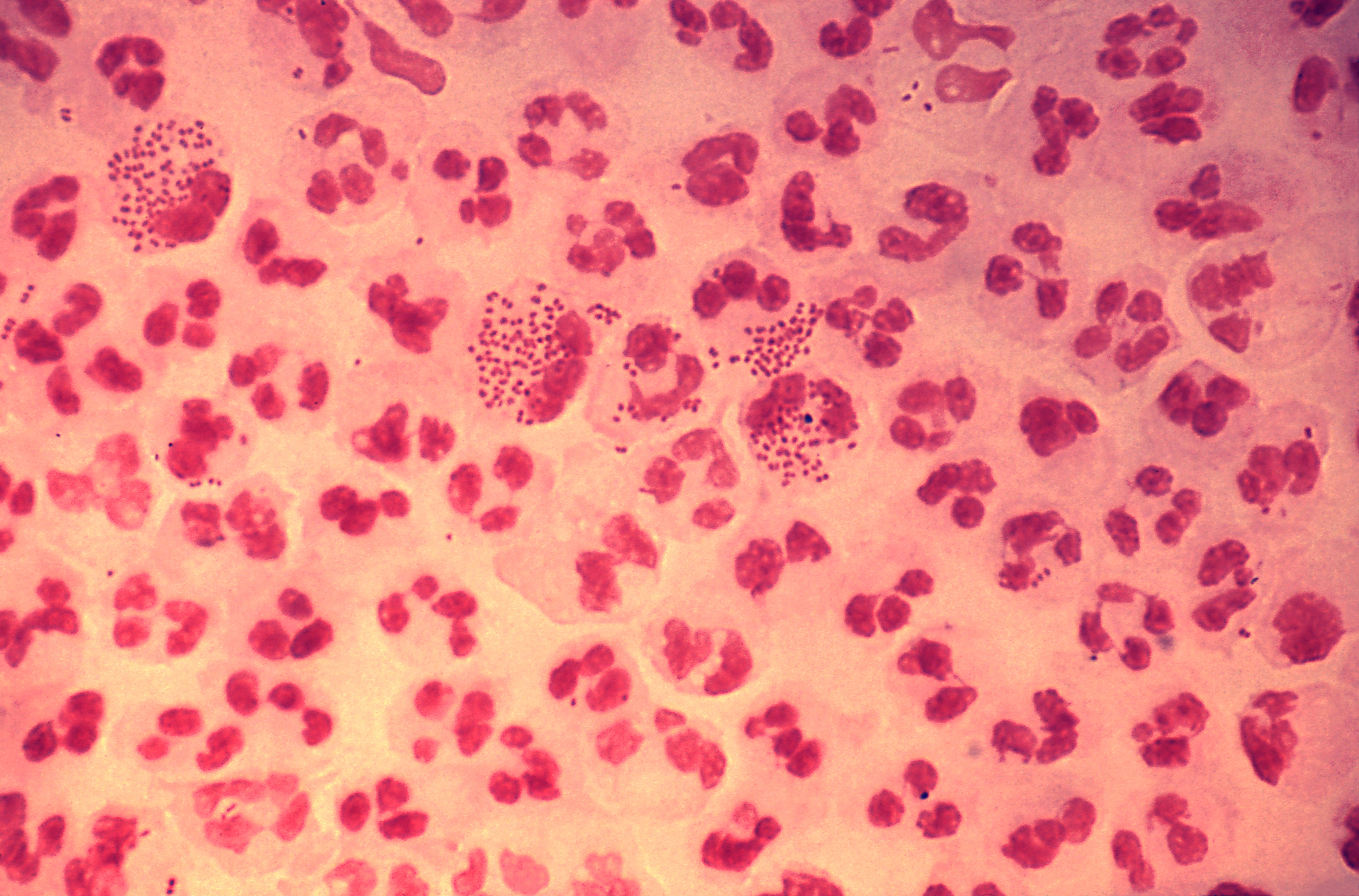
A 27-year-old woman presents to the clinic with severe pain in her left knee of 1-day duration. Physical examination reveals a red, swollen, warm, and tender left knee with a decreased range of motion. The patient affirms that she has been sexually active with several partners over the last year and that 1 of her partners has complained of dysuria and yellow urethral discharge. An arthrocentesis was performed and showed a WBC count of 60,000/µL, with 90% polymorphonuclear leukocytes. Visualization of the patient's synovial fluid is provided in the image. Which of the following is a characteristic feature of the organism causing this condition?
While testing various strains of Streptococcus pneumoniae, a researcher discovers that a certain strain of this bacteria is unable to cause disease in mice when deposited in their lungs. What physiological test would most likely deviate from normal in this strain of bacteria as opposed to a typical strain?
A 2-year-old girl who emigrated from Pakistan 2 weeks ago is brought to the emergency department because of lower limb weakness for one-day. One week ago, she had a 3-day episode of flu-like symptoms that resolved without treatment. She has not yet received any routine childhood vaccinations. Deep tendon reflexes are 1+ in the right lower extremity and absent in the left lower extremity. Analysis of cerebrospinal fluid shows a leukocyte count of 38 cells/mm3 (68% lymphocytes), a protein concentration of 49 mg/dL, and a glucose concentration of 60 mg/dL. Which of the following is the most likely diagnosis in this patient?
An 18-year-old female college student is brought to the emergency department by ambulance for a headache and altered mental status. The patient lives with her boyfriend who is with her currently. He states she had not been feeling well for the past day and has vomited several times in the past 12 hours. Lumbar puncture is performed in the emergency room and demonstrates an increased cell count with a neutrophil predominance and gram-negative diplococci on Gram stain. The patient is started on vancomycin and ceftriaxone. Which of the following is the best next step in management?
Want unlimited practice?
Get full access to all questions, explanations, and performance tracking.
Scan to download app