
Bacterial taxonomy and classification — MCQs

A 50-year-old male presents to the emergency room complaining of fever, shortness of breath, and diarrhea. He returned from a spa in the Rocky Mountains five days prior. He reports that over the past two days, he developed a fever, cough, dyspnea, and multiple watery stools. His past medical history is notable for major depressive disorder and peptic ulcer disease. He takes omeprazole and paroxetine. He does not smoke and drinks alcohol on social occasions. His temperature is 102.8°F (39.3°C), blood pressure is 120/70 mmHg, pulse is 65/min, and respirations are 20/min. Physical examination reveals dry mucus membranes, delayed capillary refill, and rales at the bilateral lung bases. A basic metabolic panel is shown below: Serum: Na+: 126 mEq/L Cl-: 100 mEq/L K+: 4.1 mEq/L HCO3-: 23 mEq/L Ca2+: 10.1 mg/dL Mg2+: 2.0 mEq/L Urea nitrogen: 14 mg/dL Glucose: 90 mg/dL Creatinine: 1.1 mg/dL Which of the following is the most appropriate growth medium to culture the pathogen responsible for this patient’s condition?
A 60-year-old man presents with fever and cough productive of rust-colored sputum and is diagnosed with community acquired pneumonia. The causative organism is isolated, and a Gram stain is shown in Figure 1. Which of the following most correctly describes additional features of the most likely causative organism?
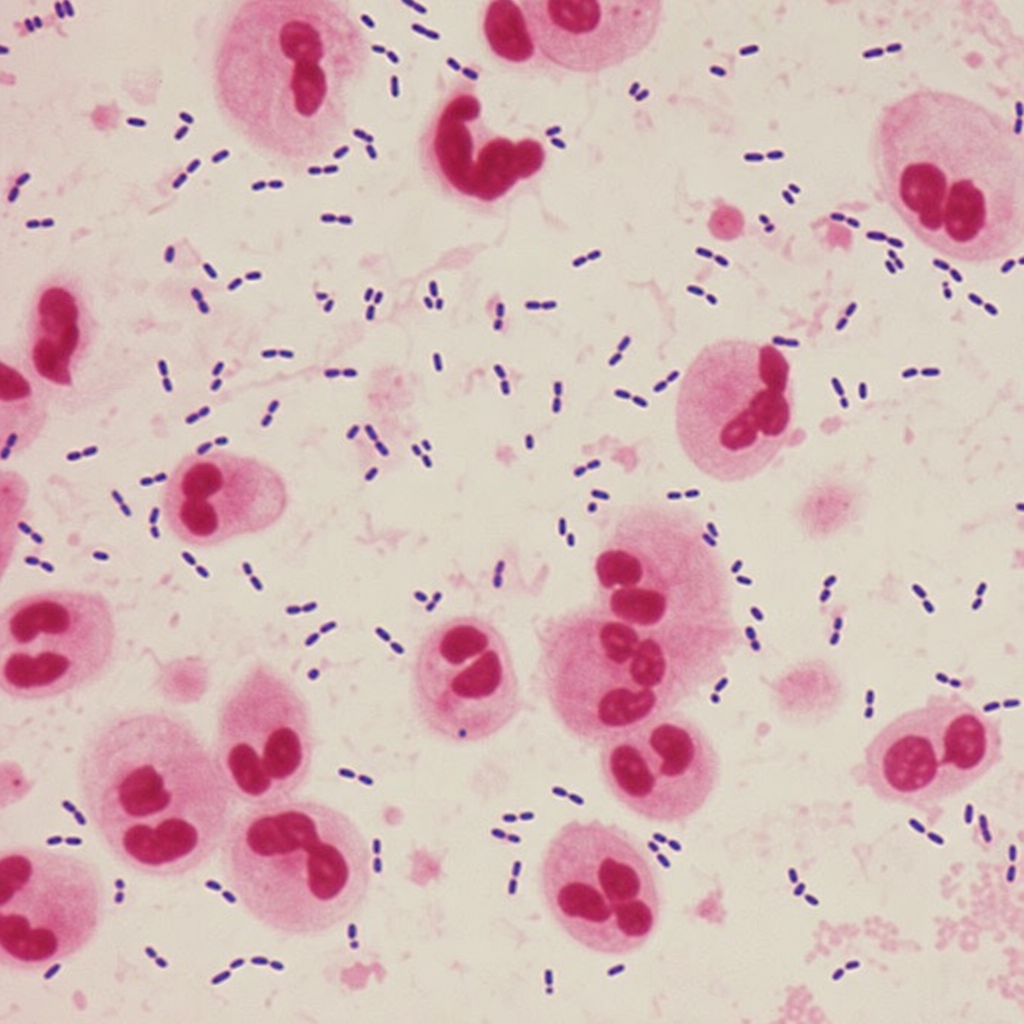
A 24-year-old woman presents to the ED with symptoms of pelvic inflammatory disease despite being previously treated with azithromycin for chlamydial infection. Based on your clinical understanding about the epidemiology of PID, you decide to obtain a gram stain which shows a gram-negative diplococci. What is the next step in order to confirm the identity of the organism described?
A 27-year-old woman visits your office with a 3-day complaint of fever, malaise, myalgias, and headaches associated with vulvar itching, vulvar soreness, dysuria, and urethral discharge. The pain when urinating is so severe that she has attempted to avoid the use of the toilet. She just returned from a spring break in the tropics and explains that she had multiple unprotected sexual encounters with men and women. Upon physical examination, the temperature was 38.7°C (101.6°F) and the heart rate was 90/min. The pelvic examination revealed vulvar ulcers, vulvar excoriations, erythema, vaginal mucosa edema, and ulcerative cervicitis. Which of the following will best aid you in the identification of the specific organism causing the above symptoms?
A 55-year-old woman with type 2 diabetes mellitus is admitted to the hospital because of a 2-day history of fever, breathlessness, and cough productive of large quantities of green sputum. She drinks 8 beers daily. Her temperature is 39°C (102.2°F), pulse is 110/min, respirations are 28/min, and blood pressure is 100/60 mm Hg. Blood and sputum cultures grow gram-negative, catalase-positive, capsulated bacilli. Which of the following components of the causal organism is the most likely cause of this patient's hypotension?
A 22-year-old woman at 30 weeks gestation presents to the obstetrician with the sudden onset of fever, headache, anorexia, fatigue, and malaise. She mentioned that she had eaten ice cream 3 days ago. Blood cultures show gram-positive rods that are catalase-positive and display distinctive tumbling motility in liquid medium. What is the most likely diagnosis?
A 10-year-old girl is brought to the emergency department because of a 2-day history of bloody diarrhea and abdominal pain. Four days ago, she visited a petting zoo with her family. Her temperature is 39.4°C (102.9°F). Abdominal examination shows tenderness to palpation of the right lower quadrant. Stool cultures at 42°C grow colonies that turn black after adding phenylenediamine. Which of the following best describes the most likely causal organism?
A 2-year-old boy has a history of recurrent bacterial infections, especially of his skin. When he has an infection, pus does not form. His mother reports that, when he was born, his umbilical cord took 5 weeks to detach. He is ultimately diagnosed with a defect in a molecule in the pathway that results in neutrophil extravasation. Which of the following correctly pairs the defective molecule with the step of extravasation that molecule affects?
An 8-year-old child is brought to the emergency department because of profuse diarrhea and vomiting that have lasted for 2 days. The boy was born at 39 weeks gestation via spontaneous vaginal delivery. He is up to date on all vaccines and is meeting all developmental milestones. Past medical history is noncontributory. The family recently made a trip to India to visit relatives. Today, his heart rate is 100/min, respiratory rate is 22/min, blood pressure is 105/65 mm Hg, and temperature is 37.2ºC (99.0°F). On physical examination, he appears unwell with poor skin turgor and dry oral mucosa. His heart has a regular rate and rhythm and his lungs are clear to auscultation bilaterally. His abdomen is sensitive to shallow and deep palpation. A gross examination of the stool reveals a 'rice water' appearance. Diagnostic microbiology results are pending. Which of the following is the best diagnostic test to aid in the identification of this patient's condition?
A scientist is studying the process of thymus-dependent B cell activation in humans. He observes that, after bacterial infections, the germinal centers of secondary lymphoid organs become highly metabolically active. After subsequent reinfection with the same pathogen, the organism is able to produce immunoglobulins at a much faster pace. Which of the following processes is likely taking place in the germinal centers at the beginning of an infection?
Want unlimited practice?
Get full access to all questions, explanations, and performance tracking.
Scan to download app