
Bacterial metabolism — MCQs

A medical technician is trying to isolate a pathogen from the sputum sample of a patient. The sample is heat fixed to a slide then covered with carbol fuchsin stain and heated again. After washing off the stain with clean water, the slide is covered with 1% sulfuric acid for decolorization. The sample is rinsed again and stained with methylene blue. Microscopic examination shows numerous red, branching filamentous organisms. Which of the following is the most likely isolated pathogen?
A 26-year-old female presents to her primary care physician concerned that she has contracted a sexually transmitted disease. She states that she is having severe pain whenever she urinates and seems to be urinating more frequently than normal. She reports that her symptoms started after she began having unprotected sexual intercourse with 1 partner earlier this week. The physician obtains a urinalysis which demonstrates the following, SG: 1.010, Leukocyte esterase: Positive, Nitrites: Positive, Protein: Trace, pH: 5.0, RBC: Negative. A urease test is performed which is negative. This patient has most likely been infected with which of the following organisms?
A 16-year-old boy presents with acute left-sided weakness. The patient is obtunded and can not provide any history other than his stomach hurts. The patient’s friend states that the patient has had episodes like this in the past and that “he has the same weird disease as his mom”. On physical examination, strength is 1 out of 5 in the left upper and lower extremities. A noncontrast CT scan of the head is normal. Laboratory tests reveal an anion gap metabolic acidosis. Which of the following is a normal function of the structure causing this patient’s condition?
E. coli has the ability to regulate its enzymes to break down various sources of energy when available. It prevents waste by the use of the lac operon, which encodes a polycistronic transcript. At a low concentration of glucose and absence of lactose, which of the following occurs?
A 24-year-old woman presents to her primary care physician with a 3 day history of pain with urination. She says that this pain has been accompanied by abdominal pain as well as a feeling like she always needs to use the restroom. She has no past medical history and no family history that she can recall. She is currently sexually active with a new partner but has tested negative for sexually transmitted infections. Physical exam reveals suprapubic tenderness and urine culture reveals gram-positive cocci. Which of the following best describes the organism that is most likely causing this patient's symptoms?
While testing various strains of Streptococcus pneumoniae, a researcher discovers that a certain strain of this bacteria is unable to cause disease in mice when deposited in their lungs. What physiological test would most likely deviate from normal in this strain of bacteria as opposed to a typical strain?
A 24-year-old man presents with low-grade fever and shortness of breath for the last 3 weeks. Past medical history is significant for severe mitral regurgitation status post mitral valve replacement five years ago. His temperature is 38.3°C (101.0°F) and respiratory rate is 18/min. Physical examination reveals vertical hemorrhages under his nails, multiple painless erythematous lesions on his palms, and two tender, raised nodules on his fingers. Cardiac auscultation reveals a new-onset 2/6 holosystolic murmur loudest at the apex with the patient in the left lateral decubitus position. A transesophageal echocardiogram reveals vegetations on the prosthetic valve. Blood cultures reveal catalase-positive, gram-positive cocci. Which of the following characteristics is associated with the organism most likely responsible for this patient’s condition?
A 16-year-old girl presents to her physician with itching, soreness, and irritation in the vulvar region. She reports that these episodes have occurred 6–7 times a year since the age of 5. She used to treat these symptoms with topical ketoconazole cream, but this time it failed to help. She also has had several episodes of oral candidiasis in the past. She is not sexually active and does not take any medication. Her vital signs are as follows: the blood pressure is 115/80 mm Hg, the heart rate is 78/min, the respiratory rate is 15/min, and the temperature is 35.5°C (97.7°F). Examination shows vulvovaginal erythema with cottage cheese-like plaques and an intact hymen. Wet mount microscopy is positive for yeast. Along with a swab culture, the physician orders a dihydrorhodamine test and myeloperoxidase staining for a suspected primary immunodeficiency. The dihydrorhodamine test is positive, and the myeloperoxidase staining reveals diminished staining. Which of the following best describes this patient's condition?
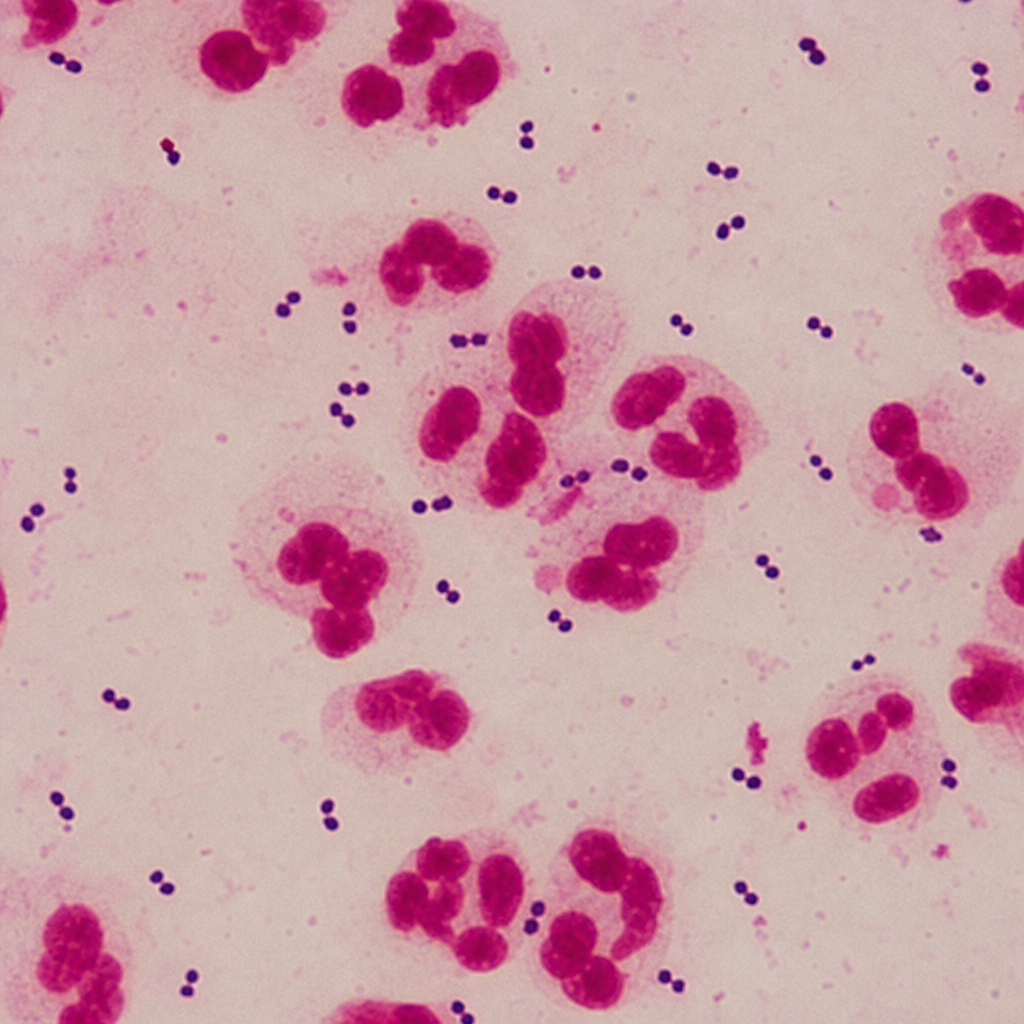
A 19-year-old college student is admitted with fever, nuchal rigidity, and a petechial rash progressing to purpura. Lumbar puncture reveals CSF with WBC 2,800 cells/µL (90% neutrophils), glucose 28 mg/dL (serum glucose 95 mg/dL), and protein 180 mg/dL. A Gram stain of CSF demonstrates Gram-negative diplococci within neutrophils. Blood cultures are pending. The organism is subsequently found to be oxidase-positive and ferments both glucose and maltose. Which of the following characteristics best distinguishes Neisseria meningitidis from Neisseria gonorrhoeae?
A 45-year-old man is brought to the emergency department after being found down outside of a bar. He does not have any identifying information and is difficult to arouse. On presentation, his temperature is 101.2°F (38.4°C), blood pressure is 109/72 mmHg, pulse is 102/min, and respirations are 18/min. Physical exam reveals an ill-appearing and disheveled man with labored breathing and coughing productive of viscous red sputum. Lung auscultation demonstrates consolidation of the left upper lobe of the patient. Given these findings, cultures are obtained and broad spectrum antibiotics are administered. Which of the following agar types should be used to culture the most likely organism in this case?
Want unlimited practice?
Get full access to all questions, explanations, and performance tracking.
Scan to download app