
Coxiella burnetii — MCQs

A medical technician is trying to isolate a pathogen from the sputum sample of a patient. The sample is heat fixed to a slide then covered with carbol fuchsin stain and heated again. After washing off the stain with clean water, the slide is covered with 1% sulfuric acid for decolorization. The sample is rinsed again and stained with methylene blue. Microscopic examination shows numerous red, branching filamentous organisms. Which of the following is the most likely isolated pathogen?
An investigator is studying the growth of an organism in different media. The organism is inoculated on a petri dish that contains heated sheep blood, vancomycin, nystatin, trimethoprim, and colistin. The resulting growth medium is incubated at 37°C. Numerous small, white colonies are seen after incubation for 48 hours. This organism is most likely to cause which of the following conditions?
A 27-year-old woman visits your office with a 3-day complaint of fever, malaise, myalgias, and headaches associated with vulvar itching, vulvar soreness, dysuria, and urethral discharge. The pain when urinating is so severe that she has attempted to avoid the use of the toilet. She just returned from a spring break in the tropics and explains that she had multiple unprotected sexual encounters with men and women. Upon physical examination, the temperature was 38.7°C (101.6°F) and the heart rate was 90/min. The pelvic examination revealed vulvar ulcers, vulvar excoriations, erythema, vaginal mucosa edema, and ulcerative cervicitis. Which of the following will best aid you in the identification of the specific organism causing the above symptoms?
A 45-year-old man presents to the physician with a complaint of recurrent chest pain for the last 2 weeks. He mentions that the pain is not present at rest, but when he walks for some distance, he feels pain like a pressure over the retrosternal region. The pain disappears within a few minutes of stopping the physical activity. He is an otherwise healthy man with no known medical disorder. He does not smoke or have any known dependence. There is no family history of ischemic heart disease or vascular disorder. On physical examination, his vital signs, including blood pressure, are normal. The diagnosis of coronary artery disease due to atherosclerosis is made. Which of the following is known to be an infection associated with this patient’s condition?
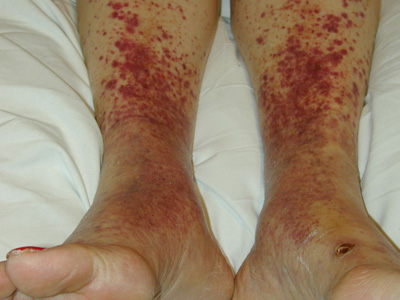
A 26-year-old male with no significant past medical history goes camping with several friends in Virginia. Several days after returning, he begins to experience fevers, headaches, myalgias, and malaise. He also notices a rash on his wrists and ankles (Figure A). Which of following should be initiated for treatment of his condition?
A previously healthy 24-year-old woman comes to the physician because of fever, headache, myalgia, photophobia, and a nonproductive cough for 2 days. Three weeks ago, she received a parrot as a birthday present. Her temperature is 38.5°C (101.3°F). Pulmonary examination shows crackles at both lung bases. Her leukocyte count is 8,000/mm3. An x-ray of the chest shows diffuse patchy infiltrates that are most prominent in the lower lobes. Which of the following is the most likely causal organism?
A 46-year-old man is brought to the emergency room by police after being found passed out on the sidewalk. He is intermittently alert and smells strongly of alcohol. He is unable to provide a history, but an electronic medical record search reveals that the patient has a history of alcohol abuse and was seen in the emergency room twice in the past year for alcohol intoxication. Further review of the medical record reveals that he works as a day laborer on a farm. His temperature is 98.8°F (37.1°C), blood pressure is 122/78 mmHg, pulse is 102/min, and respirations are 14/min. On examination, he is somnolent but arousable. He has vomitus on his shirt. He is given intravenous fluids and provided with supportive care. He vomits twice more and is discharged 6 hours later. However, 6 days after discharge, he presents to the emergency room again complaining of shortness of breath and fever. His temperature is 102°F (38.9°C), blood pressure is 100/58 mmHg, pulse is 116/min, and respirations are 24/min. The patient is actively coughing up foul-smelling purulent sputum. Which of the following is the most likely cause of this patient’s current symptoms?
A 27-year-old woman comes to the physician for a 1-week-history of painful urination and urinary frequency. She has no history of serious illness and takes no medications. She is sexually active with her boyfriend. Her temperature is 36.7°C (98.1°F). There is no costovertebral angle tenderness. Urine dipstick shows leukocyte esterase. A Gram stain does not show any organisms. Which of the following is the most likely causal pathogen?
A 3-year-old female is found to have unusual susceptibility to infections by catalase-producing organisms. This patient likely has a problem with the function of which of the following cell types?
While testing various strains of Streptococcus pneumoniae, a researcher discovers that a certain strain of this bacteria is unable to cause disease in mice when deposited in their lungs. What physiological test would most likely deviate from normal in this strain of bacteria as opposed to a typical strain?
Want unlimited practice?
Get full access to all questions, explanations, and performance tracking.
Scan to download app