
Vasopressors and inotropic support — MCQs

A 28-year-old research assistant is brought to the emergency department for severe chemical burns 30 minutes after accidentally spilling hydrochloric acid on himself. The burns cover both hands and forearms. His temperature is 37°C (98.6°F), pulse is 112/min, respirations are 20/min, and blood pressure is 108/82 mm Hg. Initial stabilization and resuscitation is begun, including respiratory support, fluid resuscitation, and cardiovascular stabilization. The burned skin is irrigated with saline water to remove the chemical agent. Which of the following is the most appropriate method to verify adequate fluid infusion in this patient?
A 32-year-old woman comes to the office for a regular follow-up. She was diagnosed with type 2 diabetes mellitus 4 years ago. Her last blood test showed a fasting blood glucose level of 6.6 mmol/L (118.9 mg/dL) and HbA1c of 5.1%. No other significant past medical history. Current medications are metformin and a daily multivitamin. No significant family history. The physician wants to take her blood pressure measurements, but the patient states that she measures it every day in the morning and in the evening and even shows him a blood pressure diary with all the measurements being within normal limits. Which of the following statements is correct?
An 83-year-old male presents with dyspnea, orthopnea, and a chest radiograph demonstrating pulmonary edema. A diagnosis of congestive heart failure is considered. The following clinical measurements are obtained: 100 bpm heart rate, 0.2 mL O2/mL systemic blood arterial oxygen content, 0.1 mL O2/mL pulmonary arterial oxygen content, and 400 mL O2/min oxygen consumption. Using the above information, which of the following values represents this patient's cardiac stroke volume?
An 82-year-old male with congestive heart failure experiences rapid decompensation of his condition, manifesting as worsening dyspnea, edema, and increased fatigue. Labs reveal an increase in his serum creatinine from baseline. As part of the management of this acute change, the patient is given IV dobutamine to alleviate his symptoms. Which of the following effects occur as a result of this therapy?
A 75-year-old male arrives by ambulance to the emergency room severely confused. His vitals are T 40 C, HR 120 bpm, BP 80/55 mmHg, RR 25. His wife explains that he injured himself about a week ago while cooking, and several days later his finger became infected, oozing with pus. He ignored her warning to see a doctor and even refused after he developed fever, chills, and severe fatigue yesterday. After being seen by the emergency physician, he was given antibiotics and IV fluids. Following initial resuscitation with IV fluids, he remains hypotensive. The ED physicians place a central venous catheter and begin infusing norepinephrine. Which of the following receptors are activated by norepinephrine?
A 60-year-old woman is brought to the emergency department by paramedics after being found unresponsive. It is not possible to obtain a history. Her blood pressure is 75/30 mmHg and pulse is 108/min. Her extremities are cool and mottled. She is admitted to the intensive care unit (ICU) for further supportive care, where she is started on a norepinephrine intravenous drip. After several hours on this infusion, which of the following changes in vitals would be expected?
A 35-year-old woman volunteers for a study on respiratory physiology. Pressure probes A and B are placed as follows: Probe A: between the parietal and visceral pleura Probe B: within the cavity of an alveolus The probes provide a pressure reading relative to atmospheric pressure. To obtain a baseline reading, she is asked to sit comfortably and breathe normally. Which of the following sets of values will most likely be seen at the end of inspiration?
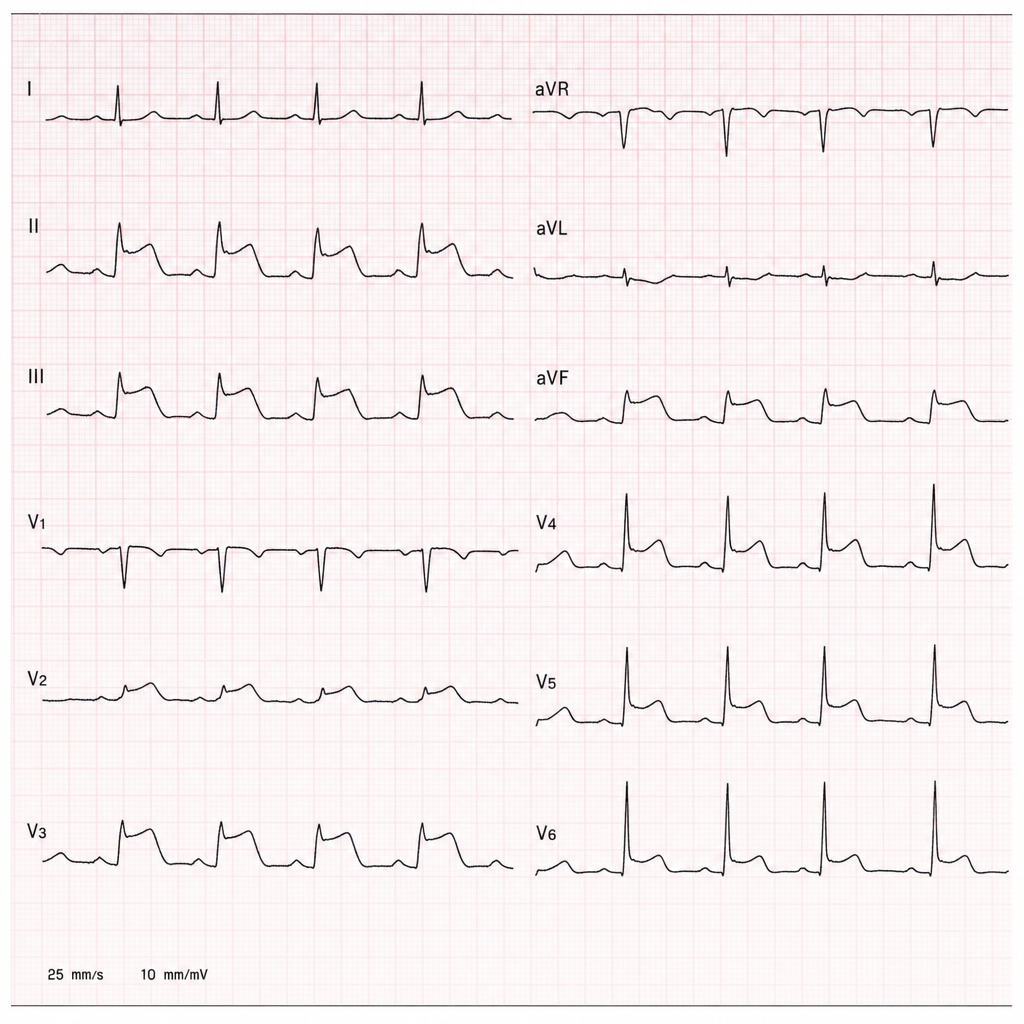
A 58-year-old man with hypertension and hyperlipidemia is brought to the emergency department by ambulance after collapsing at home. His wife states he complained of sudden severe chest pain radiating to the left arm 40 minutes ago, then became diaphoretic and lost consciousness briefly. On arrival, BP is 88/60 mmHg, HR 112 bpm, RR 22/min, SpO2 94% on room air. The ECG shown demonstrates 4 mm ST-segment elevation in leads II, III, and aVF with reciprocal changes in I and aVL. IV access is established, aspirin 325 mg has been given, and oxygen is being administered. The nearest percutaneous coronary intervention-capable facility is 25 minutes away. Which of the following is the most appropriate next step?
A 38-year-old previously healthy woman develops septic shock from necrotizing fasciitis of the lower extremity. Despite three debridements, broad-spectrum antibiotics (vancomycin, meropenem, clindamycin), IVIG, and aggressive critical care support, she develops refractory shock requiring norepinephrine 1.2 mcg/kg/min, vasopressin 0.04 units/min, and epinephrine 0.1 mcg/kg/min. Lactate is 15 mmol/L. Surgical team recommends hemipelvectomy as last option for source control. Family is devastated. ICU team notes SOFA score of 18. Synthesize an approach to management and decision-making.
A 52-year-old woman with septic shock from intra-abdominal infection undergoes emergency exploratory laparotomy for perforated diverticulitis with fecal peritonitis. Surgery reveals extensive contamination requiring damage control approach. Postoperatively, she requires norepinephrine 0.8 mcg/kg/min plus vasopressin 0.04 units/min, has lactate of 8.5 mmol/L, temperature 35.2°C, INR 2.8, pH 7.18, and base deficit -12. Planned return to OR is in 48 hours. Evaluate the priority interventions to optimize outcome.
Want unlimited practice?
Get full access to all questions, explanations, and performance tracking.
Scan to download app