
Seronegative spondyloarthropathies — MCQs

A 23-year-old man comes to the physician for frequent and painful urination. He has also had progressive painful swelling of his right knee over the past week. He is sexually active with two female partners and uses condoms inconsistently. His mother has an autoimmune disease that involves a malar rash. Examination shows conjunctivitis bilaterally. The right knee is warm, erythematous, and tender to touch; range of motion is limited. Laboratory studies show an erythrocyte sedimentation rate of 62 mm/h. Urinalysis shows WBCs. Further evaluation of this patient is most likely to reveal which of the following?
A 26-year-old woman presents with sudden-onset pain in her lower back. She says she was exercising in the gym several hours ago when she felt a sharp pain. The pain is radiating down the side of her leg and into her foot. On physical exam, her vital signs are as follows: HR 95, BP 120/70, T 37.2 degrees C. She has extreme pain shooting down her leg with a straight leg raise. Her sensation to light touch and pin-prick is intact throughout. Which of the following is the most likely diagnosis?
A 27-year-old male presents to his primary care physician complaining of pain with urination and eye redness. He reports that he developed these symptoms approximately one week ago. He also has noticed left knee and right heel pain that started a few days ago. He denies any recent trauma. He had an episode of abdominal pain and diarrhea ten days ago that resolved. He has otherwise felt well. On exam, he walks with a limp and his conjunctivae are erythematous. Laboratory findings are notable for an elevated erythrocyte sedimentation rate (ESR) and elevated C-reactive protein (CRP). Which of the following is most likely associated with this patient’s condition?
A 22-year-old man comes to the physician for a follow-up evaluation for chronic lower back pain. He has back stiffness that lasts all morning and slowly improves throughout the day. He has tried multiple over-the-counter medications, including ibuprofen, without any improvement in his symptoms. Physical examination shows tenderness over the iliac crest bilaterally and limited range of motion of the lumbar spine with forward flexion. The results of HLA-B27 testing are positive. An x-ray of the lumbar spine shows fusion of the lumbar vertebrae and sacroiliac joints. The physician plans to prescribe a new medication but first orders a tuberculin skin test to assess for the risk of latent tuberculosis reactivation. Inhibition of which of the following is the most likely primary mechanism of action of this drug?
A 42-year-old man presents to clinic complaining of increasing difficulty climbing stairs and standing up from sitting in his chair. On exam you perceive his strength to be 5/5 distally, but only 3/5 in proximal muscle groups bilaterally. There is a distinctive rash on his upper eyelids and around his eyes. Examination of the fingers is most likely to reveal which of the following?
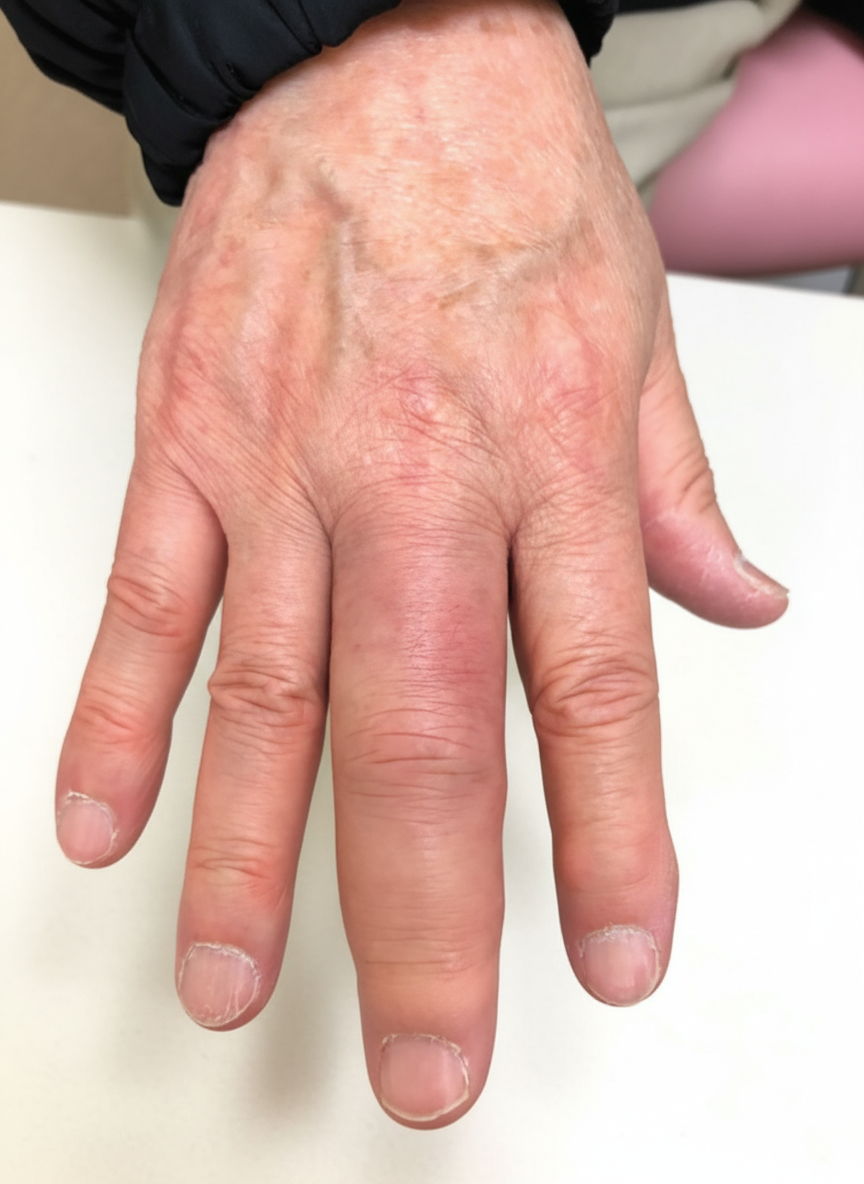
A 42-year-old woman comes to the physician because of stiffness and pain in multiple joints. She says that the fingers on both of her hands have become increasingly stiff and difficult to move over the past 8 months. She also complains of nails that break easily and look spotty as well as chronic back pain. She had a urinary tract infection a year ago that was treated with antibiotics. She is sexually active with 2 male partners and uses condoms inconsistently. Her vitals are within normal limits. A photograph of her right hand is shown. There are multiple, well-demarcated red plaques with silvery-white scales over the shins and back. Serum studies show a negative rheumatoid factor and ANA. Which of the following is the most likely diagnosis?
A 22-year-old woman presents to the emergency department with a 3-day history of fever and abdominal pain. She says that the pain is located in the left lower quadrant of the abdomen and feels crampy in nature. The pain has been associated with bloody diarrhea and joint tenderness. She has no past medical history but says that she returned 2 weeks ago from vacation in Asia where she tried many new foods. Her family history is significant for multiple cancers in close relatives. Physical exam reveals swollen ulcers on her legs, and colonoscopy reveals contiguous ulcerations from the rectum through the descending colon. Which of the following is associated with the most likely cause of this patient's symptoms?
A 47-year-old man presents to his primary care physician complaining of pain and stiffness in his right index finger and left knee. The past medical history is remarkable for severe dandruff and an episode of apparent gout in the left 1st toe 6 months ago, which never resolved. The physical examination confirms dactylitis of the right index finger and several toes, as well as synovitis of the left knee. He is also noted to have pitting of his fingernails. Plain X-rays of his hand reveal erosions in the distal interphalangeal (DIP) joint and periarticular new bone formation. Which of the following is most consistent with these findings?
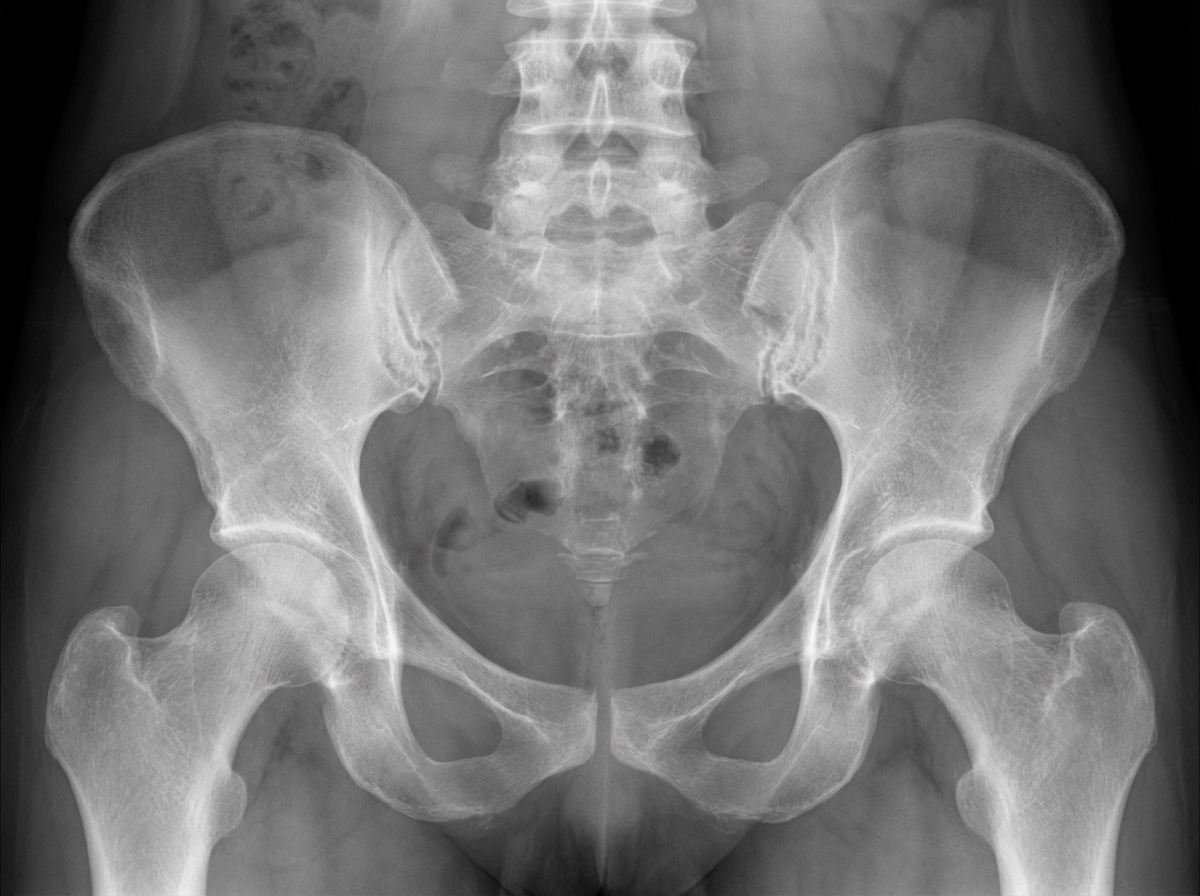
A 32-year-old woman comes to her physician because of increasing back pain for the past 10 months. The pain is worse in the morning when she wakes up and improves with activity. She used to practice yoga, but stopped 5 months ago as bending forward became increasingly difficult. She has also had bilateral hip pain for the past 4 months. She has not had any change in urination. She has celiac disease and eats a gluten-free diet. Her temperature is 37.1°C (98.8°F), pulse is 65/min, respirations are 13/min, and blood pressure is 116/72 mmHg. Examination shows the range of spinal flexion is limited. Flexion, abduction, and external rotation of bilateral hips produces pain. An x-ray of her pelvis is shown. Further evaluation of this patient is likely to show which of the following?
A 32-year-old man presents to his physician with a complaint of pain with urination that has developed and persisted over the past 8 days. Upon awakening today, he also noted a clear discharge from his urethra. The patient states he is otherwise healthy. Social history is notable for the patient working at a local farm with livestock. Review of systems is notable for left knee and ankle pain for the past week and worsening of his seasonal allergies with red and itchy eyes. His temperature is 97.7°F (36.5°C), blood pressure is 122/83 mmHg, pulse is 89/min, respirations are 14/min, and oxygen saturation is 98% on room air. Which of the following is likely to be positive in this patient?
Want unlimited practice?
Get full access to all questions, explanations, and performance tracking.
Scan to download app