
Bronchiectasis — MCQs

In patients with chronic obstructive pulmonary disease, stimulation of muscarinic acetylcholine receptors results in an increase in mucus secretion, smooth muscle contraction and bronchoconstriction. The end result is an increase in airway resistance. Which of the following pharmacologic agents interferes directly with this pathway?
A 29-year-old man presents for the evaluation of infertility. He has a history of recurrent lower respiratory tract infections, productive cough, abdominal pain, and diarrhea. Physical examination reveals clubbing and bilateral crackles on chest auscultation. Chest X-ray reveals increased pulmonary markings and peripheral bronchi with a ‘tram track’ appearance. Which of the following pathophysiologies is responsible for the patient’s condition?
A 28-year-old man presents to his primary care provider because of shortness of breath, cough, and wheezing. He reports that in high school, he occasionally had shortness of breath and would wheeze after running. His symptoms have progressively worsened over the past 6 months and are now occurring daily. He also finds himself being woken up from sleep by his wheeze approximately 3 times a week. His medical history is unremarkable. He denies tobacco use or excessive alcohol consumption. His temperature is 37.1°C (98.8°F), blood pressure is 121/82 mm Hg, and heart rate is 82/min. Physical examination is remarkable for expiratory wheezing bilaterally. Spirometry shows an FEV1 of 73% of predicted, which improves by 19% with albuterol. In addition to a short-acting beta-agonist as needed, which of the following is the most appropriate therapy for this patient?
A 62-year-old woman with hypertension and type 2 diabetes mellitus comes to the physician because of increasing shortness of breath and a dry cough over the past 6 months. She has smoked 1 pack of cigarettes daily for the past 40 years. Chest auscultation shows scattered expiratory wheezes in both lung fields. Spirometry shows an FEV1:FVC ratio of 65% and an FEV1 of 70% of predicted. Her diffusing capacity for carbon monoxide (DLCO) is 42% of predicted. Which of the following is the most likely diagnosis?
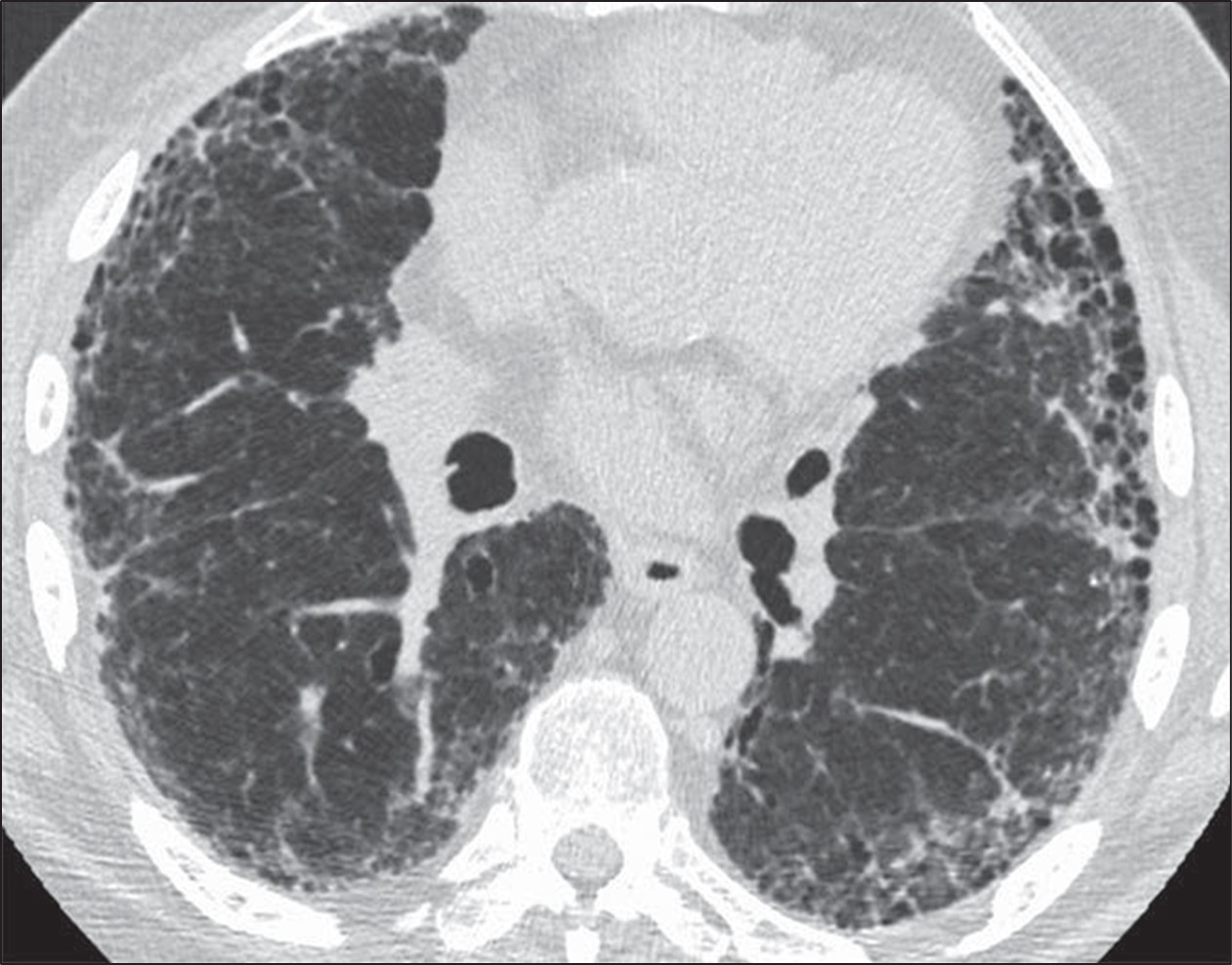
A 52-year-old man comes to the physician because of a 6-month history of shortness of breath and nonproductive cough. He has smoked 1 pack of cigarettes daily for 15 years. Cardiopulmonary examination shows fine inspiratory crackles bilaterally. There is clubbing present in the fingers bilaterally. Pulmonary function tests (PFTs) show an FVC of 78% of expected and an FEV1/FVC ratio of 92%. A CT scan of the chest is shown. Which of the following is the most likely underlying diagnosis?
A 51-year-old woman is brought to the emergency department because of an aggressive cough with copious amounts of thick, foamy, yellow-green sputum. She says she has had this cough for about 11 years with exacerbations similar to her presentation today. She also reports that her cough is worse in the morning. She was evaluated multiple times in the past because of recurrent bouts of bronchitis that have required treatment with antibiotics. She is a non-smoker. On physical examination, the blood pressure is 125/78 mm Hg, pulse rate is 80/min, respiratory rate is 16/min, and temperature is 36.7°C (98.0°F). Chest auscultation reveals crackles and wheezing over the right middle lobe and the rest of her physical examinations are normal. The chest X-ray shows irregular opacities in the right middle lobe and diffuse airway thickening. Based on this history and physical examination, which of the following is the most likely diagnosis?
A 10-year-old boy is brought to the clinic by his mother with complaints of cough productive of yellow sputum for the past couple of weeks. This is the 4th episode the boy has had this year. He has had recurrent episodes of cough since childhood, and previous episodes have subsided with antibiotics. There is no family history of respiratory disorders. His vaccinations are up to date. He has a heart rate of 98/min, respiratory rate of 13/min, temperature of 37.6°C (99.7°F), and blood pressure of 102/70 mm Hg. Auscultation of the chest reveals an apex beat on the right side of the chest. A chest X-ray reveals that the cardiac apex is on the right. A high-resolution CT scan is performed which is suggestive of bronchiectasis. Which of the following structures is most likely impaired in this patient?
A 65-year-old man is brought to the emergency department after coughing up copious amounts of blood-tinged sputum at his nursing home. He recently had an upper respiratory tract infection that was treated with antibiotics. He has a long-standing history of productive cough that has worsened since he had a stroke 3 years ago. He smoked a pack of cigarettes daily for 40 years until the stroke, after which he quit. The patient appears distressed and short of breath. His temperature is 38°C (100.4°F), pulse is 92/min, and blood pressure is 145/85 mm Hg. Pulse oximetry on room air shows an oxygen saturation of 92%. Physical examination shows digital clubbing and cyanosis of the lips. Coarse crackles are heard in the thorax. An x-ray of the chest shows increased translucency and tram-track opacities in the right lower lung field. Which of the following is the most likely diagnosis?
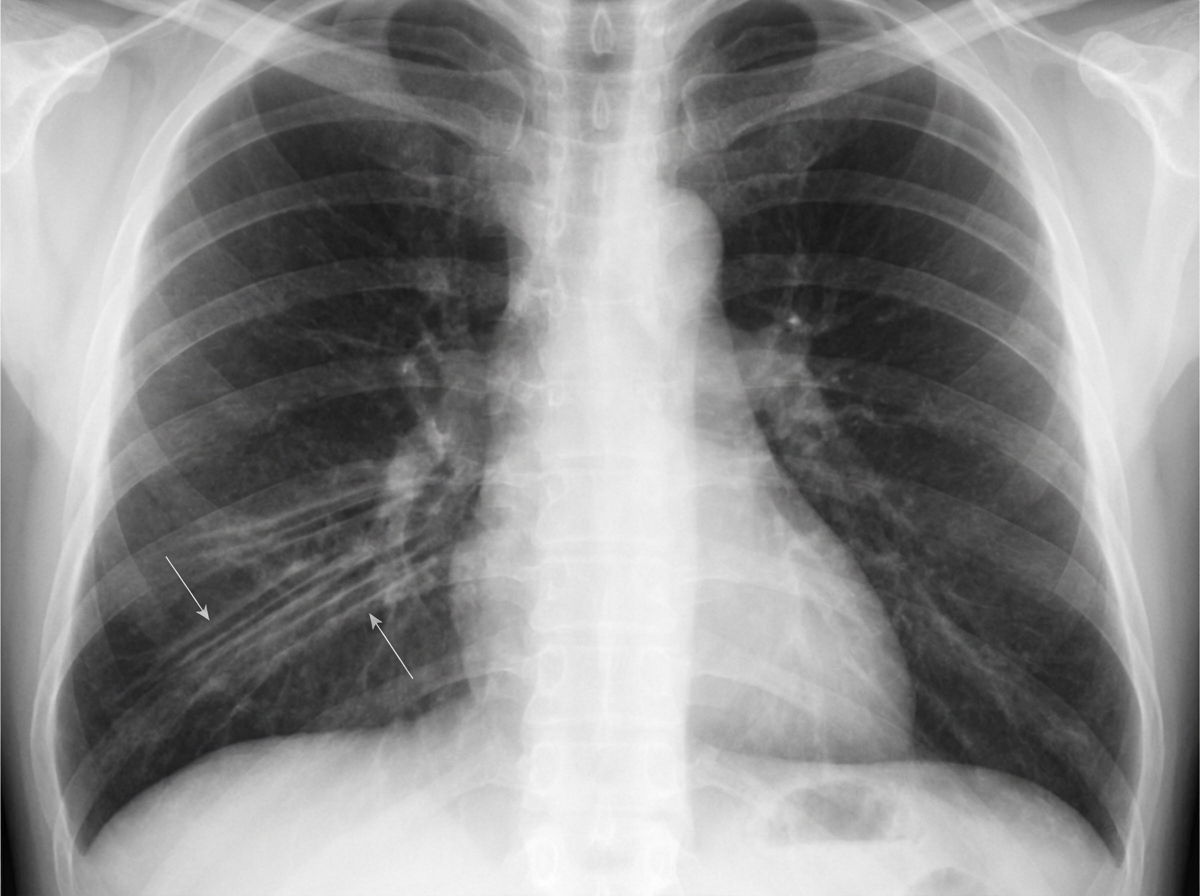
A 47-year-old alcoholic man presents to the office for a 72-hour history of intense right hemithorax pain. He also complains of fever, chills, and sweating that started 10 days ago, as well as persistent coughing with abundant malodorous sputum. Chest radiography shows a round consolidation with air-fluid levels in the middle third of the right hemithorax. Sputum samples for a direct exam, culture, and acid-fast bacilli (AFB) are sent. What is the correct diagnosis?
A new drug is designed to treat asthma by inhibiting bronchoconstriction. Experimental assays show that treated animals had markedly reduced acetylcholine binding to muscarinic receptors relative to untreated controls. The drug is most similar to which of the following:
Want unlimited practice?
Get full access to all questions, explanations, and performance tracking.
Scan to download app