
Secondary glomerular diseases — MCQs

A 62-year-old woman with type 2 diabetes mellitus comes to the physician because of a 3-month history of fatigue and weakness. Her hemoglobin A1c concentration was 13.5% 12 weeks ago. Her blood pressure is 152/92 mm Hg. Examination shows lower extremity edema. Serum studies show: K+ 5.1 mEq/L Phosphorus 5.0 mg/dL Ca2+ 7.8 mg/dL Urea nitrogen 60 mg/dL Creatinine 2.2 mg/dL Which of the following is the best parameter for early detection of this patient’s renal condition?
A 50-year-old woman comes to the emergency department because of fever and productive cough with blood in the sputum for 1 day. She also reports a sharp pain under her ribs that is worsened on taking deep breaths. Over the past 2 years, she has had repeated episodes of sinusitis, for which she used over the counter medication. She has recently started a new job at a wire-mesh factory. Her temperature is 38.3°C (100.9 °F), pulse is 72/min, respirations are 16/min, and blood pressure is 120/80 mm Hg. Physical examination shows palpable nonblanching skin lesions over her hands and feet. Examination of the nasal cavity shows ulcerations of the nasopharyngeal mucosa and a small septal perforation. Pulmonary examination shows stridor on inspiration. Laboratory studies show: Hemoglobin 13.2 g/dL Leukocyte count 10,300/mm3 Platelet count 205,000/mm3 Serum Urea nitrogen 24 mg/dL Creatinine 2.4 mg/dL Urine Protein 2+ RBC 70/hpf RBC casts numerous WBC 1–2/hpf A chest x-ray shows multiple cavitating, nodular lesions bilaterally. Which of the following additional findings is most likely to be present in this patient?
A 70-year-old man with a long-standing history of diabetes mellitus type 2 and hypertension presents with complaints of constant wrist and shoulder pain. Currently, the patient undergoes hemodialysis 2 to 3 times a week and is on the transplant list for a kidney. The patient denies any recent traumas. Which of the following proteins is likely to be increased in his plasma, causing the patient’s late complaints?
A 6-year-old boy presents to your office with hematuria. Two weeks ago the patient had symptoms of a sore throat and fever. Although physical exam is unremarkable, laboratory results show a decreased serum C3 level and an elevated anti-DNAse B titer. Which of the following would you most expect to see on renal biopsy?
A 40-year-old woman comes to the emergency department because of difficulty walking for the past 4 hours. She first noticed her symptoms after getting up this morning and her foot dragging while walking. She feels tired. She has a history of chronic sinusitis. Six months ago, she was diagnosed with asthma. Current medications include an albuterol inhaler and inhaled corticosteroids. Her temperature is 38.9°C (102°F), pulse is 80/min, and her blood pressure is 140/90 mm Hg. Auscultation of her lungs shows diffuse wheezing over bilateral lung fields. Physical examination shows tender subcutaneous nodules on the extensor surfaces of the elbows. There are palpable, non-blanching erythematous lesions on both shins. Dorsiflexion of the right foot is impaired. Sensation to pinprick, light touch, and vibration is decreased over the ulnar aspect of the left forearm. Laboratory studies show: Hemoglobin 11.3 g/dL Leukocyte count 24,500 Segmented neutrophils 48% Eosinophils 29% Lymphocytes 19% Monocytes 4% Platelet count 290,000/mm3 Serum Urea nitrogen 32 mg/dL Creatinine 1.85 mg/dL Urine Blood 2+ Protein 3+ Which of the following is the most likely diagnosis in this patient?
A 21-year-old male presents to your office with hematuria 3 days after the onset of a productive cough and fever. Following renal biopsy, immunofluorescence shows granular IgA deposits in the glomerular mesangium. Which of the following do you suspect in this patient?
A 73-year-old man comes to the physician because of progressive fatigue and shortness of breath on exertion for 3 weeks. He has swelling of his legs. He has not had nausea or vomiting. His symptoms began shortly after he returned from a trip to Cambodia. He occasionally takes ibuprofen for chronic back pain. He has a history of arterial hypertension and osteoarthritis of both knees. He had an episode of pneumonia 4 months ago. His current medications include lisinopril and hydrochlorothiazide. He has no history of drinking or smoking. His temperature is 37°C (98.6°F), pulse is 101/min, and blood pressure is 135/76 mm Hg. Examination shows pitting edema of the upper and lower extremities. Laboratory studies show: Hemoglobin 14.1 g/dL Leukocyte count 6,800/mm3 Platelet count 216,000/mm3 Serum Urea nitrogen 26 mg/dL Creatinine 2.9 mg/dL Albumin 1.6 g/dL Urine Blood negative Protein 4+ Glucose negative Renal biopsy with Congo red stain shows apple-green birefringence under polarized light. Further evaluation of this patient is most likely to show which of the following findings?
A 51-year-old African American man presents to his primary care physician’s office for an annual visit. He has no major concerns and says that he has been healthy for the last year. His past medical history is significant for diabetes as well as long standing hypertension that has developed gradually since his 30's; however, he has refused to take any medications. Physical exam shows no abnormal findings. Routine laboratory testing reveals the following: Serum creatinine concentration: 1.5 mg/dL Blood urea nitrogen: 31 mg/dL Based on these results, urine studies are conducted that reveal mild proteinuria of less than 1 g/day and no casts. Which of the following is most likely associated with the cause of this patient's elevated creatinine?
A 43-year-old man is referred by his family physician because his urine dipstick reveals 3+ protein and urinalysis reveals 1-2 red cells/high power field, but is otherwise negative. He does not have any current complaints. His family history is irrelevant. He denies smoking and alcohol use. His temperature is 36.7°C (98.06°F), blood pressure is 130/82 mm Hg, and pulse is 78/min. Physical examination is unremarkable. Which of the following is the best next step in the management of this patient’s condition?
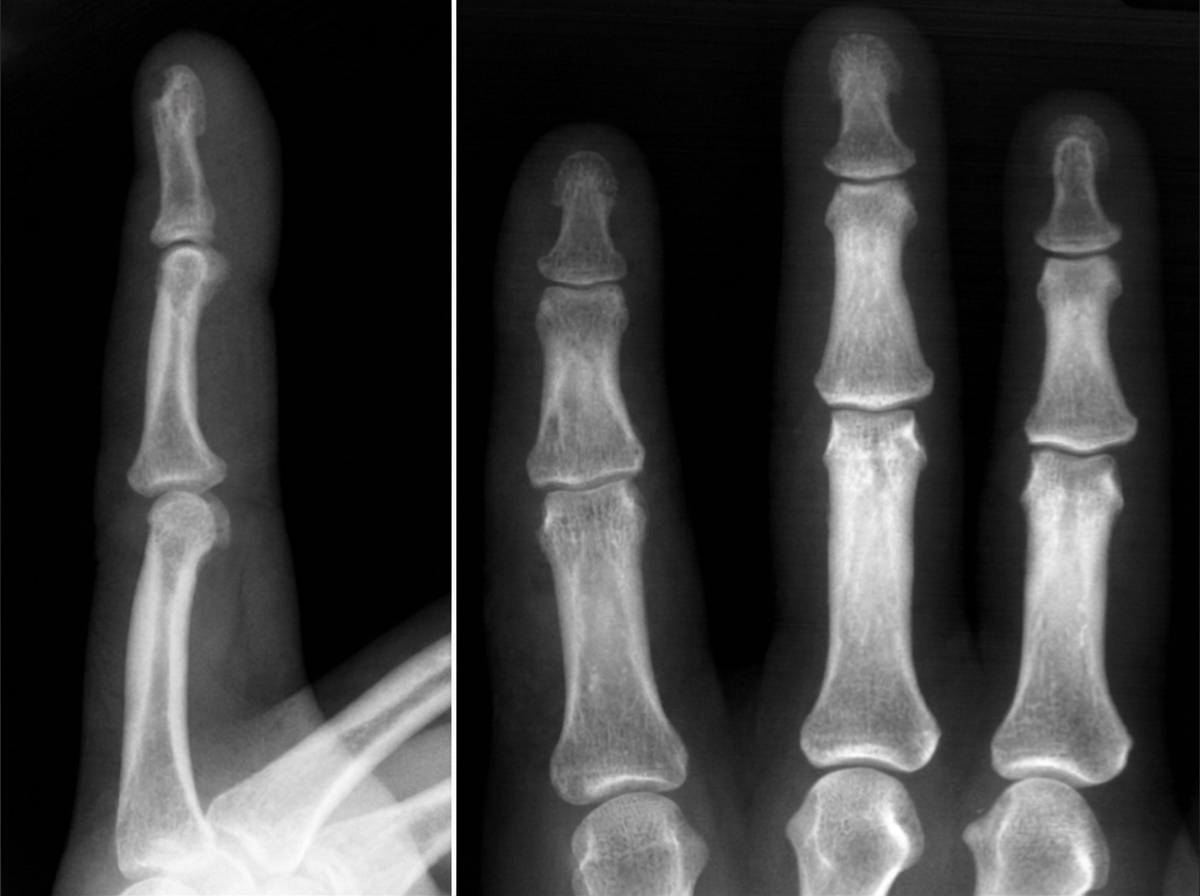
A 76-year-old woman presents to the office with a generalized weakness for the past month. She has a past medical history significant for uncontrolled hypertension and type 2 diabetes mellitus. Her temperature is 37.0°C (98.6°F), blood pressure is 135/82 mm Hg, pulse is 90/min, respiratory rate is 17/min, and oxygen saturation is 99% on room air. Physical exam shows no remarkable findings. Her last recorded glomerular filtration rate was 30 mL/min. A radiograph of the patient’s hand is given. Which of the following lab findings is most likely to be found in this patient?
Want unlimited practice?
Get full access to all questions, explanations, and performance tracking.
Scan to download app