
Primary glomerular diseases — MCQs

A 41-year-old man presents at an office for a regular health check-up. He has no complaints. He has no history of significant illnesses. He currently takes omeprazole for gastroesophageal reflux disease. He occasionally smokes cigarettes and drinks alcohol. The family history is unremarkable. The vital signs include: blood pressure 133/67 mm Hg, pulse 67/min, respiratory rate 15/min, and temperature 36.7°C (98.0°F). The physical examination was within normal limits. A complete blood count reveals normal values. A urinalysis was ordered which shows the following: pH 6.7 Color light yellow RBC none WBC none Protein absent Cast hyaline casts Glucose absent Crystal none Ketone absent Nitrite absent Which of the following is the likely etiology for hyaline casts in this patient?
A 12-year-old girl is presented to the office by her mother with complaints of cola-colored urine and mild facial puffiness that began 5 days ago. According to her mother, she had a sore throat 3 weeks ago. Her immunization records are up to date. The mother denies fever and any change in bowel habits. The vital signs include blood pressure 138/78 mm Hg, pulse 88/min, temperature 36.8°C (98.2°F), and respiratory rate 11/min. On physical examination, there is pitting edema of the upper and lower extremities bilaterally. An oropharyngeal examination is normal. Urinalysis shows the following results: pH 6.2 Color dark brown Red blood cell (RBC) count 18–20/HPF White blood cell (WBC) count 3–4/HPF Protein 1+ Cast RBC casts Glucose absent Crystal none Ketone absent Nitrite absent 24 h urine protein excretion 0.6 g HPF: high-power field Which of the following would best describe the light microscopy findings in this case?
A 20-year-old man comes to the clinic complaining of fever and a sore throat for 5 days. He receives oral penicillin from his primary doctor. After a day of antibiotic treatment, he developed gross hematuria. As a child, he recalls having multiple episodes of hematuria. The vital signs are within normal limits. On physical examination, pharyngeal edema and cervical lymphadenopathy are present. His laboratory examination reveals the following: WBC 11,000/mm3 Neutrophils 76% Lymphocytes 23% Eosinophils 1% Platelets 150,000/mm3 Hemoglobin 14 g/dL Hct 41.2% BUN 16 mg/dL Creatinine 0.9 mg/dL ASO titer 100 Urinalysis shows hematuria but no proteinuria. Immunofluorescence shows granular IgA immune complex deposits in the mesangium. Hepatitis B, hepatitis C, and HIV serology are negative. ASO titers and C3 levels are within normal limits. What is the most likely diagnosis?
A 6-year-old boy is brought to the physician because of increasing swelling around his eyes for the past 3 days. During this period, he has had frothy light yellow urine. He had a sore throat 12 days ago. He appears tired. His temperature is 37°C (98.6°F), pulse is 90/min, and blood pressure is 105/65 mm Hg. Examination shows periorbital edema and pitting edema of the lower extremities. Cardiopulmonary examination shows no abnormalities. Which of the following findings on urinalysis is most likely associated with this patient's condition?
A 62-year-old man comes to the physician because of fatigue and decreased urine output for 2 weeks. He has not been to the physician for many years and takes no medications. Serum studies show a urea nitrogen concentration of 42 mg/dL and a creatinine concentration of 2.3 mg/dL. Urinalysis shows heavy proteinuria. A photomicrograph of a section of a kidney biopsy specimen is shown. Which of the following is the most likely underlying cause of this patient's symptoms?
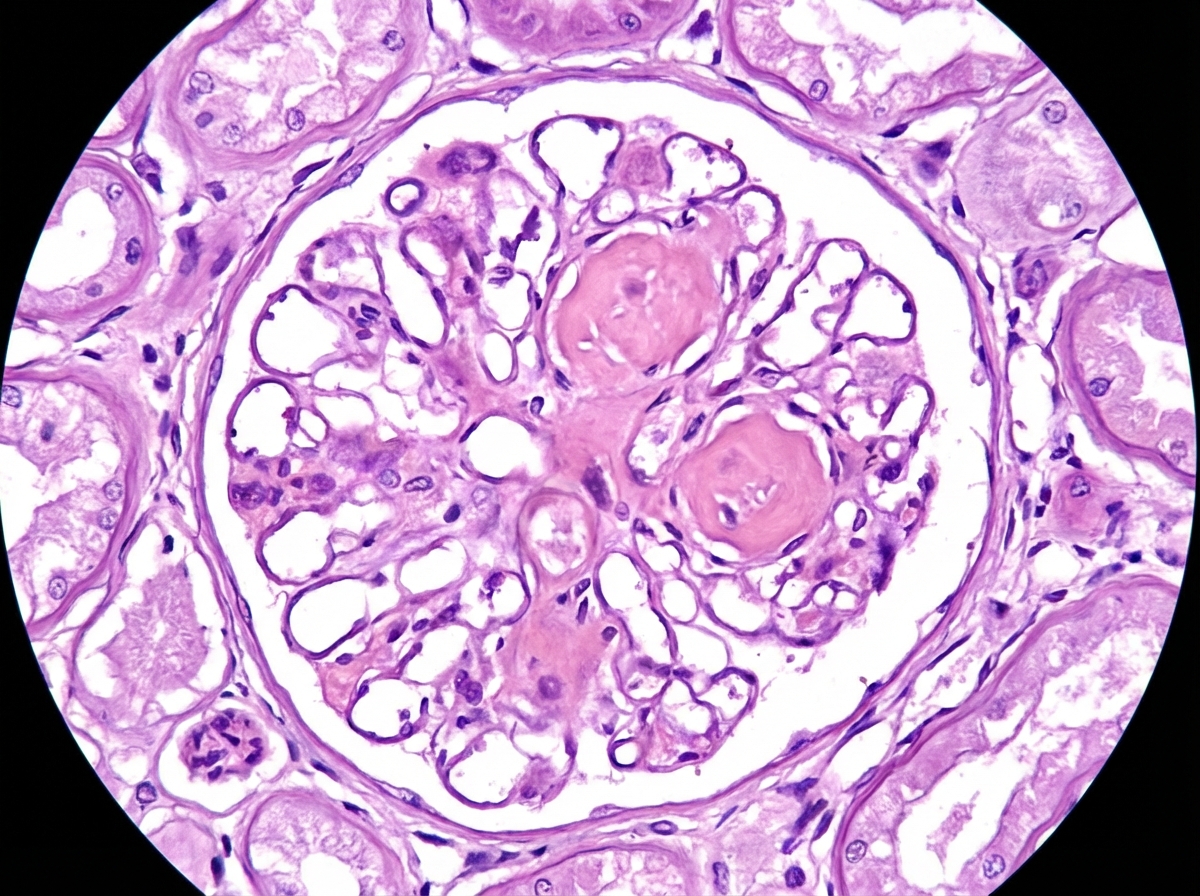
A 4-year-old girl is brought to the physician because of increasing swelling around her eyes and over both her feet for the past 4 days. During this period, she has had frothy light yellow urine. Her vital signs are within normal limits. Physical examination shows periorbital edema and 2+ pitting edema of the lower legs and ankles. A urinalysis of this patient is most likely to show which of the following findings?
A 43-year-old man is referred by his family physician because his urine dipstick reveals 3+ protein and urinalysis reveals 1-2 red cells/high power field, but is otherwise negative. He does not have any current complaints. His family history is irrelevant. He denies smoking and alcohol use. His temperature is 36.7°C (98.06°F), blood pressure is 130/82 mm Hg, and pulse is 78/min. Physical examination is unremarkable. Which of the following is the best next step in the management of this patient’s condition?
A 14-year-old boy is brought to the emergency department from school after falling in gym class. He was unable to stand after the accident and has a painful and swollen knee. On presentation he says that he has never had an incident like this before; however, he does suffer from hard to control nosebleeds and prolonged bleeding after minor cuts. Based on his presentation a panel of bleeding tests is obtained with the following results: Bleeding time: Prolonged Prothrombin time: Normal Partial thromboplastin time: Prolonged Which of the following describes the function of the component that is defective in the most likely cause of this patient's symptoms?
A 44-year-old woman comes to the physician with increasingly yellow sclera and pruritus over the past 3 months. She has intermittent right-upper-quadrant pain and discomfort. She has no history of any serious illnesses and takes no medications. Her vital signs are within normal limits. Her sclera are icteric. Skin examination shows linear scratch marks on the trunk and limbs. The remainder of the physical examination is unremarkable. Laboratory studies show: Complete blood count Hemoglobin 15 g/dL Mean corpuscular volume 95 μm3 Leukocyte count 6,000/mm3 with a normal differential Serum Alkaline phosphatase 470 U/L Aspartate aminotransferase (AST, GOT) 38 U/L Alanine aminotransferase (ALT, GPT) 45 U/L γ-Glutamyltransferase (GGT) 83 U/L (N=5–50 U/L) Bilirubin, total 2.7 mg/dL Bilirubin, direct 1.4 mg/dL Magnetic resonance cholangiopancreatography (MRCP) shows a multifocal and diffuse beaded appearance of the intrahepatic and extrahepatic biliary ducts. Which of the following is the most appropriate diagnostic study at this time?
A 32-year-old man comes to the emergency department because of recurrent episodes of vomiting for 1 day. He has had over 15 episodes of bilious vomiting. During this period he has had cramping abdominal pain but has not had a bowel movement or passed flatus. He does not have fever or diarrhea. He was diagnosed with Crohn disease at the age of 28 years which has been well controlled with oral mesalamine. He underwent a partial small bowel resection for midgut volvulus at birth. His other medications include vitamin B12, folic acid, loperamide, ferrous sulfate, and vitamin D3. He appears uncomfortable and his lips are parched. His temperature is 37.1°C (99.3°F), pulse is 103/min, and blood pressure is 104/70 mm Hg. The abdomen is distended, tympanitic, and tender to palpation over the periumbilical area and the right lower quadrant. Rectal examination is unremarkable. A CT scan of the abdomen shows multiple dilated loops of small bowel with a transition zone in the mid to distal ileum. After 24 hours of conservative management with IV fluid resuscitation, nasogastric bowel decompression, promethazine, and analgesia, his condition does not improve and a laparotomy is scheduled. During the laparotomy, two discrete strictures are noted in the mid-ileum, around 20 cm apart. Which of the following is the most appropriate next step in management?
Want unlimited practice?
Get full access to all questions, explanations, and performance tracking.
Scan to download app