
Hemolytic anemias — MCQs

A 3-year-old boy is brought to the physician because of a 1-week history of yellowish discoloration of his eyes and skin. He has had generalized fatigue and mild shortness of breath for the past month. Three weeks ago, he was treated for a urinary tract infection with antibiotics. His father underwent a splenectomy during childhood. Examination shows pale conjunctivae and jaundice. The abdomen is soft and nontender; there is nontender splenomegaly. Laboratory studies show: Hemoglobin 9.1 g/dL Mean corpuscular volume 89 μm3 Mean corpuscular hemoglobin 32 pg/cell Mean corpuscular hemoglobin concentration 37.8% Hb/cell Leukocyte count 7800/mm3 Platelet count 245,000/mm3 Red cell distribution width 22.8% (N=13%–15%) Serum Bilirubin Total 13.8 mg/dL Direct 1.9 mg/dL Lactate dehydrogenase 450 U/L Which of the following is the most likely pathophysiology of these findings?
A 2-year-old girl with a history of SS-hemoglobin is brought to her pediatrician by her mother, who noted an abdominal mass. On exam, the girl's spleen is palpably enlarged, and her palms and conjunctiva are noted to be extremely pale. Serum haptoglobin levels are decreased. Which of the following is the most likely cause of this patient's symptoms?
A 27-year-old African American man presents to a primary care physician for a routine checkup as a new patient. The patient states that he has been doing well lately and recently was promoted at his job. He states that 2 weeks ago he went to the ED for severe pain and was treated with morphine and oral fluids and discharged home that night. This had happened once before and he was treated similarly. The patient states that he drinks 7 to 8 alcoholic beverages per night and smokes 1 pack of cigarettes per day. The patient states that he has been gaining weight recently due to a diet consisting mostly of fast food. Basic labs are ordered as seen below. Hemoglobin: 8 g/dL Hematocrit: 28% Mean corpuscular volume: 72 um^3 Leukocyte count: 6,500/mm^3 with normal differential Platelet count: 157,000/mm^3 Serum: Na+: 139 mEq/L Cl-: 100 mEq/L K+: 4.3 mEq/L HCO3-: 25 mEq/L BUN: 20 mg/dL Glucose: 99 mg/dL Creatinine: 1.1 mg/dL LDH: 540 U/L Ca2+: 10.2 mg/dL AST: 12 U/L ALT: 10 U/L Which of the following is the best explanation of this patient's laboratory abnormalities?
A 21-year-old college student is admitted to the emergency department with complaints of pharyngitis, headache, and a persistent, non-productive, dry, hacking cough. The patient complains of feeling tired and fatigued and denies fever/chills. On physical examination, her mucosa is pale. A complete blood count is remarkable for decreased hemoglobin. The physician suspects viral pneumonia, but the sputum culture tests come back with the following description: ‘fried-egg shaped colonies on sterol-containing media, and mulberry-shaped colonies on media containing sterols’. A direct Coombs test comes back positive. Which of the following statements is true regarding the complications associated with Mycoplasma pneumoniae?
A 25-year-old man of Mediterranean descent makes an appointment with his physician because his skin and sclera have become yellow. He complains of fatigue and fever that started at the same time icterus appeared. On examination, he is tachycardic and tachypneic. The oxygen (O2) saturation is < 90%. He has increased unconjugated bilirubin, hemoglobinemia, and an increased number of reticulocytes in the peripheral blood. What is the most likely diagnosis?
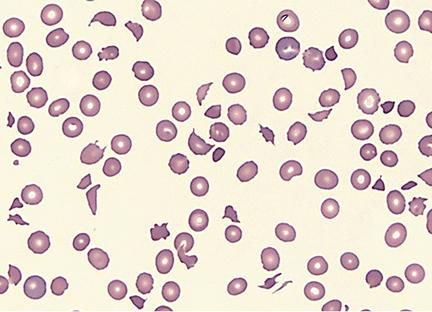
A 58-year old man comes to the emergency department because of progressively worsening shortness of breath and fatigue for 3 days. During the last month, he has also noticed dark colored urine. One month ago, he underwent mechanical aortic valve replacement for high-grade aortic stenosis. A photomicrograph of a peripheral blood smear from the patient is shown. Which of the following findings is most likely to be seen in this patient?
A 4-year-old boy is brought to the physician because of yellowish discoloration of his eyes and skin for 5 days. He has had generalized fatigue and mild shortness of breath over the past 2 months. Two weeks ago, he was treated for a urinary tract infection with antibiotics. His father has a history of undergoing a splenectomy in his childhood. Examination shows pale conjunctivae and jaundice. The abdomen is soft and nontender; the spleen is palpated 4 to 5 cm below the left costal margin. Laboratory studies show: Hemoglobin 9.9 g/dL Mean corpuscular volume 88 μm3 Mean corpuscular hemoglobin 31.7 pg/cell Mean corpuscular hemoglobin concentration 37.0% Hb/cell Leukocyte count 6600/mm3 Platelet count 233,000/mm3 Red cell distribution width 24.3% (N = 13–15) Serum Bilirubin Total 12.3 mg/dL Direct 1.8 mg/dL Lactate dehydrogenase 401 U/L Which of the following is the most likely cause of these findings?
A 55-year-old man comes to the physician because of progressive daytime sleepiness and exertional dyspnea for the past 6 months. Physical examination shows conjunctival pallor and several subcutaneous purple spots on his legs. His hemoglobin concentration is 8.5 g/dL, leukocyte count is 3,000/mm3, and platelet count is 16,000/mm3. Which of the following laboratory values is most likely to be increased in this patient?
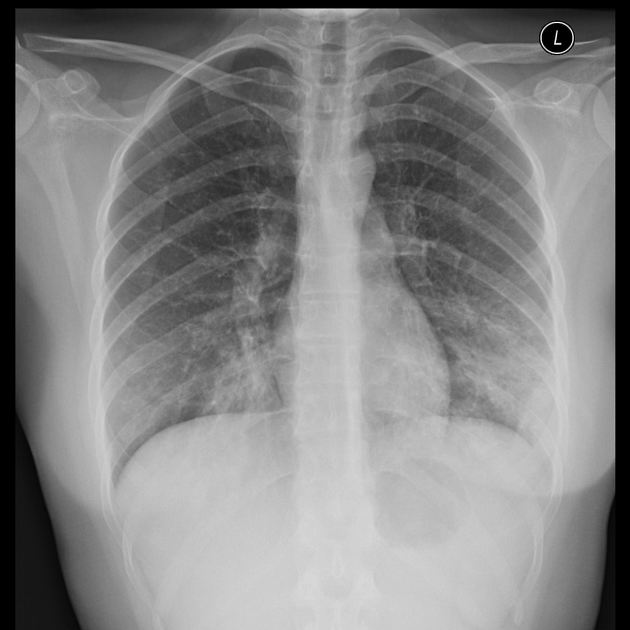
A 24-year-old woman, otherwise healthy, presents with a non-productive cough, sore throat, and myalgia. The patient reports that her symptoms started gradually 2 weeks ago and have not improved. She has no significant past medical history and no current medications. She is a college student and denies any recent overseas travel. The patient received the flu vaccine this year, and her 2-part PPD required for school was negative. She does not smoke, drink, or use recreational drugs. The patient denies being sexually active. The vital signs include: temperature 37.0°C (98.6°F), blood pressure 110/75 mm Hg, pulse 98/min, respirations 20/min, and oxygen saturation 99% on room air. On physical exam, the patient is alert and cooperative. The cardiac exam is normal. There are rales present bilaterally over both lung fields. The skin and conjunctiva are pale. The laboratory tests are pending. The chest X-ray is shown in the image. Which of the following laboratory findings would also commonly be found in this patient?
A 68-year-old woman comes to the physician because of increasing heartburn for the last few months. During this period, she has taken ranitidine several times a day without relief and has lost 10 kg (22 lbs). She has retrosternal pressure and burning with every meal. She has had heartburn for several years and took ranitidine as needed. She has hypertension. She has smoked one pack of cigarettes daily for the last 40 years and drinks one glass of wine occasionally. Other current medications include amlodipine and hydrochlorothiazide. She appears pale. Her height is 163 cm (5 ft 4 in), her weight is 75 kg (165 lbs), BMI is 27.5 kg/m2. Her temperature is 37.2°C (98.96°F), pulse is 78/min, and blood pressure is 135/80 mm Hg. Cardiovascular examination shows no abnormalities. Abdominal examination shows mild tenderness to palpation in the epigastric region. Bowel sounds are normal. The remainder of the examination shows no abnormalities. Laboratory studies show: Hemoglobin 10.2 g/dL Mean corpuscular volume 78 μm Mean corpuscular hemoglobin 23 pg/cell Leukocyte count 9,500/mm3 Platelet count 330,000/mm3 Serum Na+ 137 mEq/L K+ 3.8 mEq/L Cl- 100 mEq/L HCO3- 25 mEq/L Creatinine 1.2 mg/dL Lactate dehydrogenase 260 U/L Alanine aminotransferase 18 U/L Aspartate aminotransferase 15 U/L Lipase (N < 280 U/L) 40 U/L Troponin I (N < 0.1 ng/mL) 0.029 ng/mL An ECG shows normal sinus rhythm without ST-T changes. Which of the following is the most appropriate next step in the management of this patient?
Want unlimited practice?
Get full access to all questions, explanations, and performance tracking.
Scan to download app