
Anticoagulation management — MCQs

A 43-year-old woman was admitted to the hospital for anticoagulation following a pulmonary embolism. She was found to have a deep venous thrombosis on further workup after a long plane ride coming back from visiting China. She denies any personal history of blood clots in her past, but she says that her mother has also had to be treated for pulmonary embolism in the recent past. Her past medical history is significant for preeclampsia, hypertension, polycystic ovarian syndrome, and hypercholesterolemia. She currently smokes 1 pack of cigarettes per day, drinks a glass of wine per day, and she currently denies any illicit drug use. The vital signs include: temperature 36.7°C (98.0°F), blood pressure 126/74 mm Hg, heart rate 111/min, and respiratory rate 23/min. On physical examination, her pulses are bounding and complexion is pale, but breath sounds remain clear. Oxygen saturation was initially 81% on room air, with a new oxygen requirement of 8 L by face mask. On day 6 of combined heparin and warfarin anticoagulation, her platelet count decreases from 182,000/mcL to 63,000/mcL. Her international normalized ratio (INR) is not yet therapeutic. What is the next best step in therapy?
A 66-year-old man with coronary artery disease and hypertension comes to the emergency department because of intermittent retrosternal chest pain, lightheadedness, and palpitations. He has smoked one pack of cigarettes daily for 39 years. His pulse is 140/min and irregularly irregular, respirations are 20/min, and blood pressure is 108/60 mm Hg. An ECG shows an irregular, narrow-complex tachycardia with absent P waves. A drug with which of the following mechanisms of action is most likely to be effective in the long-term prevention of embolic stroke in this patient?
A 21-year-old woman comes to the physician because of a 1-day history of right leg pain. The pain is worse while walking and improves when resting. Eight months ago, she was diagnosed with a pulmonary embolism and was started on warfarin. Anticoagulant therapy was discontinued two months ago. Her mother had systemic lupus erythematosus. On examination, her right calf is diffusely erythematous, swollen, and tender. Cardiopulmonary examination shows no abnormalities. On duplex ultrasonography, the right popliteal vein is not compressible. Laboratory studies show an elevated serum level of D-dimer and insensitivity to activated protein C. Further evaluation of this patient is most likely to show which of the following?
A 28-year-old woman, gravida 1, para 0, at 32 weeks' gestation is evaluated for vaginal bleeding. Five days ago, she was admitted to the hospital and started on treatment for a deep vein thrombosis in the right leg. Her pulse is 125/min and blood pressure is 95/67 mm Hg. Physical examination shows large hematomas on the upper limbs and swelling in the right calf. There is a large amount of bright red blood in the vaginal vault. Laboratory studies show a hemoglobin of 8.9 mg/dL, platelet count of 185,000/mm3, and activated partial thromboplastin time of 160 seconds. Which of the following is the most appropriate pharmacotherapy to rapidly reverse this patient's coagulopathy?
A 68-year-old man undergoes successful mechanical prosthetic aortic valve replacement for severe aortic valve stenosis. After the procedure, he is started on an oral medication and instructed that he should take for the rest of his life and that he should avoid consuming large amounts of dark-green, leafy vegetables. Which of the following laboratory parameters should be regularly monitored to guide dosing of this drug?
A 59-year-old woman comes to the physician because of left leg swelling that started after a transcontinental flight. A duplex ultrasound of the left leg shows a noncompressible popliteal vein. A drug is prescribed that inhibits the coagulation cascade. Two weeks later, laboratory studies show: Platelet count 210,000/mm3 Partial thromboplastin time 28 seconds (normal: 25-35) Prothrombin time 12 seconds (normal: 11-13) Thrombin time 15 seconds (control: 15 seconds) Which of the following drugs was most likely prescribed?
A 74-year-old man presents to the emergency department with shortness of breath that started about 30 minutes ago. He is also experiencing chest pain on deep inspiration. He has several significant medical conditions including chronic obstructive pulmonary disease, hypertension, and dyslipidemia. He used to smoke about 3 packs of cigarettes every day until last year when he quit. He was in the emergency room 2 weeks ago for a hemorrhagic stroke which was promptly treated. He currently weighs 97.5 kg (215 lb). His respirations are 20/min, the blood pressure is 110/80 mm Hg, and the pulse is 105/min. On physical examination, Homan's sign is positive. An ECG and chest X-ray are performed. His current oxygen saturation is at 87% and D-dimer results are positive. He is wheeled in for a CT scan. What is the most appropriate initial treatment for this patient?
A 30-year-old man with history of intravenous drug use and methamphetamine-associated chronic thromboembolic pulmonary hypertension (CTEPH) is brought to the emergency department by his girlfriend for worsening abdominal pain and fevers. The patient said the pain was initially around his umbilicus, but he is now experiencing intense tenderness near his groin. He was initially prescribed rivaroxaban, but due to insurance issues, he was switched to warfarin for management of CTEPH two weeks ago. His temperature is 102°F (38.9°C), blood pressure is 95/60 mmHg, pulse is 95/min, respirations are 22/min. He states that his blood pressure usually runs low. His physical exam is notable for an unremarkable cardiac exam, bibasilar crackles, and RLQ tenderness with rebound tenderness when the LLQ is palpated. Laboratory results are shown below: Hemoglobin: 11 g/dL Hematocrit: 35 % Leukocyte count: 16,000/mm^3 with normal differential Platelet count: 190,000/mm^3 Serum: Na+: 137 mEq/L Cl-: 100 mEq/L K+: 3.7 mEq/L HCO3-: 23 mEq/L BUN: 40 mg/dL Glucose: 110 mg/dL Creatinine: 0.8 mg/dL Ca2+: 9.1 mg/dL AST: 34 U/L ALT: 45 U/L International normalized ratio (INR): 6.2 Prothrombin time (PT): 40 seconds Partial thromboplastin time: 70 seconds Blood type: O Rhesus: Positive Antibody screen: Negative A clinical diagnosis is made and supported by the surgical consult team in lieu of imaging. The next operating room for an add-on procedure will not be available for another 5 hours. Appropriate medical therapy is initiated. What is the best next step for surgical optimization?
A 52-year-old man who was recently hospitalized with a pulmonary embolism is put on an unfractionated heparin drip as a bridge to chronic warfarin therapy. During morning rounds, he is found to have diffuse bruising despite minimal trauma, and his heparin infusion rate is found to be faster than prescribed. A coagulation panel is obtained, which shows a aPTT of 130 seconds (therapeutic 70-120 seconds), and the decision is made to reverse the effects of heparin. Which of the following would most likely be administered in order to do this?
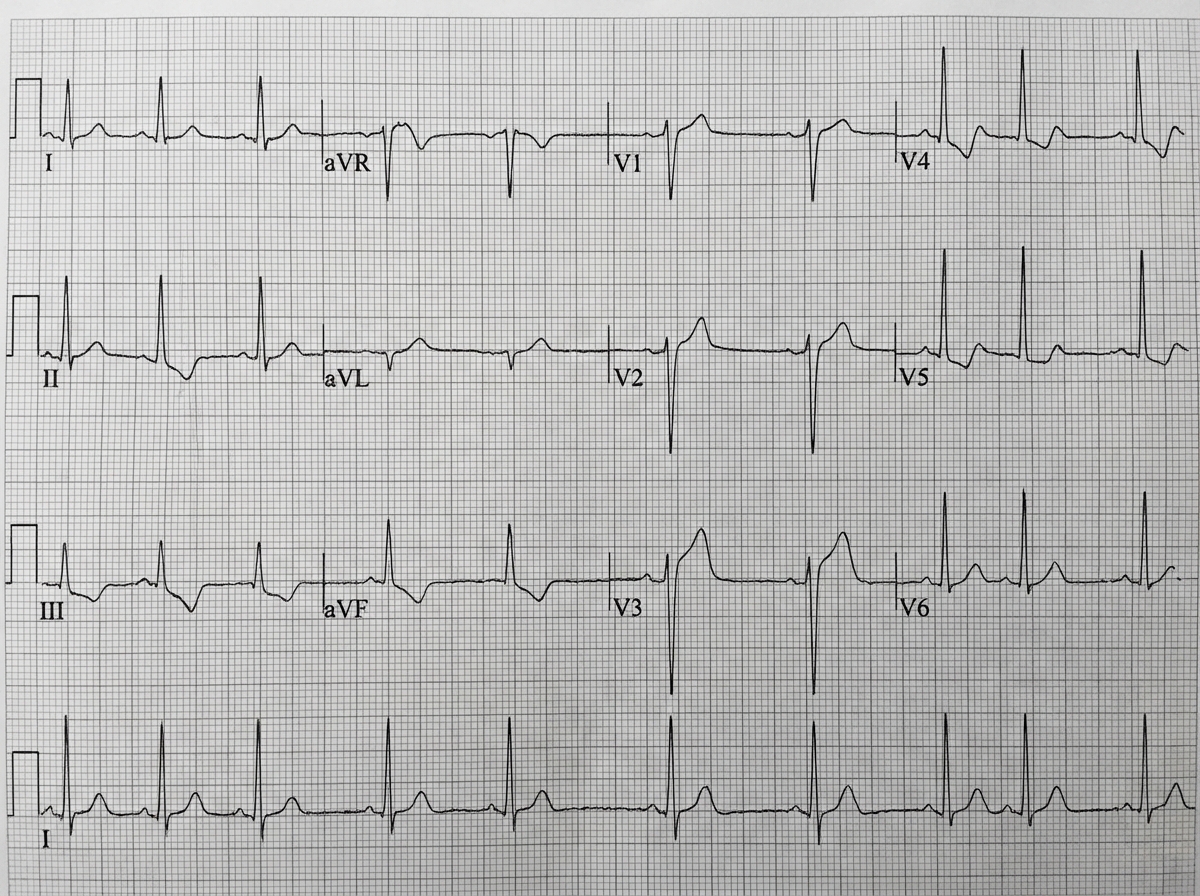
A 71-year-old man develops worsening chest pressure while shoveling snow in the morning. He tells his wife that he has a squeezing pain that is radiating to his jaw and left arm. His wife calls for an ambulance. On the way, he received chewable aspirin and 3 doses of sublingual nitroglycerin with little relief of pain. He has borderline diabetes and essential hypertension. He has smoked 15–20 cigarettes daily for the past 37 years. His blood pressure is 172/91 mm Hg, the heart rate is 111/min and the temperature is 36.7°C (98.0°F). On physical examination in the emergency department, he looks pale, very anxious and diaphoretic. His ECG is shown in the image. Troponin levels are elevated. Which of the following is the best next step in the management of this patient condition?
Want unlimited practice?
Get full access to all questions, explanations, and performance tracking.
Scan to download app