
Metabolic bone disease — MCQs

A 65-year-old female with chronic renal failure presents with recent onset of bone pain. Serum analysis reveals decreased levels of calcium and elevated levels of parathyroid hormone. One of the mechanisms driving the elevated PTH is most similar to that seen in:
A 70-year-old woman presents to the office for a yearly physical. She states she has recently started experiencing pain in her legs and her back. Last year, she experienced a fracture of her left arm while trying to lift groceries. The patient states that she does not consume any dairy and does not go outside often because of the pain in her legs and back. Of note, she takes carbamazepine for seizures. On exam, her vitals are within normal limits. You suspect the patient might have osteomalacia. Testing for which of the following is the next best step to confirm your suspicion?
A 47-year-old African-American woman presents to her primary care physician for a general checkup appointment. She works as a middle school teacher and has a 25 pack-year smoking history. She has a body mass index (BMI) of 22 kg/m^2 and is a vegetarian. Her last menstrual period was 1 week ago. Her current medications include oral contraceptive pills. Which of the following is a risk factor for osteoporosis in this patient?
An investigator is studying the effects of hyperphosphatemia on calcium homeostasis. A high-dose phosphate infusion is administered intravenously to a healthy subject over the course of 3 hours. Which of the following sets of changes is most likely to occur in response to the infusion? $$$ Serum parathyroid hormone %%% Serum total calcium %%% Serum calcitriol %%% Urine phosphate $$$
A 64-year-old female presents to her primary care physician for an annual checkup. She states that her health is adequate, but she has not been doing well since her husband died last year. She is able to get by but admits to having trouble caring for herself, cooking, cleaning, and paying her bills. The patient complains of diffuse muscle aches and pains. She has a past medical history of anxiety and seasonal affective disorder. She is not currently taking any medications. On physical exam, you note a gaunt woman with a depressed affect. You note that her body mass index (BMI) and height have both decreased since her last annual visit. On physical exam, her cardiac, pulmonary, and abdominal exams are within normal limits. Lab work is drawn and is as follows: Serum: Na+: 135 mEq/L K+: 3.7 mEq/L Cl-: 100 mEq/L HCO3-: 23 mEq/L Urea nitrogen: 7 mg/dL Glucose: 70 mg/dL Creatinine: 0.8 mg/dL Ca2+: 8.0 mg/dL Mg2+: 1.5 mEq/L Parathyroid hormone: 855 pg/mL Alkaline phosphatase: 135 U/L Phosphorus: 2.6 mg/dL Hemoglobin: 14 g/dL Hematocrit: 36% Platelet count: 187,000/mm^3 Leukocyte count: 4,700/mm^3 What is the most likely diagnosis?
A 58-year-old man comes to the physician because of a 6-month history of headaches and back pain. Examination shows mild sensorineural hearing loss. Serum concentration of alkaline phosphatase is increased. An x-ray of the skull is shown. The most appropriate pharmacotherapy for this patient is a drug that has which of the following mechanisms of action?
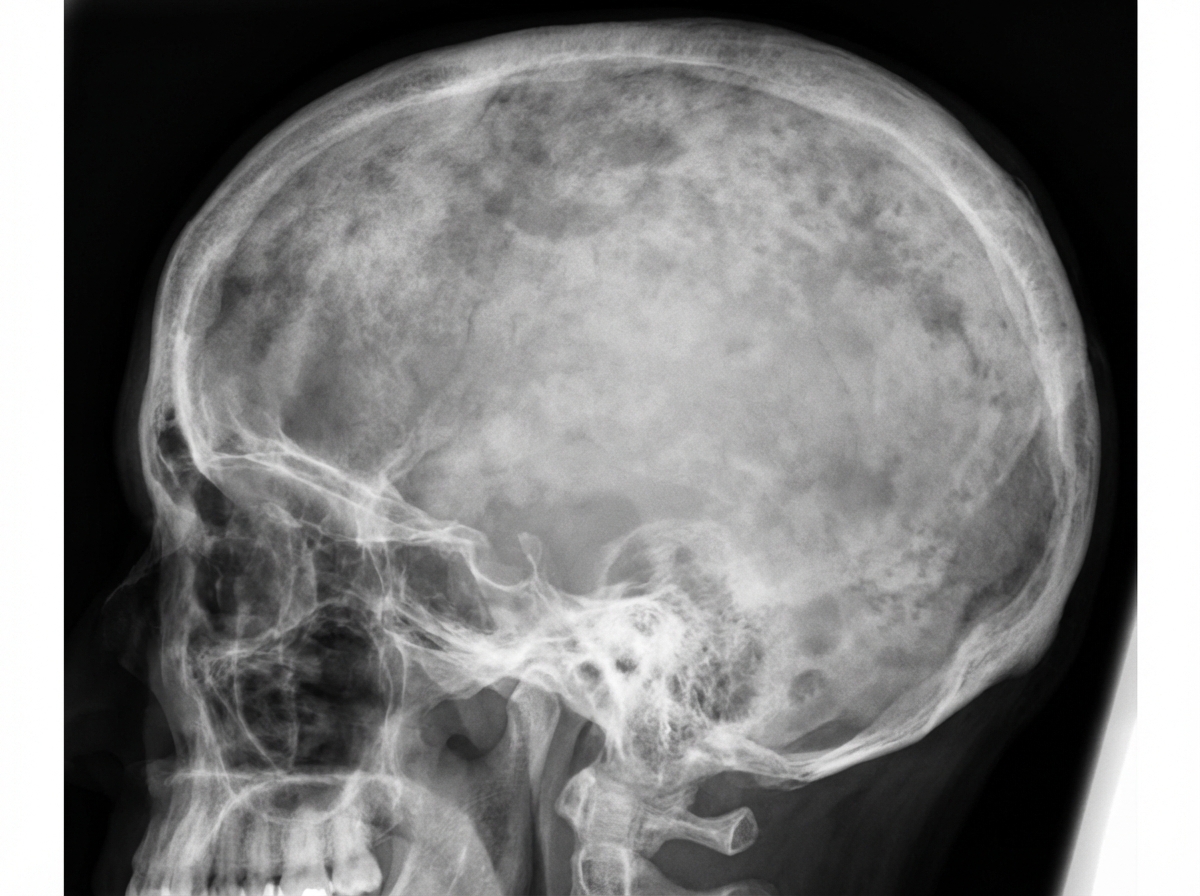
A 67-year-old male presents with left hip pain. Examination reveals mild effusions in both knees, with crepitus in both patellofemoral joints. He states his hearing has worsened recently and that he feels like his hats don't fit anymore. Bone scan reveals diffuse uptake in the calvarium, right proximal femur, and left ilium. Which of the following laboratory abnormalities would be expected in this patient?
A 61-year-old woman comes to the physician because of a constant, dull headache and generalized body pains for the past 8 months. She has also had difficulty hearing from her left side, which started a month after the onset of the headaches. Five months ago, she had surgery to correct a fracture of the right femur that occurred without a fall or any significant trauma. Five years ago, she underwent a total thyroidectomy for localized thyroid carcinoma. She takes levothyroxine and calcium supplements, which she started after menopause. Physical examination reveals a prominent forehead and irregular, tender skull surface. Bony tenderness is present over bilateral hip and knee joints, with decreased range of motion of the right hip joint and increased anterior curvature of both tibias. Laboratory studies show a highly elevated level of alkaline phosphatase, with vitamin D, calcium and PTH levels within normal limits. A plain x-ray of the head is most likely to show which of the following findings?
A 55-year-old woman comes to the physician because of a 6-month history of worsening shortness of breath on exertion and fatigue. She has type 1 diabetes mellitus, hypertension, hypercholesterolemia, and chronic kidney disease. Her mother was diagnosed with colon cancer at the age of 65 years. Her blood pressure is 145/92 mm Hg. Examination shows conjunctival pallor. Laboratory studies show: Hemoglobin 9.2 g/dL Mean corpuscular volume 88 μm3 Reticulocyte count 0.6 % Serum Ferritin 145 ng/mL Creatinine 3.1 mg/dL Calcium 8.8 mg/dL A fecal occult blood test is pending. Which of the following is the most likely underlying cause of this patient's symptoms?
An investigator is studying bone metabolism and compares the serum studies and bone biopsy findings of a cohort of women 25–35 years of age with those from a cohort of women 55–65 years of age. Which of the following processes is most likely to be increased in the cohort of older women?
Want unlimited practice?
Get full access to all questions, explanations, and performance tracking.
Scan to download app