
Hypothyroidism — MCQs

A 43-year-old woman presents to the physician with the complaint of worsening fatigue over the past several months. She has found that she requires nearly double the amount of coffee consumption each day to stay awake at work and that despite maintaining a balanced, healthy diet, she has experienced significant weight gain. A blood test confirms the presence of anti-thyroid peroxidase antibodies. Which of the following additional findings would be most consistent with the underlying pathophysiology of her condition?
A 45-year-old woman presents to her primary care provider complaining of daytime drowsiness and fatigue. She reports that she can manage at most a couple of hours of work before needing a nap. She has also noted impaired memory and a 6.8 kg (15 lb) weight gain. She denies shortness of breath, chest pain, lightheadedness, or blood in her stool. At the doctor’s office, the vital signs include: pulse 58/min, blood pressure 104/68 mm Hg, and oxygen saturation 99% on room air. The physical exam is notable only for slightly dry skin. The complete blood count (CBC) is within normal limits. Which of the following is a likely additional finding in this patient?
A 27-year-old G1P0 at 12 weeks estimated gestational age presents for prenatal care. The patient says she has occasional nausea and vomiting and a few episodes of palpitations and diarrhea this last week. Physical examination is unremarkable, except for a heart rate of 145/min. Basic thyroid function tests are shown in the table below. Which of the following additional laboratory tests would be most useful in assessing this patient's condition? Thyroid-stimulating hormone (TSH) 0.28 mIU/L (0.3–4.5 mIU/L) Total T4 12 µg/dL (5.4–11.5 µg/dL)
A 49-year-old woman presents to the office because of tremors for 2 months. She says that her hands have been shaking a lot, especially when she feels stressed. In addition, she has been sweating more than usual and has lost 8 kg (17.6 lb) in the last 2 months. She has a past medical history of vitiligo. Her vital signs are a heart rate of 98/min, a respiratory rate of 14/min, a temperature of 37.6°C (99.7°F), and a blood pressure of 115/75 mm Hg. Physical examination shows a fine, bilateral hand tremor and a diffuse goiter. Which of the following hormonal imbalances is most likely present?
A 44-year-old woman comes to the physician because of a 6-month history of fatigue, constipation, and a 7-kg (15.4-lb) weight gain. Menses occur irregularly in intervals of 40–50 days. Her pulse is 51/min, and blood pressure is 145/86 mm Hg. Examination shows conjunctival pallor and cool, dry skin. There is mild, nonpitting periorbital edema. Serum thyroid-stimulating hormone concentration is 8.1 μU/mL. Treatment with the appropriate pharmacotherapy is initiated. After several weeks of therapy with this drug, which of the following hormonal changes is expected?
A 54-year-old woman is brought to the emergency department by a nurse 30 minutes after receiving scheduled radiation therapy for papillary thyroid cancer. After the radioisotope was ingested, the physician realized that a much larger fixed dose was given instead of the appropriate dose based on radiation dosimetry. Which of the following pharmacotherapies should be administered immediately to prevent complications from this exposure?
A 23-year-old woman is brought to the emergency department by her friend because of a 1-hour episode of confusion. Earlier that night, they were at a dance club, and the patient was very energetic and euphoric. Thirty minutes after arriving, she became agitated and nauseous. She no longer seemed to know where she was or how she got there, and she began talking to herself. She has no major medical illness. She is an undergraduate student at a local college. She does not smoke but drinks 10–14 mixed drinks each week. Her temperature is 38.3°C (100.9°F), pulse is 115/min and regular, respirations are 16/min, and blood pressure is 138/84 mm Hg. She oriented to self but not to time or place. Throughout the examination, she grinds her teeth. Her pupils are 7 mm in diameter and minimally reactive. Her skin is diffusely flushed and diaphoretic. Cardiopulmonary examination shows no abnormalities. Serum studies show: Na+ 129 mEq/L K+ 3.7 mEq/L HCO3- 22 mEq/L Creatinine 1.2 mg/dL Glucose 81 mg/dL Which of the following substances is the most likely cause of this patient's presentation?
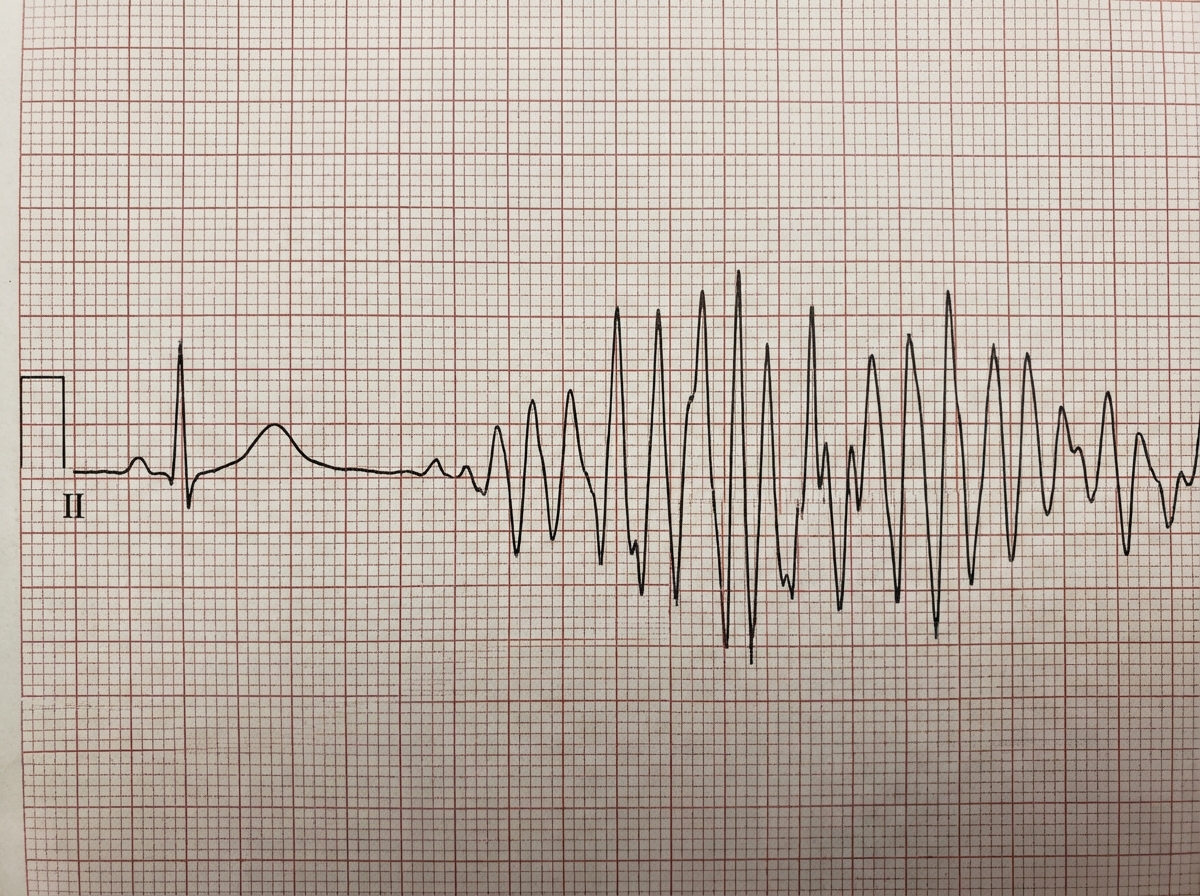
Four days into hospitalization for severe pneumonia, a 76-year-old woman suddenly becomes unresponsive. She has no history of heart disease. She is on clarithromycin and ceftriaxone. Her carotid pulse is not detected. A single-lead ECG strip is shown. Previous ECG shows QT prolongation. Laboratory studies show: Serum Na+ 145 mEq/L K+ 6.1 mEq/L Ca2+ 10.5 mEq/L Mg2+ 1.8 mEq/L Thyroid-stimulating hormone 0.1 μU/mL Cardiopulmonary resuscitation has been initiated. Which of the following is the most likely underlying cause of this patient’s recent condition?
A 42-year-old man presents to the clinic for a several-month history of fatigue, and it is starting to affect his work. He often needs to sneak away in the middle of the day to take naps or else he cannot focus and is at risk of falling asleep at his desk. He has been feeling like this for approximately 1 year. Otherwise, he feels healthy and takes no medications. On further questioning, he also had constipation and thinks he has gained some weight. He denies shortness of breath, chest pain, lightheadedness, or blood in his stool. The vital signs include: pulse 56/min, blood pressure 124/78 mm Hg, and oxygen saturation 99% on room air. The physical exam is notable only for slightly dry skin. The complete blood count (CBC) is within normal limits, and the thyroid-stimulating hormone (TSH) is 8.0 μU/mL. Which of the following is the next best treatment for this patient?
A 41-year-old woman comes to the physician because of a 3-month history of anxiety, difficulty falling asleep, heat intolerance, and a 6-kg (13.2-lb) weight loss. The patient's nephew, who is studying medicine, mentioned that her symptoms might be caused by a condition that is due to somatic activating mutations of the genes for the TSH receptor. Examination shows warm, moist skin and a 2-cm, nontender, subcutaneous mass on the anterior neck. Which of the following additional findings should most raise concern for a different underlying etiology of her symptoms?
Want unlimited practice?
Get full access to all questions, explanations, and performance tracking.
Scan to download app