
Antiplatelet therapy — MCQs

A 53-year-old man is brought to the emergency department because of wheezing and shortness of breath that began 1 hour after he took a new medication. Earlier in the day he was diagnosed with stable angina pectoris and prescribed a drug that irreversibly inhibits cyclooxygenase-1 and 2. He has chronic rhinosinusitis and asthma treated with inhaled β-adrenergic agonists and corticosteroids. His respirations are 26/min. Examination shows multiple small, erythematous nasal mucosal lesions. After the patient is stabilized, therapy for primary prevention of coronary artery disease should be switched to a drug with which of the following mechanisms of action?
A 66-year-old woman presents to the emergency department complaining of palpitations. She says that she has been experiencing palpitations and lightheadedness for the past 6 months, but before this morning the episodes usually resolved on their own. The patient's medical history is significant for a transient ischemia attack 2 months ago, hypertension, and diabetes. She takes aspirin, metformin, and lisinopril. She states her grandfather died of a stroke, and her mom has a "blood disorder." An electrocardiogram is obtained that shows an irregularly irregular rhythm with rapid ventricular response, consistent with atrial fibrillation. She is given intravenous metoprolol, which resolves her symptoms. In addition to starting a beta-blocker for long-term management, the patient meets criteria for anticoagulation. Both unfractionated heparin and warfarin are started. Five days later, the patient begins complaining of pain and swelling of her left lower extremity. A Doppler ultrasound reveals thrombosis in her left popliteal and tibial veins. A complete blood count is obtained that shows a decrease in platelet count from 245,000/mm^3 to 90,000/mm^3. Coagulation studies are shown below: Prothrombin time (PT): 15 seconds Partial thromboplastin time (PTT): 37 seconds Bleeding time: 14 minutes Which of the following is the most likely diagnosis?
A 54-year-old man is brought to the emergency department 1 hour after the sudden onset of shortness of breath, severe chest pain, and sweating. He has hypertension and type 2 diabetes mellitus. He has smoked one pack and a half of cigarettes daily for 20 years. An ECG shows ST-segment elevations in leads II, III, and avF. The next hospital with a cardiac catheterization unit is more than 2 hours away. Reperfusion pharmacotherapy is initiated. Which of the following is the primary mechanism of action of this medication?
A 70-year-old male presents for an annual exam. His past medical history is notable for shortness of breath when he sleeps, and upon exertion. Recently he has experienced dyspnea and lower extremity edema that seems to be worsening. Both of these symptoms have resolved since he was started on several medications and instructed to weigh himself daily. Which of the following is most likely a component of his medical management?
Drug A is an experimental compound being investigated for potential use as a protectant against venous thrombosis. Binding assays reveal that the drug’s primary mechanism of action is to block carboxylation of glutamic acid residues in certain serum proteins. Drug A is most similar to which of the following:
A 69-year-old man is brought by his son to the emergency department with weakness in his right arm and leg. The man insists that he is fine and blames his son for "creating panic". Four hours ago the patient was having tea with his wife when he suddenly dropped his teacup. He has had difficulty moving his right arm since then and cannot walk because his right leg feels stuck. He has a history of hypertension and dyslipidemia, for which he currently takes lisinopril and atorvastatin, respectively. He is allergic to aspirin and peanuts. A computerized tomography (CT) scan shows evidence of an ischemic stroke. Which medication would most likely prevent such attacks in this patient in the future?
A 73-year-old man presents to the outpatient clinic complaining of chest pain with exertion. He states that resting for a few minutes usually resolves the chest pain. Currently, he takes 81 mg of aspirin daily. He has a blood pressure of 127/85 mm Hg and heart rate of 75/min. Physical examination reveals regular heart sounds and clear lung sounds bilateral. Which medication regimen below should be added?
A 64-year-old woman comes to the emergency room because of a sudden weakness in her right arm and leg. She has atrial fibrillation, tinea unguium, gastroesophageal reflux disease, hypertension, and hypercholesterolemia. Current medications include warfarin, enalapril, simvastatin, lansoprazole, hydrochlorothiazide, griseofulvin, and ginkgo biloba. Two weeks ago, she had an appointment with her podiatrist. Physical examination shows sagging of her right lower face and decreased muscle strength in her right upper and lower extremity. Babinski sign is positive on the right. Her prothrombin time is 14 seconds (INR = 1.5). Which of the following drugs is the most likely underlying cause of this patient's current condition?
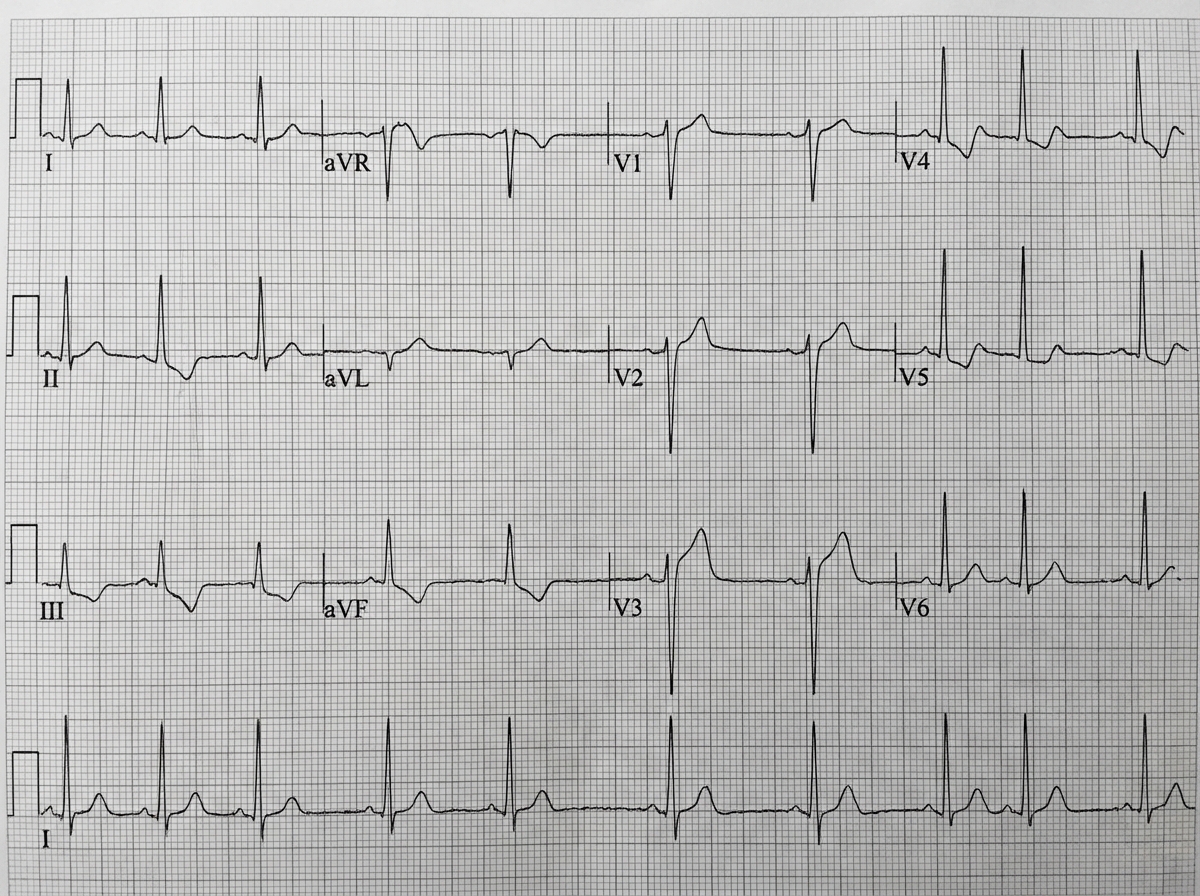
A 71-year-old man develops worsening chest pressure while shoveling snow in the morning. He tells his wife that he has a squeezing pain that is radiating to his jaw and left arm. His wife calls for an ambulance. On the way, he received chewable aspirin and 3 doses of sublingual nitroglycerin with little relief of pain. He has borderline diabetes and essential hypertension. He has smoked 15–20 cigarettes daily for the past 37 years. His blood pressure is 172/91 mm Hg, the heart rate is 111/min and the temperature is 36.7°C (98.0°F). On physical examination in the emergency department, he looks pale, very anxious and diaphoretic. His ECG is shown in the image. Troponin levels are elevated. Which of the following is the best next step in the management of this patient condition?
A 71-year-old woman presents with a transient episode of right arm and hand weakness that resolved in approximately one hour. Her symptoms started while she was gardening. Her past medical history is notable for hypertension, diabetes, anxiety, and dyslipidemia. Her current medications include insulin, metformin, and fluoxetine. Examination reveals a left carotid bruit. Ultrasound duplex of her carotid arteries demonstrates right and left carotid stenosis of 35% and 50%, respectively. Which of the following is the best next step in management?
Want unlimited practice?
Get full access to all questions, explanations, and performance tracking.
Scan to download app