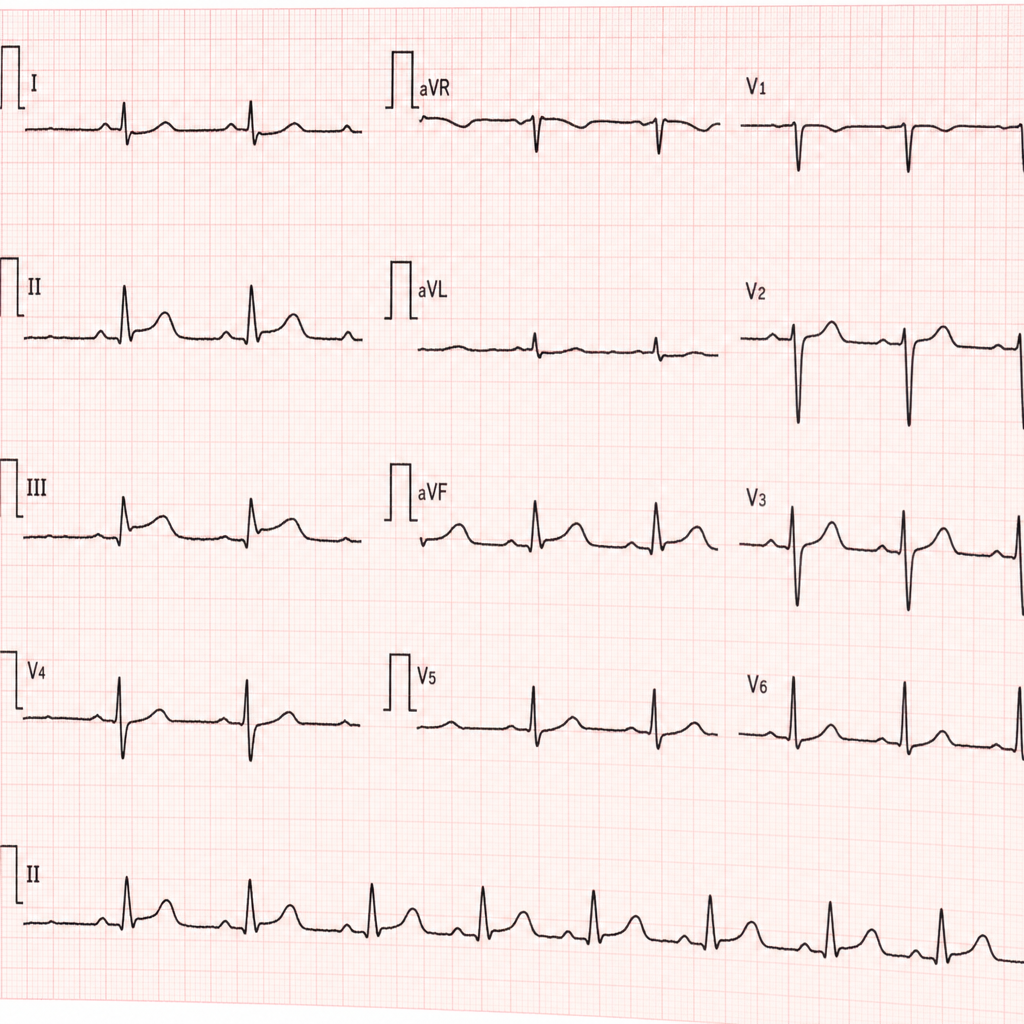
A 56-year-old patient developed excruciating chest discomfort in the past 72 hours, relieved by GTN spray. Troponin I is normal, and the ECG shows features of left ventricular hypertrophy (LVH) with T wave flattening. The patient is already on statins, aspirin, and metoprolol 50 mg . What is the next best step in management?
Q2
A 78-year-old male with a 35-pack-year smoking history, hyperlipidemia, and peripheral vascular disease is at home eating dinner with his wife when he suddenly has acute onset, crushing chest pain. He lives in a remote rural area, and, by the time the paramedics arrive 30 minutes later, he is pronounced dead. What is the most likely cause of this patient's death?
Q3
A 57-year-old man is brought to the emergency department after having chest pain for the last hour. He rates his pain as 8/10, dull in character, and says it is associated with sweating and shortness of breath. He has a history of diabetes and hypercholesterolemia. His current medication list includes amlodipine, aspirin, atorvastatin, insulin, and esomeprazole. He has smoked 2 packs of cigarettes per day for the past 25 years. His blood pressure is 98/66 mm Hg, pulse is 110/min, oxygen saturation is 94% on room air, and BMI is 31.8 kg/m2. His lungs are clear to auscultation. An electrocardiogram (ECG) is shown below. The patient is given 325 mg of oral aspirin and sublingual nitroglycerin. What is the most appropriate next step in the management of this condition?
Q4
A 73-year-old woman arrives at the emergency department due to intense central chest pain for 30 minutes this morning. She says the pain was cramping in nature and radiated down her left arm. She has a history of atrial fibrillation and type 2 diabetes mellitus. Her pulse is 98/min, respiratory rate is 19/min, temperature is 36.8°C (98.2°F), and blood pressure is 160/91 mm Hg. Cardiovascular examination shows no abnormalities. ECG is shown below. Which of the following biochemical markers would most likely be elevated and remain elevated for a week after this acute event?
Q5
A 55-year-old woman is brought to the emergency department by her husband because of chest pain and a cough productive of blood-tinged sputum that started 1 hour ago. Two days ago, she returned from a trip to China. She has smoked 1 pack of cigarettes daily for 35 years. Her only home medication is oral hormone replacement therapy for postmenopausal hot flashes. Her pulse is 123/min and blood pressure is 91/55 mm Hg. Physical examination shows distended neck veins. An ECG shows sinus tachycardia, a right bundle branch block, and T-wave inversion in leads V5–V6. Despite appropriate lifesaving measures, the patient dies. Examination of the lung on autopsy shows a large, acute thrombus in the right pulmonary artery. Based on the autopsy findings, which of the following is the most likely origin of the thrombus?
ACS US Medical PG Practice Questions and MCQs
Question 1: A 56-year-old patient developed excruciating chest discomfort in the past 72 hours, relieved by GTN spray. Troponin I is normal, and the ECG shows features of left ventricular hypertrophy (LVH) with T wave flattening. The patient is already on statins, aspirin, and metoprolol 50 mg . What is the next best step in management?
A. LMWH (Low Molecular Weight Heparin)
B. Increase beta blocker dose
C. IV NTG Drip
D. Add Clopidogrel (Correct Answer)
E. Arrange urgent coronary angiography
Explanation: ***Add Clopidogrel***
- The patient presents with **unstable angina** (chest discomfort relieved by GTN, normal troponin, and ECG changes indicative of ischemia) and is already on aspirin, statins, and a beta-blocker.
- Adding **clopidogrel** (or another P2Y12 inhibitor) is crucial for **dual antiplatelet therapy (DAPT)**, which is a cornerstone in the management of unstable angina/NSTEMI to prevent further thrombotic events.
- This is the **immediate next step** to optimize medical therapy before considering invasive strategies.
*LMWH (Low Molecular Weight Heparin)*
- While **anticoagulation** is important in acute coronary syndromes and would be appropriate to add, the question asks for the **next best step** given the patient's existing management.
- LMWH would typically be added alongside DAPT, but establishing dual antiplatelet therapy takes priority.
*Increase beta blocker dose*
- The patient is already on metoprolol 50 mg, and while **titrating beta-blockers** is important for symptom control and reducing myocardial oxygen demand, the immediate priority in unstable angina is to address the underlying thrombotic process with DAPT.
- Beta-blocker optimization can be done after ensuring adequate antiplatelet therapy.
*IV NTG Drip*
- **Intravenous nitroglycerin (IV NTG)** is used to relieve ongoing chest pain and reduce preload/afterload, especially in severe or refractory symptoms.
- However, the patient's chest discomfort was already **relieved by GTN spray**, indicating that immediate pain control with IV NTG is not the most urgent next step compared to preventing further thrombotic events with DAPT.
*Arrange urgent coronary angiography*
- While **coronary angiography** is indicated in high-risk unstable angina, the immediate next step is to **optimize medical management** with dual antiplatelet therapy.
- Angiography timing depends on risk stratification; in a stable patient already on aspirin, beta-blockers, and statins, adding clopidogrel first ensures optimal antiplatelet coverage before any invasive procedure.
- Early invasive strategy (angiography within 24-72 hours) would be appropriate after medical stabilization.
Question 2: A 78-year-old male with a 35-pack-year smoking history, hyperlipidemia, and peripheral vascular disease is at home eating dinner with his wife when he suddenly has acute onset, crushing chest pain. He lives in a remote rural area, and, by the time the paramedics arrive 30 minutes later, he is pronounced dead. What is the most likely cause of this patient's death?
A. Ventricular septum rupture
B. Heart block
C. Ventricular fibrillation (Correct Answer)
D. Chordae tendineae rupture
E. Cardiac tamponade
Explanation: ***Ventricular fibrillation***
- This is the most common cause of sudden cardiac death in the setting of acute **myocardial infarction** (MI), especially in the initial hours.
- The sudden onset of **crushing chest pain** in a patient with significant cardiac risk factors strongly suggests an acute MI, leading to electrical instability.
*Ventricular septum rupture*
- A ventricular septum rupture is a mechanical complication of MI that typically occurs **3 to 5 days post-infarction**, not acutely.
- It would present with a new **holosystolic murmur** and signs of heart failure (e.g., hypotension, pulmonary edema), symptoms not described here.
*Heart block*
- While heart blocks can occur during MI, they usually cause **bradycardia** and syncope rather than sudden death from acute crushing chest pain, unless they progress to asystole.
- A heart block alone is less likely to be the immediate cause of sudden death in this scenario compared to a severe arrhythmia.
*Chordae tendineae rupture*
- Chordae tendineae rupture is also a mechanical complication of MI that usually occurs **2 to 7 days post-infarction** and leads to severe **mitral regurgitation**.
- It would present with acute pulmonary edema and a new harsh holosystolic murmur, which would develop after the initial chest pain, not as the immediate cause of sudden demise.
*Cardiac tamponade*
- Cardiac tamponade from a **free wall rupture** is a catastrophic complication that typically occurs 1 to 3 days after MI.
- It presents with **Beck's triad** (hypotension, jugular venous distension, muffled heart sounds) and pulsus paradoxus, which are not described in this acute, sudden death scenario.
Question 3: A 57-year-old man is brought to the emergency department after having chest pain for the last hour. He rates his pain as 8/10, dull in character, and says it is associated with sweating and shortness of breath. He has a history of diabetes and hypercholesterolemia. His current medication list includes amlodipine, aspirin, atorvastatin, insulin, and esomeprazole. He has smoked 2 packs of cigarettes per day for the past 25 years. His blood pressure is 98/66 mm Hg, pulse is 110/min, oxygen saturation is 94% on room air, and BMI is 31.8 kg/m2. His lungs are clear to auscultation. An electrocardiogram (ECG) is shown below. The patient is given 325 mg of oral aspirin and sublingual nitroglycerin. What is the most appropriate next step in the management of this condition?
A. Observation
B. Echocardiography
C. Percutaneous coronary intervention (Correct Answer)
D. Enoxaparin
E. Metoprolol
Explanation: ***Percutaneous coronary intervention***
- The ECG shows significant **ST-segment elevation in leads V2-V6, I, and aVL**, indicating an anterior and lateral ST-elevation myocardial infarction (STEMI).
- Given the ongoing chest pain and ECG findings, **emergent percutaneous coronary intervention (PCI)** is the most appropriate next step to restore blood flow and minimize myocardial damage.
*Observation*
- This patient is experiencing an acute STEMI, which requires immediate and aggressive intervention, not just observation.
- Delaying treatment significantly increases the risk of large infarction, heart failure, and death.
*Echocardiography*
- While echocardiography is useful in evaluating myocardial function and assessing complications after an MI, it is not the immediate priority in a patient with ongoing STEMI.
- The focus must be on prompt reperfusion, usually within 90 minutes of first medical contact.
*Enoxaparin*
- Enoxaparin is an anticoagulant often used in acute coronary syndrome management, including STEMI.
- However, it is an adjunctive therapy to reperfusion, and not the definitive next step for someone presenting with an acute STEMI.
*Metoprolol*
- Beta-blockers like metoprolol can be beneficial in STEMI to reduce myocardial oxygen demand and modify ventricular remodeling.
- However, they are typically given after reperfusion therapy is initiated and the patient is hemodynamically stable, especially in the setting of hypotension (98/66 mmHg here).
Question 4: A 73-year-old woman arrives at the emergency department due to intense central chest pain for 30 minutes this morning. She says the pain was cramping in nature and radiated down her left arm. She has a history of atrial fibrillation and type 2 diabetes mellitus. Her pulse is 98/min, respiratory rate is 19/min, temperature is 36.8°C (98.2°F), and blood pressure is 160/91 mm Hg. Cardiovascular examination shows no abnormalities. ECG is shown below. Which of the following biochemical markers would most likely be elevated and remain elevated for a week after this acute event?
A. Alanine aminotransferase
B. Creatinine-kinase MB
C. Troponin I (Correct Answer)
D. Aspartate transaminase
E. Lactate dehydrogenase (LDH)
Explanation: ***Troponin I***
- **Troponin I** is a highly specific cardiac marker that is elevated in myocardial injury and can remain elevated for **up to two weeks** after the event.
- Its elevation correlates with the degree of myocardial damage, making it a critical marker for diagnosing **acute coronary syndrome**.
*Alanine aminotransferase*
- Primarily a liver enzyme, its elevation does not directly indicate myocardial injury and does not remain elevated for **an extended period** in the context of acute chest pain.
- Its utility is mainly in **liver function assessment**, not in acute coronary events.
*Creatinine-kinase MB*
- While it indicates myocardial damage, **CK-MB** typically returns to baseline levels within **48-72 hours** following the acute event, unlike troponin.
- It is less specific than troponin for cardiac injury, especially in cases of skeletal muscle injury.
*Aspartate transaminase*
- Similar to alanine aminotransferase, it is not a **specific marker for myocardial injury** and is elevated in various **hepatic conditions**.
- It also does not remain elevated for a sufficient duration to be considered useful in diagnosing myocardial infarction.
*Lactate dehydrogenase (LDH)*
- Although LDH is released during myocardial injury and remains elevated for **10-14 days** (similar to troponin), it **lacks specificity** for cardiac tissue.
- LDH can be elevated in many conditions, including **hemolysis, liver disease, muscle injury, and various malignancies**, making it less reliable for diagnosing acute coronary syndrome.
- While historically used as a late marker for MI, **troponin has replaced LDH** due to its superior cardiac specificity.
Question 5: A 55-year-old woman is brought to the emergency department by her husband because of chest pain and a cough productive of blood-tinged sputum that started 1 hour ago. Two days ago, she returned from a trip to China. She has smoked 1 pack of cigarettes daily for 35 years. Her only home medication is oral hormone replacement therapy for postmenopausal hot flashes. Her pulse is 123/min and blood pressure is 91/55 mm Hg. Physical examination shows distended neck veins. An ECG shows sinus tachycardia, a right bundle branch block, and T-wave inversion in leads V5–V6. Despite appropriate lifesaving measures, the patient dies. Examination of the lung on autopsy shows a large, acute thrombus in the right pulmonary artery. Based on the autopsy findings, which of the following is the most likely origin of the thrombus?
A. Iliac vein (Correct Answer)
B. Subclavian vein
C. Renal vein
D. Great saphenous vein
E. Posterior tibial vein
Explanation: ***Iliac vein***
- The iliac vein is a common source of **deep vein thrombosis (DVT)**, which can embolize to the pulmonary arteries, especially with risk factors like prolonged travel and hormone replacement therapy. This type of thrombus is often large enough to cause significant hemodynamic instability and death, as seen clinically.
- The patient's presentation with **chest pain**, **blood-tinged sputum**, **hypotension**, **tachycardia**, **distended neck veins**, and ECG changes (right bundle branch block, T-wave inversion in V5-V6 suggesting **right heart strain**) is classic for a massive pulmonary embolism (PE) originating from a large venous thrombosis, most commonly from the iliofemoral system.
*Subclavian vein*
- While subclavian vein thrombosis can occur, it's typically associated with **central venous catheters** or **thoracic outlet syndrome**. These risk factors are not mentioned in the patient's history.
- Thrombi from this location are a less common cause of **massive pulmonary embolism** compared to lower extremity deep vein thrombosis.
*Renal vein*
- **Renal vein thrombosis** is usually associated with conditions like nephrotic syndrome, malignancy, or hypercoagulable states, and often presents with flank pain or hematuria.
- While it can lead to PE, it's a less common source for a **massive clot** causing acute cardiopulmonary collapse than lower extremity veins.
*Great saphenous vein*
- The great saphenous vein is part of the **superficial venous system**. Superficial thrombophlebitis is generally a benign condition with a low risk of pulmonary embolism.
- When superficial clots do extend into the deep system, they can cause PE, but the primary origin of a massive, fatal PE is typically from the **deep veins**.
*Posterior tibial vein*
- The posterior tibial vein is a **deep vein**, and thrombosis here can certainly lead to PE. However, it is a smaller vein compared to the iliac veins.
- While a posterior tibial vein clot *could* embolize, a **massive pulmonary embolism** resulting in acute death is more frequently caused by larger thrombi from the more proximal, wider deep veins like the iliac or femoral veins.