
Anticoagulation in ACS — MCQs

A 43-year-old woman was admitted to the hospital for anticoagulation following a pulmonary embolism. She was found to have a deep venous thrombosis on further workup after a long plane ride coming back from visiting China. She denies any personal history of blood clots in her past, but she says that her mother has also had to be treated for pulmonary embolism in the recent past. Her past medical history is significant for preeclampsia, hypertension, polycystic ovarian syndrome, and hypercholesterolemia. She currently smokes 1 pack of cigarettes per day, drinks a glass of wine per day, and she currently denies any illicit drug use. The vital signs include: temperature 36.7°C (98.0°F), blood pressure 126/74 mm Hg, heart rate 111/min, and respiratory rate 23/min. On physical examination, her pulses are bounding and complexion is pale, but breath sounds remain clear. Oxygen saturation was initially 81% on room air, with a new oxygen requirement of 8 L by face mask. On day 6 of combined heparin and warfarin anticoagulation, her platelet count decreases from 182,000/mcL to 63,000/mcL. Her international normalized ratio (INR) is not yet therapeutic. What is the next best step in therapy?
A primary care physician who focuses on treating elderly patients is researching recommendations for secondary prevention. She is particularly interested in recommendations regarding aspirin, as she has several patients who ask her if they should take it. Of the following, which patient should be started on lifelong aspirin as monotherapy for secondary prevention of atherosclerotic cardiovascular disease?
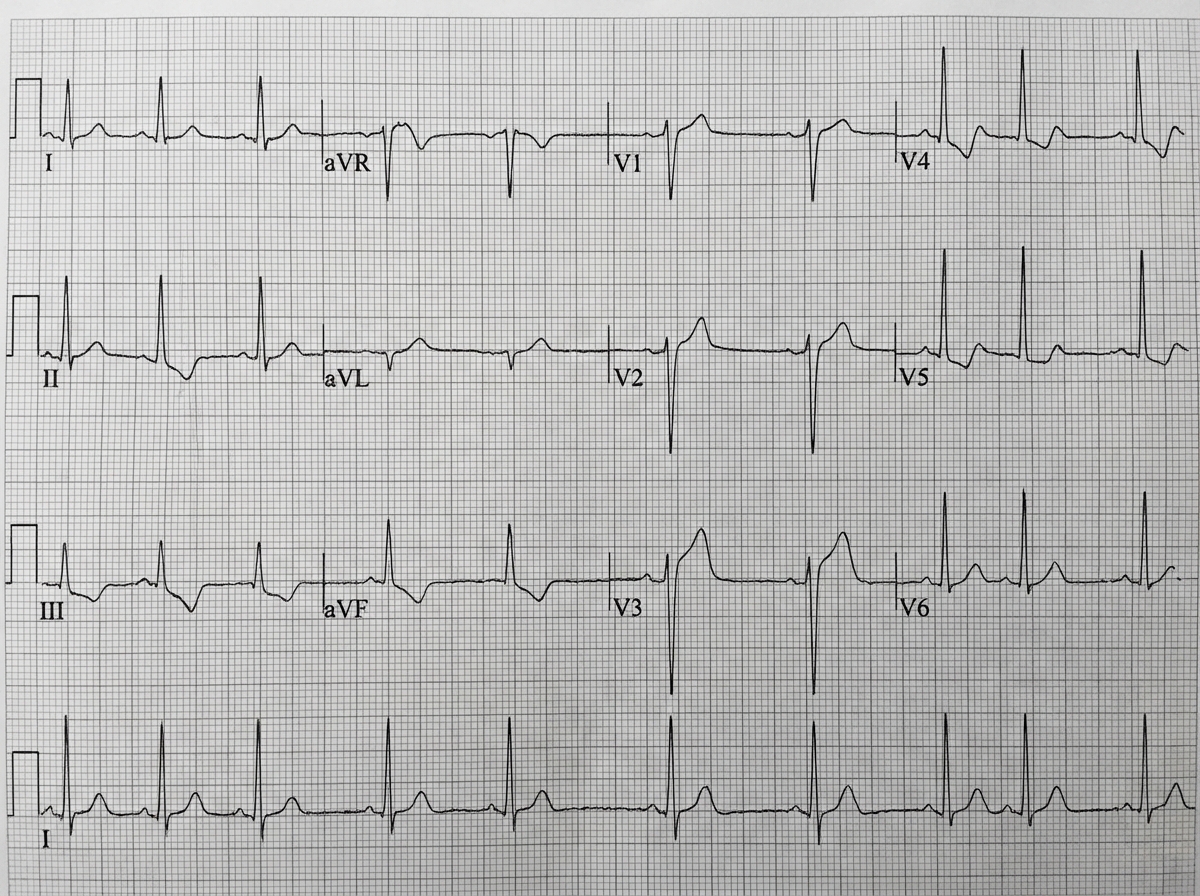
A 71-year-old man develops worsening chest pressure while shoveling snow in the morning. He tells his wife that he has a squeezing pain that is radiating to his jaw and left arm. His wife calls for an ambulance. On the way, he received chewable aspirin and 3 doses of sublingual nitroglycerin with little relief of pain. He has borderline diabetes and essential hypertension. He has smoked 15–20 cigarettes daily for the past 37 years. His blood pressure is 172/91 mm Hg, the heart rate is 111/min and the temperature is 36.7°C (98.0°F). On physical examination in the emergency department, he looks pale, very anxious and diaphoretic. His ECG is shown in the image. Troponin levels are elevated. Which of the following is the best next step in the management of this patient condition?
A 59-year-old woman comes to the physician because of left leg swelling that started after a transcontinental flight. A duplex ultrasound of the left leg shows a noncompressible popliteal vein. A drug is prescribed that inhibits the coagulation cascade. Two weeks later, laboratory studies show: Platelet count 210,000/mm3 Partial thromboplastin time 28 seconds (normal: 25-35) Prothrombin time 12 seconds (normal: 11-13) Thrombin time 15 seconds (control: 15 seconds) Which of the following drugs was most likely prescribed?
A 56-year-old man comes to the emergency department because of progressive swelling and pain in his left calf for 1 day. He does not have shortness of breath or chest pain. He has hypertension and chronic kidney disease. Current medications include enalapril, aspirin, simvastatin, and vitamin D. His temperature is 100.4°F (38°C), pulse is 84/min, and blood pressure is 135/92 mm Hg. Physical examination shows tenderness and swelling of the left lower extremity. A venous Doppler ultrasonography shows a thrombus in the left popliteal vein. Treatment with unfractionated heparin is begun. Two days later, physical examination shows improvement of symptoms. Laboratory studies at admission and 2 days after admission show: Admission Two days after admission Hemoglobin 11.2 g/dL 11.1 g/dL Leukocyte count 5,500/mm3 6,100/mm3 Platelet count 230,000/mm3 170,000/mm3 Serum Prothrombin time 12 seconds 13 seconds Partial thromboplastin time 30 seconds 55 seconds Estimated glomerular filtration rate 29 mL/min/1.73 m2 28 mL/min/1.73 m2 Which of the following is the most appropriate next step in management?
Drug A is an experimental compound being investigated for potential use as a protectant against venous thrombosis. Binding assays reveal that the drug’s primary mechanism of action is to block carboxylation of glutamic acid residues in certain serum proteins. Drug A is most similar to which of the following:
A 35-year-old woman is brought to the emergency department 30 minutes after the onset of severe dyspnea. On arrival, she is unresponsive. Her pulse is 160/min, respirations are 32/min, and blood pressure is 60/30 mm Hg. CT angiography of the chest shows extensive pulmonary embolism in both lungs. She is given a drug that inhibits both thrombin and factor Xa. Which of the following medications was most likely administered?
A 74-year-old man presents to the emergency department with shortness of breath that started about 30 minutes ago. He is also experiencing chest pain on deep inspiration. He has several significant medical conditions including chronic obstructive pulmonary disease, hypertension, and dyslipidemia. He used to smoke about 3 packs of cigarettes every day until last year when he quit. He was in the emergency room 2 weeks ago for a hemorrhagic stroke which was promptly treated. He currently weighs 97.5 kg (215 lb). His respirations are 20/min, the blood pressure is 110/80 mm Hg, and the pulse is 105/min. On physical examination, Homan's sign is positive. An ECG and chest X-ray are performed. His current oxygen saturation is at 87% and D-dimer results are positive. He is wheeled in for a CT scan. What is the most appropriate initial treatment for this patient?
A 61-year-old man presents to the primary care clinic to establish care. He has not seen a physician for many years. He has no complaints or concerns but, on further questioning, does have some vague abdominal discomfort. He has no known past medical history and takes no medications. His social history is notable for injecting heroin throughout his late-teens and 20s, but he has been clean and sober for over a decade. At the clinic, the vital signs include: heart rate 90/min, respiratory rate 17/min, blood pressure 110/65 mm Hg, and temperature 37.0°C (98.6°F). The physical exam shows a slightly distended abdomen. The laboratory studies are notable for a platelet count of 77,000/uL and an international normalized ratio (INR) of 1.7. Which of the following is the next best step in the diagnosis of this patient?
A 64-year-old man comes to the emergency department complaining of fatigue and abdominal distension. He has a remote history of intravenous drug use. Vital signs include a normal temperature, blood pressure of 120/80 mm Hg, and a pulse of 75/min. Physical examination reveals jaundice and a firm liver. Abdominal ultrasonography shows liver surface nodularity, moderate splenomegaly, and increased diameter of the portal vein. Complete blood count of the patient is shown: Hemoglobin 14 g/dL Mean corpuscular volume 90/μm3 Mean corpuscular hemoglobin 30 pg/cell Mean corpuscular hemoglobin concentration 34% Leukocyte count 7,000/mm3 Platelet count 50,000/mm3 Which of the following best represents the mechanism of low platelet count in this patient?
Want unlimited practice?
Get full access to all questions, explanations, and performance tracking.
Scan to download app