
Geriatric screening protocols — MCQs

A 68-year-old female presents to your office for her annual check-up. Her vitals are HR 85, T 98.8 F, RR 16, BP 125/70. She has a history of smoking 1 pack a day for 35 years, but states she quit five years ago. She had her last pap smear at age 64 and states all of her pap smears have been normal. She had her last colonoscopy at age 62, which was also normal. Which of the following is the next best test for this patient?
A 62-year-old man comes to his primary care physician with a 3-month history of insomnia and severe work anxiety. He says that he is unable to retire because he has no financial resources; however, the stress level at his work has been causing him to have worsening performance and he is afraid of being fired. He thinks that he would be able to resume work normally if he was able to decrease his level of anxiety. His physician prescribes him a trial 1-month regimen of benzodiazepine therapy and schedules a follow-up appointment to see whether this treatment has been effective. Three weeks later, the patient's wife calls and says "My husband was fired from work and it's your fault for prescribing that medication! I know he must have been taking too much of that drug. Don't you know that he had a horrible problem with drug abuse in his 30s?" Which of the following is the most appropriate first action for the physician to take?
A 66-year-old man is brought into the emergency department by his daughter for a change in behavior. Yesterday the patient seemed more confused than usual and was asking the same questions repetitively. His symptoms have not improved over the past 24 hours, thus the decision to bring him in today. Last year, the patient was almost completely independent but he then suffered a "series of falls," after which his ability to care for himself declined. After this episode he was no longer able to cook for himself or pay his bills but otherwise had been fine up until this episode. The patient has a past medical history of myocardial infarction, hypertension, depression, diabetes mellitus type II, constipation, diverticulitis, and peripheral neuropathy. His current medications include metformin, insulin, lisinopril, hydrochlorothiazide, sodium docusate, atorvastatin, metoprolol, fluoxetine, and gabapentin. On exam you note a confused man who is poorly kept. He has bruises over his legs and his gait seems unstable. He is alert to person and place, and answers some questions inappropriately. The patient's pulse is 90/minute and his blood pressure is 170/100 mmHg. Which of the following is the most likely diagnosis?
An investigator conducts a case-control study to evaluate the relationship between benzodiazepine use among the elderly population (older than 65 years of age) that resides in assisted-living facilities and the risk of developing Alzheimer dementia. Three hundred patients with Alzheimer dementia are recruited from assisted-living facilities throughout the New York City metropolitan area, and their rates of benzodiazepine use are compared to 300 controls. Which of the following describes a patient who would be appropriate for the study's control group?
A 77-year-old Caucasian woman presents to her primary care provider for a general checkup. The patient is with her daughter who brought her to this appointment. The patient states that she is doing well and has some minor joint pain in both hips. She states that sometimes she is sad because her husband recently died. She lives alone and follows a vegan diet. The patient's daughter states that she has noticed her mother struggling with day to day life. It started 2 years ago with her forgetting simple instructions or having difficulty running errands. Now the patient has gotten to the point where she can no longer pay her bills. Sometimes the patient forgets how to get home. The patient has a past medical history of obesity, hypertension, gastroesophageal reflux disease (GERD) controlled with pantoprazole, and diabetes mellitus. Her temperature is 99.5°F (37.5°C), blood pressure is 158/108 mmHg, pulse is 90/min, respirations are 17/min, and oxygen saturation is 98% on room air. Which of the following will most likely help with this patient's presentation?
A 26-year-old primigravida woman comes to her primary care physician for the second prenatal visit. She is 10 weeks pregnant. She has no current complaint except for occasional nausea. She does not have any chronic health problems. She denies smoking or alcohol intake. Her family history is positive for paternal colon cancer at the age of 55. Vital signs include a temperature of 37.1°C (98.8°F), blood pressure of 120/60 mm Hg, and pulse of 90/min. Physical examination discloses no abnormalities. According to the United States Preventive Services Task Force (USPSTF), which of the following screening tests is recommended for this patient?
A 27-year-old woman presents for her routine annual examination. She has no complaints. She has a 3-year-old child who was born via normal vaginal delivery with no complications. She had a Pap smear during her last pregnancy and the findings were normal. Her remaining past medical history is not significant, and her family history is also not significant. Recently, one of her close friends was diagnosed with breast cancer at the age of 36, and, after reading some online research, she wants to be checked for all types of cancer. Which of the following statements would be the best advice regarding the most appropriate screening tests for this patient?
A 72-year-old man is brought to the physician by his wife for memory issues over the last 7 months. The patient's wife feels that he has gradually become more forgetful. He commonly misplaces his car keys and forgets his children's names. He seems to have forgotten how to make dinner and sometimes serves uncooked noodles or raw meat. One night he parked his car in a neighbor's bushes and was found wandering the street. He has a history of hypertension, hyperlipidemia, and COPD. Current medications include atorvastatin, metoprolol, ipratropium, and fluticasone. Vital signs are within normal limits. He is alert and oriented to person and place only. Neurologic examination shows no focal findings. His Mini-Mental State Examination score is 19/30. A complete blood count and serum concentrations of electrolytes, urea nitrogen, creatinine, thyroid-stimulating hormone, liver function tests, vitamin B12 (cobalamin), and folate are within the reference range. Which of the following is the most appropriate next step in diagnosis?
A 33-year-old woman comes to the physician because of vision impairment in her right eye for the past 2 weeks. During this period, she was unable to distinguish colors with her right eye. She also reports pain with eye movement. She has no double vision. She occasionally has headaches that are relieved by ibuprofen. One year ago, she had a similar episode that affected her left eye and resolved spontaneously. She has no history of serious illness. She works at a library and enjoys reading, even in poor lighting conditions. Her vital signs are within normal limits. The pupils are equal, round, and reactive to light and accommodation. Without correction, visual acuity is 20/50 in the left eye, and 20/100 in the right eye. With spectacles, the visual acuity is 20/20 in the left eye and 20/100 in the right eye. Slit lamp examination shows no abnormalities. A CT scan of the head shows no abnormalities. Which of the following is the most likely diagnosis?
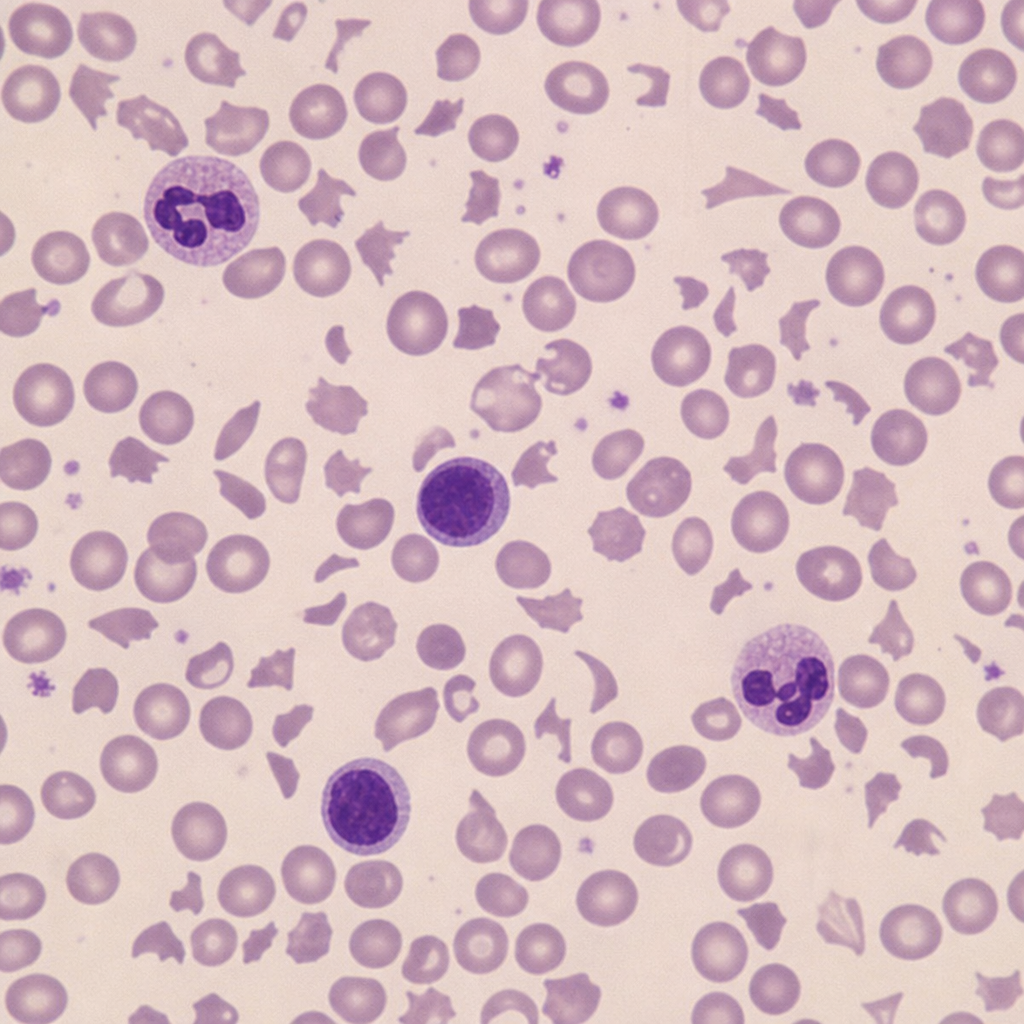
A peripheral blood smear from a 45-year-old woman with a 2-week history of fatigue, jaundice, and confusion is shown. She was recently started on ticlopidine following coronary stent placement. Her laboratory values include: hemoglobin 7.1 g/dL, platelets 18,000/µL, creatinine 2.8 mg/dL, LDH 980 U/L, and indirect bilirubin 3.4 mg/dL. Direct Coombs test is negative. The image demonstrates the most diagnostically discriminating finding. Based on the peripheral smear finding and the complete clinical picture, what is the most likely diagnosis?
Want unlimited practice?
Get full access to all questions, explanations, and performance tracking.
Scan to download app