
Red flags in fever — MCQs

A 2-year-old boy presents for a routine checkup. The patient’s mother says that he has been ‘under the weather’ for the past few days. She did not measure his temperature at home but states that he has felt warm. She denies any episodes of diarrhea or vomiting. No significant past medical history or current medications. The patient attends daycare. He is due for a hepatitis A vaccine. The patient was born at term with no prenatal or perinatal complications. The vital signs include: temperature 37.8°C (100.1°F), blood pressure 112/62 mm Hg, pulse 80/min, respiratory rate 18/min, and oxygen saturation 99% on room air. The patient is alert and responsive. The physical exam is unremarkable. Which of the following is the most appropriate next step in the management of this patient?
A 22-year-old female is brought to the emergency department by her roommate with a one day history of fever and malaise. She did not feel well after class the previous night and has been in her room since then. She has not been eating or drinking due to severe nausea. Her roommate checked on her one hour ago and was alarmed to find a fever of 102°F (38.9°C). On physical exam temperature is 103°F (40°C), blood pressure is 110/66 mmHg, pulse is 110/min, respirations are 23/min, and pulse oximetry is 98% on room air. She refuses to move her neck and has a rash on her trunk. You perform a lumbar puncture and the CSF analysis is shown below. Appearance: Cloudy Opening pressure: 180 mm H2O WBC count: 150 cells/µL (93% PMN) Glucose level: < 40 mg/dL Protein level: 50 mg/dL Gram stain: gram-negative diplococci Based on this patient's clinical presentation, which of the following should most likely be administered?
A 67-year-old man presents to the emergency department with confusion. The patient is generally healthy, but his wife noticed him becoming progressively more confused as the day went on. The patient is not currently taking any medications and has no recent falls or trauma. His temperature is 102°F (38.9°C), blood pressure is 126/64 mmHg, pulse is 120/min, respirations are 17/min, and oxygen saturation is 98% on room air. Physical exam is notable for a confused man who cannot participate in a neurological exam secondary to his confusion. No symptoms are elicited with flexion of the neck and jolt accentuation of headache is negative. Initial laboratory values are unremarkable and the patient's chest radiograph and urinalysis are within normal limits. An initial CT scan of the head is unremarkable. Which of the following is the best next step in management?
A 4-year-old boy is brought to the emergency department with difficulty breathing. His mother reports that he developed a fever last night and began to have trouble breathing this morning. The boy was born at 39 weeks gestation via spontaneous vaginal delivery. He is unvaccinated (conscientious objection by the family) and is meeting all developmental milestones. At the hospital, his vitals are temperature 39.8°C (103.6°F), pulse 122/min, respiration rate 33/min, blood pressure 110/66 mm Hg, and SpO2 93% on room air. On physical examination, he appears ill with his neck hyperextended and chin protruding. His voice is muffled and is drooling. The pediatrician explains that there is one particular bacteria that commonly causes these symptoms. At what age should the patient have first received vaccination to prevent this condition from this particular bacteria?
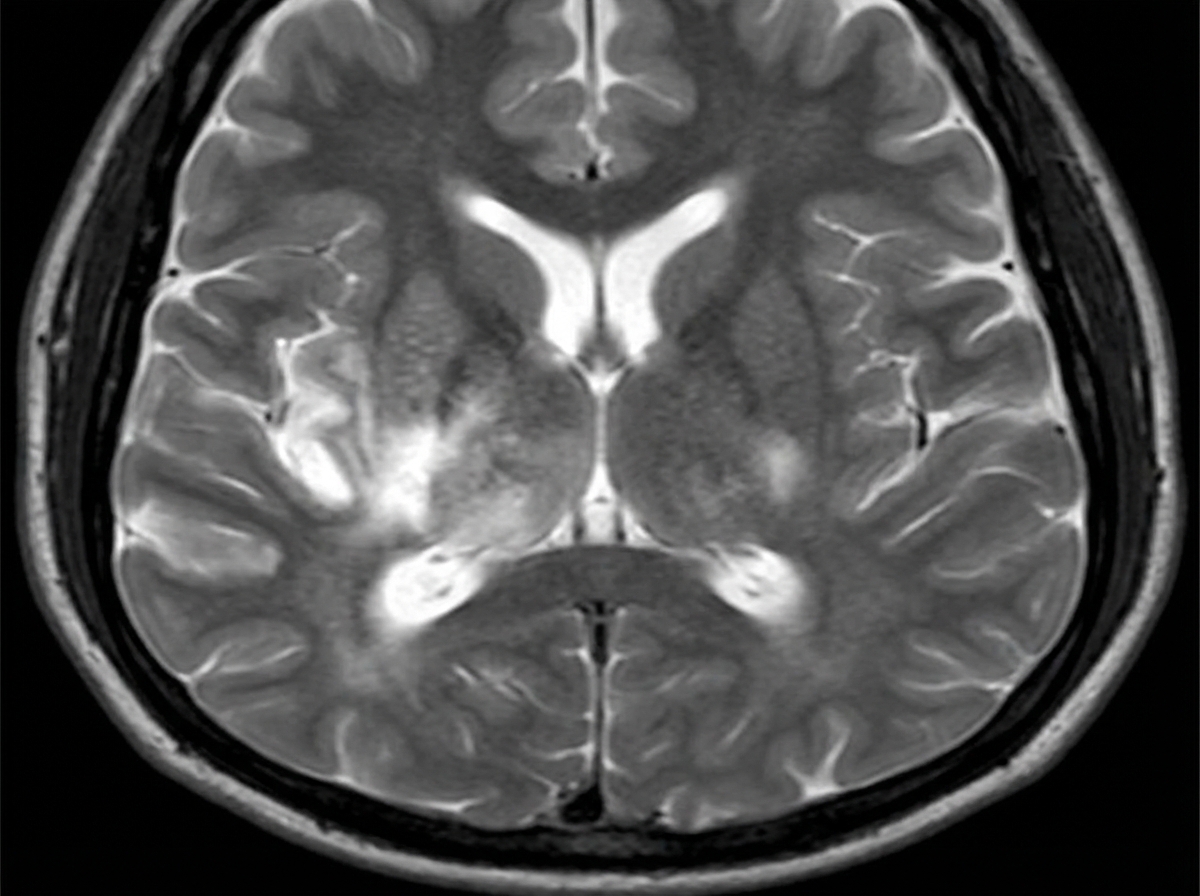
A 24-year-old man is brought to the emergency department after he is found sluggish, drowsy, feverish, and complaining about a headache. His past medical history is unremarkable. His vital signs include: blood pressure 120/60 mm Hg, heart rate 70/min, respiratory rate 17/min, and body temperature 39.0°C (102.2°F). On physical examination, the patient is dysphasic and incapable of following commands. Gait ataxia is present. No meningeal signs or photophobia are present. A noncontrast CT of the head is unremarkable. A T2 MRI is performed and is shown in the image. A lumbar puncture (LP) is subsequently performed. Which of the following CSF findings would you most likely expect to find in this patient?
A 65-year-old man presents to the emergency department due to an episode of lightheadedness. The patient was working at his garage workbench when he felt like he was going to faint. His temperature is 98.8°F (37.1°C), blood pressure is 125/62 mmHg, pulse is 117/min, respirations are 14/min, and oxygen saturation is 98% on room air. Laboratory values are ordered as seen below. Hemoglobin: 7 g/dL Hematocrit: 22% Leukocyte count: 6,500/mm^3 with normal differential Platelet count: 197,000/mm^3 The patient is started on blood products and a CT scan is ordered. Several minutes later, his temperature is 99.5°F (37.5°C), blood pressure is 87/48 mmHg, and pulse is 180/min. The patient's breathing is labored. Which of the following is also likely to be true?
A 27-year-old woman comes to the physician because of a 3-day history of a sore throat and fever. Her temperature is 38.5°C (101.3°F). Examination shows edematous oropharyngeal mucosa and enlarged tonsils with purulent exudate. There is tender cervical lymphadenopathy. If left untreated, which of the following conditions is most likely to occur in this patient?
A previously healthy 40-year-old woman comes to the physician because of a 3-day history of fever, headaches, and fatigue. She also reports a persistent tingling sensation in her right hand and numbness in her right arm that started this morning. Physical examination shows pallor, mild scleral icterus, and petechiae on her forearms and legs. On mental status examination, she appears confused and is only oriented to person. Laboratory studies show: Hemoglobin 11.1 g/dL Platelet count 39,500/mm3 Bleeding time 9 minutes Prothrombin time 14 seconds Partial thromboplastin time 35 seconds Serum Creatinine 1.7 mg/dL Total bilirubin 2.1 mg/dL A peripheral blood smear shows fragmented erythrocytes. Which of the following is the most likely underlying cause of this patient's condition?
A 21-year-old man presents with fever, headache, and clouded sensorium for the past 3 days. His fever is low-grade. He says his headache is mild-to-moderate in intensity and associated with nausea, vomiting, and photophobia. There is no history of a sore throat, pain on urination, abdominal pain, or loose motions. He smokes 1–2 cigarettes daily and drinks alcohol socially. Past medical history and family history are unremarkable. His vital signs include: blood pressure 120/80 mm Hg, pulse 106/min, temperature 37.3°C (99.2°F). On physical examination, he is confused, disoriented, and agitated. Extraocular movements are intact. The neck is supple on flexion. He is moving all his 4 limbs spontaneously. A noncontrast CT scan of the head is within normal limits. A lumbar puncture is performed, and cerebrospinal fluid results are still pending. The patient is started on empiric intravenous acyclovir. Which of the following clinical features favors encephalitis rather than meningitis?
A 43-year-old woman was admitted to the hospital after a fall. When the emergency services arrived, she was unresponsive, did not open her eyes, but responded to painful stimuli. The witnesses say that she had convulsions lasting about 30 seconds when she lost consciousness after a traumatic event. On her way to the hospital, she regained consciousness. On admission, she complained of intense headaches and nausea. She opened her eyes spontaneously, was responsive but confused, and was able to follow motor commands. Her vital signs are as follows: blood pressure, 150/90 mm Hg; heart rate, 62/min; respiratory rate, 13/min; and temperature, 37.3℃ (99.1℉). There are no signs of a skull fracture. The pupils are round, equal, and poorly reactive to light. She is unable to fully abduct both eyes. Ophthalmoscopy does not show papillary edema or retinal hemorrhages. She has nuchal rigidity and a positive Kernig sign. An urgent head CT does not show any abnormalities. Which of the following is a proper investigation to perform in this patient?
Want unlimited practice?
Get full access to all questions, explanations, and performance tracking.
Scan to download app