
Documentation requirements — MCQs

A 79-year-old male presents to your office for his annual flu shot. On physical exam you note several linear bruises on his back. Upon further questioning he denies abuse from his daughter and son-in-law, who live in the same house. The patient states he does not want this information shared with anyone. What is the most appropriate next step, paired with its justification?
An unconscious 22-year-old woman is brought to the emergency department by police after being found in a park. Physical examination reveals torn clothing and evidence of sexual assault. Which of the following is the most appropriate first step in collecting forensic evidence?
A 25-year-old man comes to the physician for severe back pain. He describes the pain as shooting and stabbing. On a 10-point scale, he rates the pain as a 9 to 10. The pain started after he lifted a heavy box at work; he works at a supermarket and recently switched from being a cashier to a storekeeper. The patient appears to be in severe distress. Vital signs are within normal limits. On physical examination, the spine is nontender without paravertebral muscle spasms. Range of motion is normal. A straight-leg raise test is negative. After the physical examination has been completed, the patient asks for a letter to his employer attesting to his inability to work as a storekeeper. Which of the following is the most appropriate response?
A 28-year-old woman dies shortly after receiving a blood transfusion. Autopsy reveals widespread intravascular hemolysis and acute renal failure. Investigation reveals that she received type A blood, but her medical record indicates she was type O. In a malpractice lawsuit, which of the following elements must be proven?
A psychiatrist receives a call from a patient who expresses thoughts of harming his ex-girlfriend. The patient describes a detailed plan to attack her at her workplace. Which of the following represents the psychiatrist's most appropriate legal obligation?
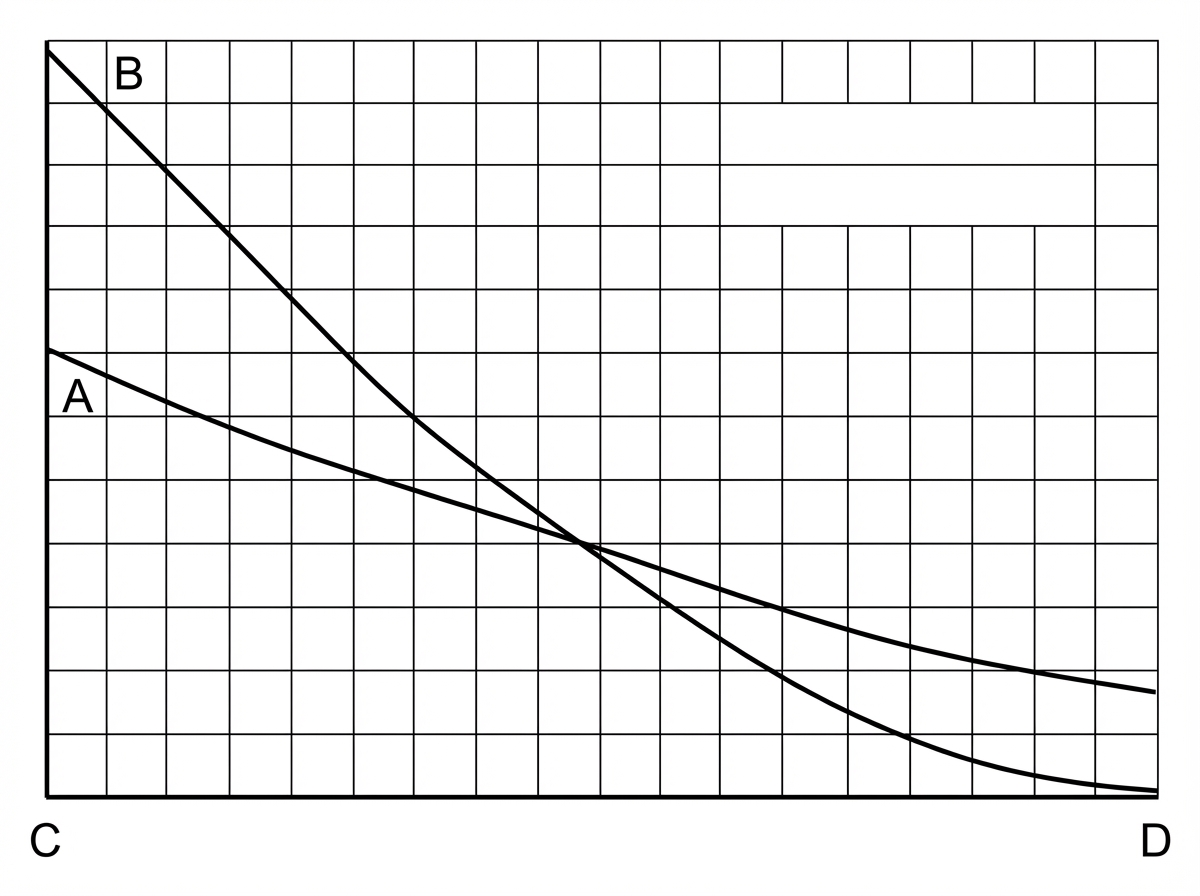
A young researcher is responsible for graphing laboratory data involving pulmonary blood flow and ventilation pattern obtained from a healthy volunteer who was standing in an upright position. After plotting the following graph, the researcher realizes he forgot to label the curves and the x-axis (which represents the position in the lung). Which of the following is the appropriate label for each point on the graph?
A 65-year-old man is admitted to the hospital because of a 1-month history of fatigue, intermittent fever, and weakness. Results from a peripheral blood smear taken during his evaluation are indicative of possible acute myeloid leukemia. Bone marrow aspiration and subsequent cytogenetic studies confirm the diagnosis. The physician sets aside an appointed time-slot and arranges a meeting in a quiet office to inform him about the diagnosis and discuss his options. He has been encouraged to bring someone along to the appointment if he wanted. He comes to your office at the appointed time with his daughter. He appears relaxed, with a full range of affect. Which of the following is the most appropriate opening statement in this situation?
An 86-year-old male is admitted to the hospital under your care for management of pneumonia. His hospital course has been relatively uneventful, and he is progressing well. While making morning rounds on your patients, the patient's cousin approaches you in the hallway and asks about the patient's prognosis and potential future discharge date. The patient does not have an advanced directive on file and does not have a medical power of attorney. Which of the following is the best course of action?
Want unlimited practice?
Get full access to all questions, explanations, and performance tracking.
Scan to download app