
Interpretation differences — MCQs

You are conducting a study comparing the efficacy of two different statin medications. Two groups are placed on different statin medications, statin A and statin B. Baseline LDL levels are drawn for each group and are subsequently measured every 3 months for 1 year. Average baseline LDL levels for each group were identical. The group receiving statin A exhibited an 11 mg/dL greater reduction in LDL in comparison to the statin B group. Your statistical analysis reports a p-value of 0.052. Which of the following best describes the meaning of this p-value?
A medical research study is evaluating an investigational novel drug (medication 1) as compared with standard therapy (medication 2) in patients presenting to the emergency department with myocardial infarction (MI). The study enrolled a total of 3,000 subjects, 1,500 in each study arm. Follow-up was conducted at 45 days post-MI. The following are the results of the trial: Endpoints Medication 1 Medication 2 P-Value Primary: death from cardiac causes 134 210 0.03 Secondary: hyperkalemia 57 70 0.4 What is the relative risk of death from a cardiac cause, expressed as a percentage? (Round to the nearest whole number.)
A 6-month-old male presents for a routine visit to his pediatrician. Two months ago, the patient was seen for tachypnea and wheezing, and diagnosed with severe respiratory syncytial virus (RSV) bronchiolitis. After admission to the hospital and supportive care, the patient recovered and currently is not experiencing any trouble breathing. Regarding the possibility of future reactive airway disease, which of the following statements is most accurate?
A physician attempts to study cirrhosis in his state. Using a registry of admitted patients over the last 10 years at the local hospital, he isolates all patients who have been diagnosed with cirrhosis. Subsequently, he contacts this group of patients, asking them to complete a survey assessing their prior exposure to alcohol use, intravenous drug abuse, blood transfusions, personal history of cancer, and other medical comorbidities. An identical survey is given to an equal number of patients in the registry who do not carry a prior diagnosis of cirrhosis. Which of the following is the study design utilized by this physician?
A survey was conducted in a US midwestern town in an effort to assess maternal mortality over the past year. The data from the survey are given in the table below: Women of childbearing age 250,000 Maternal deaths 2,500 Number of live births 100, 000 Number of deaths of women of childbearing age 7,500 Maternal death is defined as the death of a woman while pregnant or within 42 days of termination of pregnancy from any cause related to or aggravated by, the pregnancy. Which of the following is the maternal mortality rate in this midwestern town?
In 2013 the national mean score on the USMLE Step 1 exam was 227 with a standard deviation of 22. Assuming that the scores for 15,000 people follow a normal distribution, approximately how many students scored above the mean but below 250?
You are interested in studying the etiology of heart failure reduced ejection fraction (HFrEF) and attempt to construct an appropriate design study. Specifically, you wish to look for potential causality between dietary glucose consumption and HFrEF. Which of the following study designs would allow you to assess for and determine this causality?
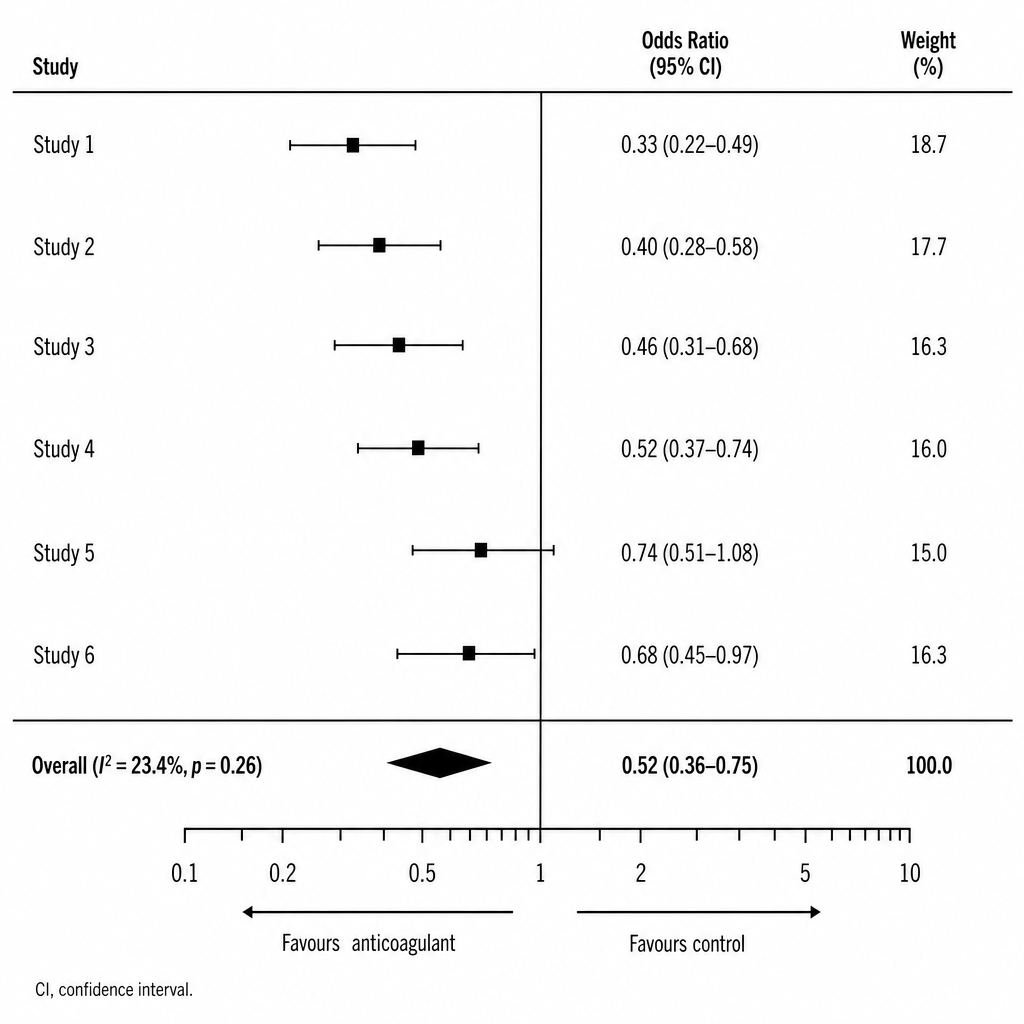
An investigator presents a forest plot from a meta-analysis of six RCTs examining whether a new anticoagulant reduces stroke in patients with non-valvular atrial fibrillation. The image shows individual study odds ratios with 95% confidence intervals and an overall pooled estimate. Studies 1–4 show confidence intervals entirely to the left of the line of no effect. Study 5 shows a confidence interval of 0.74 (95% CI: 0.51–1.08). Study 6 shows a confidence interval of 0.68 (95% CI: 0.45–0.97). Which of the following conclusions is best supported by these results?
A research fellow proposes a nested case-control study within an existing cohort examining antibiotic exposure and C. difficile infection. The mentor suggests this design wastes the cohort structure and that relative risk should be calculated instead. The fellow argues that odds ratios from nested case-control studies approximate relative risk while being more efficient. Evaluate the validity of each position and synthesize the optimal approach.
Two studies examine statin therapy and stroke prevention. Study A (cohort, n=10,000) reports RR=0.75. Study B (case-control, n=2,000) reports OR=0.68. The absolute stroke rate in the general population is 2% over 5 years. Analyze these findings to determine which study provides more accurate information for clinical decision-making and why.
Want unlimited practice?
Get full access to all questions, explanations, and performance tracking.
Scan to download app