
Adjusted odds ratios — MCQs

A researcher is investigating whether there is an association between the use of social media in teenagers and bipolar disorder. In order to study this potential relationship, she collects data from people who have bipolar disorder and matched controls without the disorder. She then asks how much on average these individuals used social media in the 3 years prior to their diagnosis. This continuous data is divided into 2 groups: those who used more than 2 hours per day and those who used less than 2 hours per day. She finds that out of 1000 subjects, 500 had bipolar disorder of which 300 used social media more than 2 hours per day. She also finds that 400 subjects who did not have the disorder also did not use social media more than 2 hours per day. Which of the following is the odds ratio for development of bipolar disorder after being exposed to more social media?
A randomized control double-blind study is conducted on the efficacy of 2 sulfonylureas. The study concluded that medication 1 was more efficacious in lowering fasting blood glucose than medication 2 (p ≤ 0.05; 95% CI: 14 [10-21]). Which of the following is true regarding a 95% confidence interval (CI)?
An investigator for a nationally representative health survey is evaluating the heights and weights of men and women aged 18–74 years in the United States. The investigator finds that for each sex, the distribution of heights is well-fitted by a normal distribution. The distribution of weight is not normally distributed. Results are shown: Mean Standard deviation Height (inches), men 69 0.1 Height (inches), women 64 0.1 Weight (pounds), men 182 1.0 Weight (pounds), women 154 1.0 Based on these results, which of the following statements is most likely to be correct?
A 45-year-old man comes to the clinic concerned about his recent exposure to radon. He heard from his co-worker that radon exposure can cause lung cancer. He brings in a study concerning the risks of radon exposure. In the study, there were 300 patients exposed to radon, and 18 developed lung cancer over a 10-year period. To compare, there were 500 patients without radon exposure and 11 developed lung cancer over the same 10-year period. If we know that 0.05% of the population has been exposed to radon, what is the attributable risk percent for developing lung cancer over a 10 year period after radon exposure?
An investigator is measuring the blood calcium level in a sample of female cross country runners and a control group of sedentary females. If she would like to compare the means of the two groups, which statistical test should she use?
You are reading through a recent article that reports significant decreases in all-cause mortality for patients with malignant melanoma following treatment with a novel biological infusion. Which of the following choices refers to the probability that a study will find a statistically significant difference when one truly does exist?
A medical research study is beginning to evaluate the positive predictive value of a novel blood test for non-Hodgkin’s lymphoma. The diagnostic arm contains 700 patients with NHL, of which 400 tested positive for the novel blood test. In the control arm, 700 age-matched control patients are enrolled and 0 are found positive for the novel test. What is the PPV of this test?
You submit a paper to a prestigious journal about the effects of coffee consumption on mesothelioma risk. The first reviewer lauds your clinical and scientific acumen, but expresses concern that your study does not have adequate statistical power. Statistical power refers to which of the following?
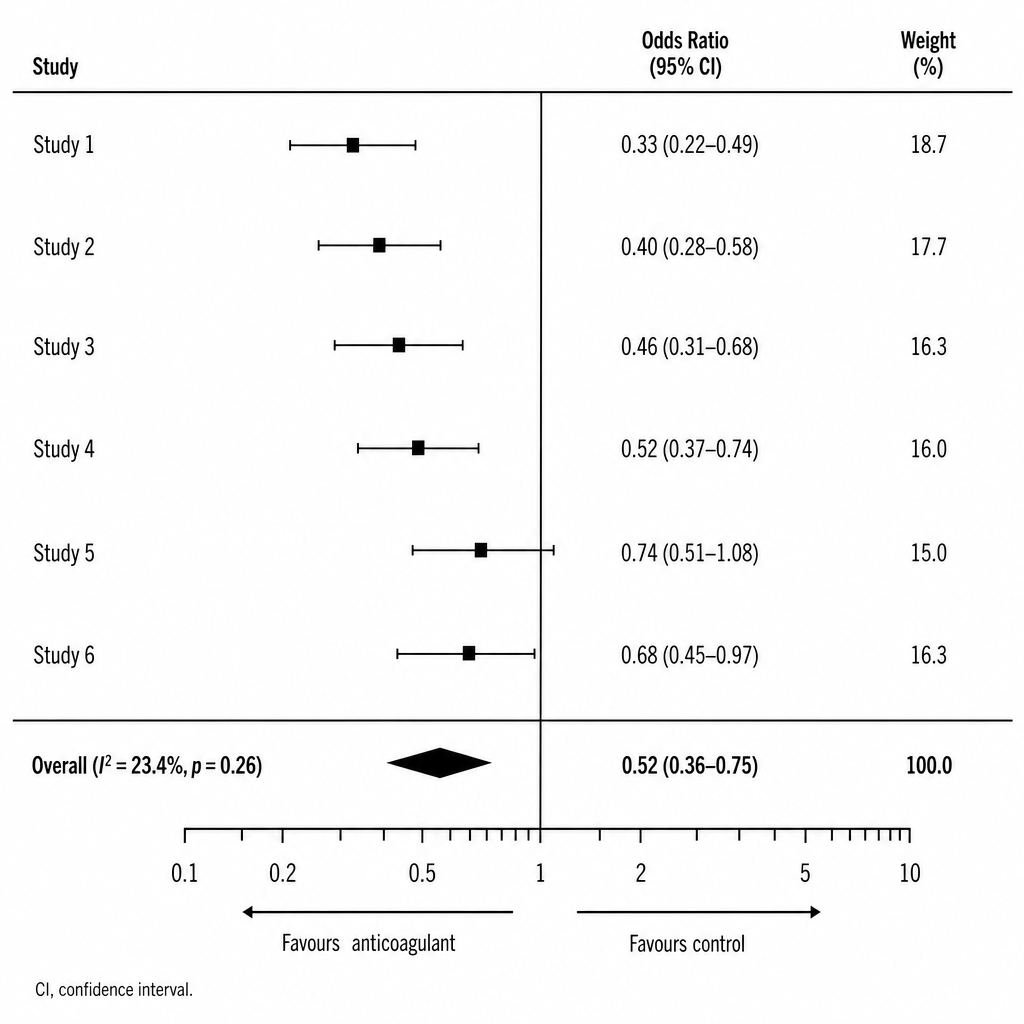
An investigator presents a forest plot from a meta-analysis of six RCTs examining whether a new anticoagulant reduces stroke in patients with non-valvular atrial fibrillation. The image shows individual study odds ratios with 95% confidence intervals and an overall pooled estimate. Studies 1–4 show confidence intervals entirely to the left of the line of no effect. Study 5 shows a confidence interval of 0.74 (95% CI: 0.51–1.08). Study 6 shows a confidence interval of 0.68 (95% CI: 0.45–0.97). Which of the following conclusions is best supported by these results?
A research fellow proposes a nested case-control study within an existing cohort examining antibiotic exposure and C. difficile infection. The mentor suggests this design wastes the cohort structure and that relative risk should be calculated instead. The fellow argues that odds ratios from nested case-control studies approximate relative risk while being more efficient. Evaluate the validity of each position and synthesize the optimal approach.
Want unlimited practice?
Get full access to all questions, explanations, and performance tracking.
Scan to download app