
Strengths and limitations of cohort studies — MCQs

A 25-year-old man with a genetic disorder presents for genetic counseling because he is concerned about the risk that any children he has will have the same disease as himself. Specifically, since childhood he has had difficulty breathing requiring bronchodilators, inhaled corticosteroids, and chest physiotherapy. He has also had diarrhea and malabsorption requiring enzyme replacement therapy. If his wife comes from a population where 1 in 10,000 people are affected by this same disorder, which of the following best represents the likelihood a child would be affected as well?
A scientist is studying the characteristics of a newly discovered infectious disease in order to determine its features. He calculates the number of patients that develop the disease over several months and finds that on average 75 new patients become infected per month. Furthermore, he knows that the disease lasts on average 2 years before patients are either cured or die from the disease. If the population being studied consists of 7500 individuals, which of the following is the prevalence of the disease?
The APPLE study investigators are currently preparing for a 30-year follow-up evaluation. They are curious about the number of participants who will partake in follow-up interviews. The investigators noted that of the 83 participants who participated in the APPLE study's 20-year follow-up, 62 were in the treatment group and 21 were in the control group. Given the unequal distribution of participants between groups at follow-up, this finding raises concerns for which of the following?
A group of environmental health scientists recently performed a nationwide cross-sectional study that investigated the risk of head and neck cancers in patients with a history of cigar and pipe smoking. In collaboration with three teams of epidemiologists that have each conducted similar cross-sectional studies in their respective countries, they have agreed to contribute their data to an international pooled analysis of the relationship between non-cigarette tobacco consumption and prevalence of head and neck cancers. Which of the following statements regarding the pooled analysis in comparison to the individual studies is true?
A 28-year-old male presents to his primary care physician with complaints of intermittent abdominal pain and alternating bouts of constipation and diarrhea. His medical chart is not significant for any past medical problems or prior surgeries. He is not prescribed any current medications. Which of the following questions would be the most useful next question in eliciting further history from this patient?
A scientist is designing a study to determine whether eating a new diet is able to lower blood pressure in a group of patients. In particular, he believes that starting the diet may help decrease peak blood pressures throughout the day. Therefore, he will equip study participants with blood pressure monitors and follow pressure trends over a 24-hour period. He decides that after recruiting subjects, he will start them on either the new diet or a control diet and follow them for 1 month. After this time, he will switch patients onto the other diet and follow them for an additional month. He will analyze the results from the first month against the results from the second month for each patient. This type of study design is best at controlling for which of the following problems with studies?
In recent years, psoriasis has been identified as a risk factor for cardiovascular disease. A researcher conducted a study in which he identified 200 patients with psoriasis and 200 patients without psoriasis. The patients were followed for 10 years. At the end of this period, participants' charts were reviewed for myocardial infarction during this time interval. Myocardial infarction No myocardial infarction Total Psoriasis 12 188 200 No psoriasis 4 196 200 Total 16 384 400 What is the 10-year risk of myocardial infarction in participants with psoriasis?
A population is studied for risk factors associated with testicular cancer. Alcohol exposure, smoking, dietary factors, social support, and environmental exposure are all assessed. The researchers are interested in the incidence and prevalence of the disease in addition to other outcomes. Which pair of studies would best assess the 1. incidence and 2. prevalence?
Many large clinics have noticed that the prevalence of primary biliary cholangitis (PBC) has increased significantly over the past 20 years. An epidemiologist is working to identify possible reasons for this. After analyzing a series of nationwide health surveillance databases, the epidemiologist finds that the incidence of PBC has remained stable over the past 20 years. Which of the following is the most plausible explanation for the increased prevalence of PBC?
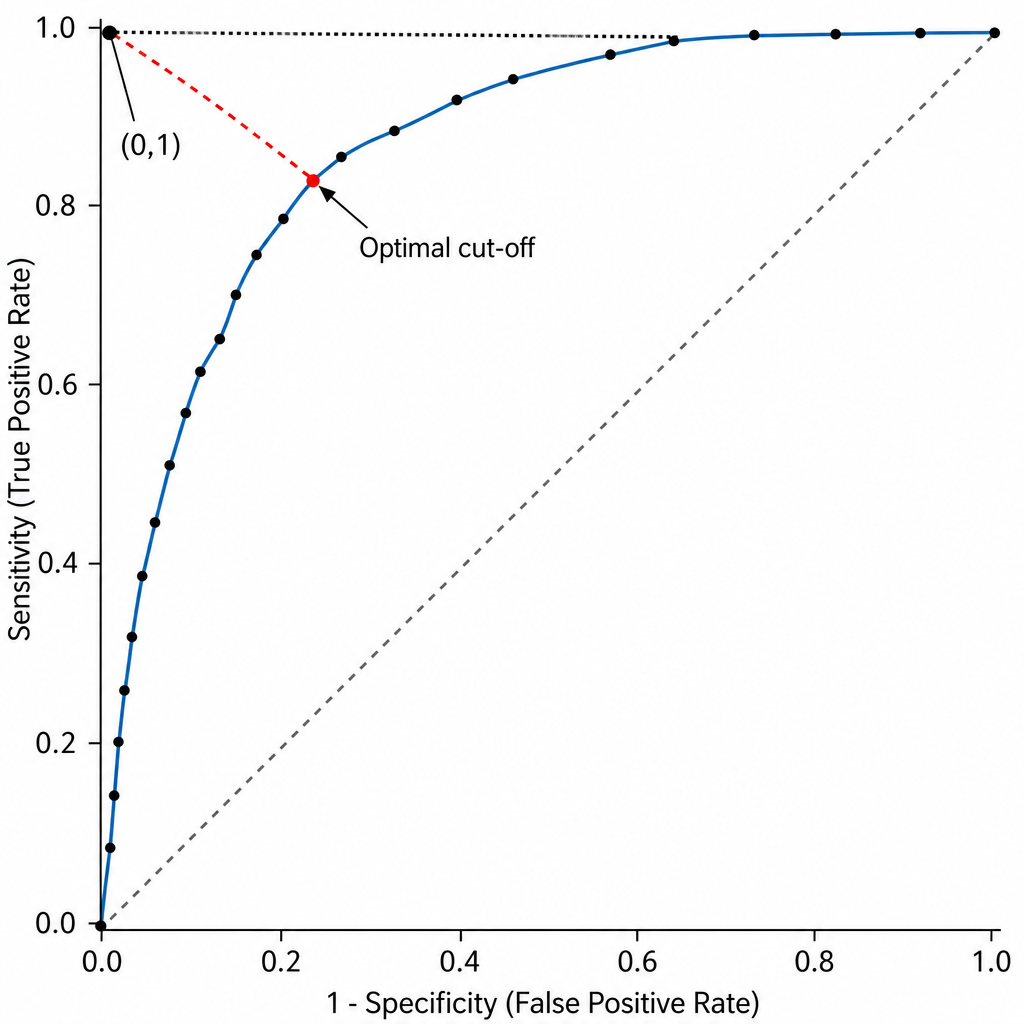
A clinician wants to select the single cut-off point on a diagnostic biomarker's ROC curve that minimizes the Euclidean distance to the upper-left corner (0,1), thereby simultaneously minimizing the false-negative rate and the false-positive rate. Which of the following best describes this optimal cut-off point selection criterion on the ROC curve?
Want unlimited practice?
Get full access to all questions, explanations, and performance tracking.
Scan to download app