
Loss to follow-up handling — MCQs

A researcher is conducting a study to compare fracture risk in male patients above the age of 65 who received annual DEXA screening to peers who did not receive screening. He conducts a randomized controlled trial in 900 patients, with half of participants assigned to each experimental group. The researcher ultimately finds similar rates of fractures in the two groups. He then notices that he had forgotten to include 400 patients in his analysis. Including the additional participants in his analysis would most likely affect the study's results in which of the following ways?
An otherwise healthy 67-year-old woman comes to your clinic after being admitted to the hospital for 2 weeks after breaking her hip. She has not regularly seen a physician for the past several years because she has been working hard at her long-time job as a schoolteacher. You wonder if she has not been taking adequate preventative measures to prevent osteoporosis and order the appropriate labs. Although she is recovering from surgery well, she is visibly upset because she is worried that her hospital bill will bankrupt her. Which of the following best describes her Medicare coverage?
You are reading through a recent article that reports significant decreases in all-cause mortality for patients with malignant melanoma following treatment with a novel biological infusion. Which of the following choices refers to the probability that a study will find a statistically significant difference when one truly does exist?
Study X examined the relationship between coffee consumption and lung cancer. The authors of Study X retrospectively reviewed patients' reported coffee consumption and found that drinking greater than 6 cups of coffee per day was associated with an increased risk of developing lung cancer. However, Study X was criticized by the authors of Study Y. Study Y showed that increased coffee consumption was associated with smoking. What type of bias affected Study X, and what study design is geared to reduce the chance of that bias?
A 57-year-old man presents to his oncologist to discuss management of small cell lung cancer. The patient is a lifelong smoker and was diagnosed with cancer 1 week ago. The patient states that the cancer was his fault for smoking and that there is "no hope now." He seems disinterested in discussing the treatment options and making a plan for treatment and followup. The patient says "he does not want any treatment" for his condition. Which of the following is the most appropriate response from the physician?
You submit a paper to a prestigious journal about the effects of coffee consumption on mesothelioma risk. The first reviewer lauds your clinical and scientific acumen, but expresses concern that your study does not have adequate statistical power. Statistical power refers to which of the following?
A pharmaceutical company conducts a randomized clinical trial in an attempt to show that their new anticoagulant drug prevents more thrombotic events following total knee arthroplasty than the current standard of care. However, a significant number of patients are lost to follow-up or fail to complete treatment according to the study arm to which they were assigned. Several patients in the novel drug arm are also switched at a later time to a novel anticoagulant or warfarin per their primary care physician. All patients enrolled in the study are subsequently analyzed based on the initial group they were assigned to and there is a significant improvement in outcome of the new drug. What analysis most appropriately describes this trial?
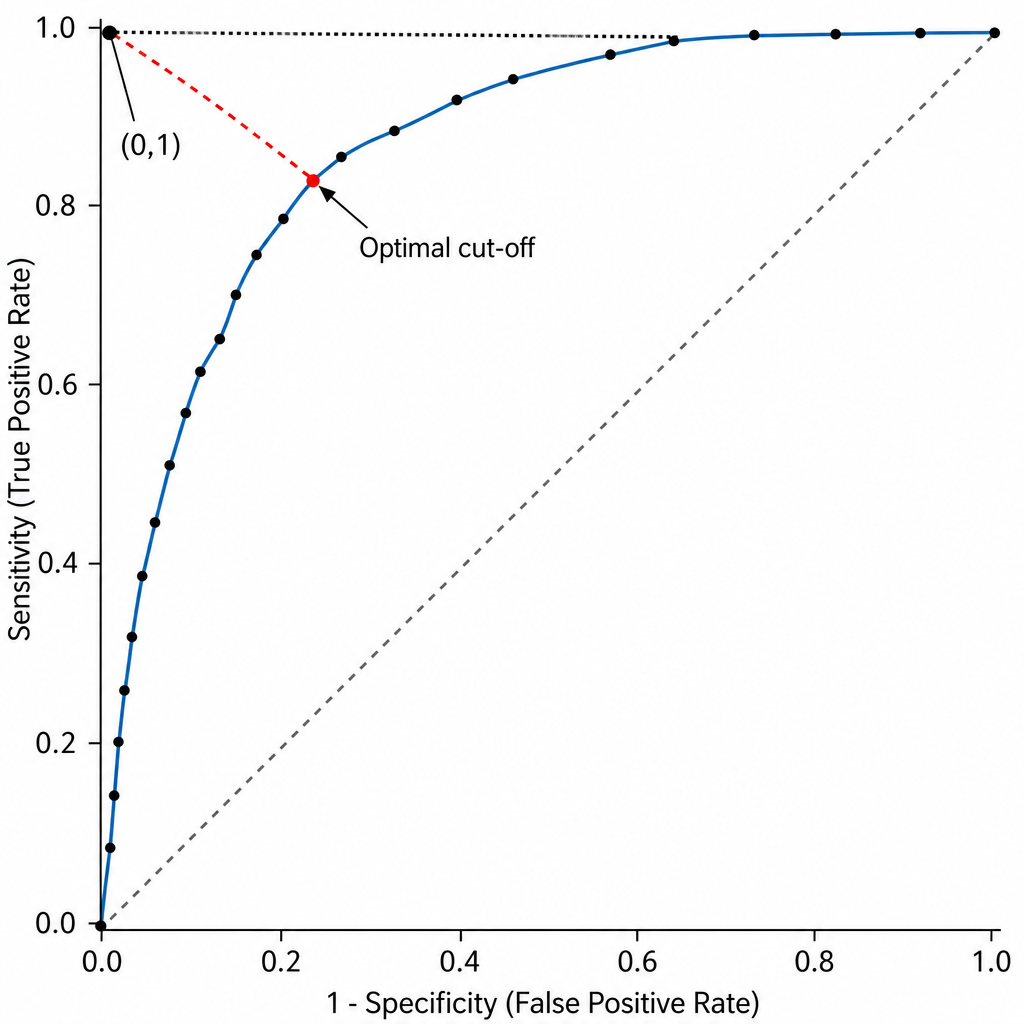
A clinician wants to select the single cut-off point on a diagnostic biomarker's ROC curve that minimizes the Euclidean distance to the upper-left corner (0,1), thereby simultaneously minimizing the false-negative rate and the false-positive rate. Which of the following best describes this optimal cut-off point selection criterion on the ROC curve?
A researcher wants to determine whether there is an association between CRP values and the risk of MI or cancer. Four relative risk (RR) values were plotted $(0.5,1.5,1.7,1.8)$ with respect to CRP levels. What conclusion can be drawn?
A researcher wants to study the carcinogenic effects of a food additive. From the literature, he finds that 7 different types of cancers have been linked to the consumption of this food additive. He wants to study all 7 possible outcomes. He conducts interviews with people who consume food containing these additives and people who do not. He then follows both groups for several years to see if they develop any of these 7 cancers or any other health outcomes. Which of the following study models best represents this study?
Want unlimited practice?
Get full access to all questions, explanations, and performance tracking.
Scan to download app